




























Kick-start your app creation
Whether you’re a beginner or a pro, Dynatrace Developer has the tools and support you need to create incredible apps with minimal effort.
Go to Dynatrace Developer
 MySQL (remote monitoring)
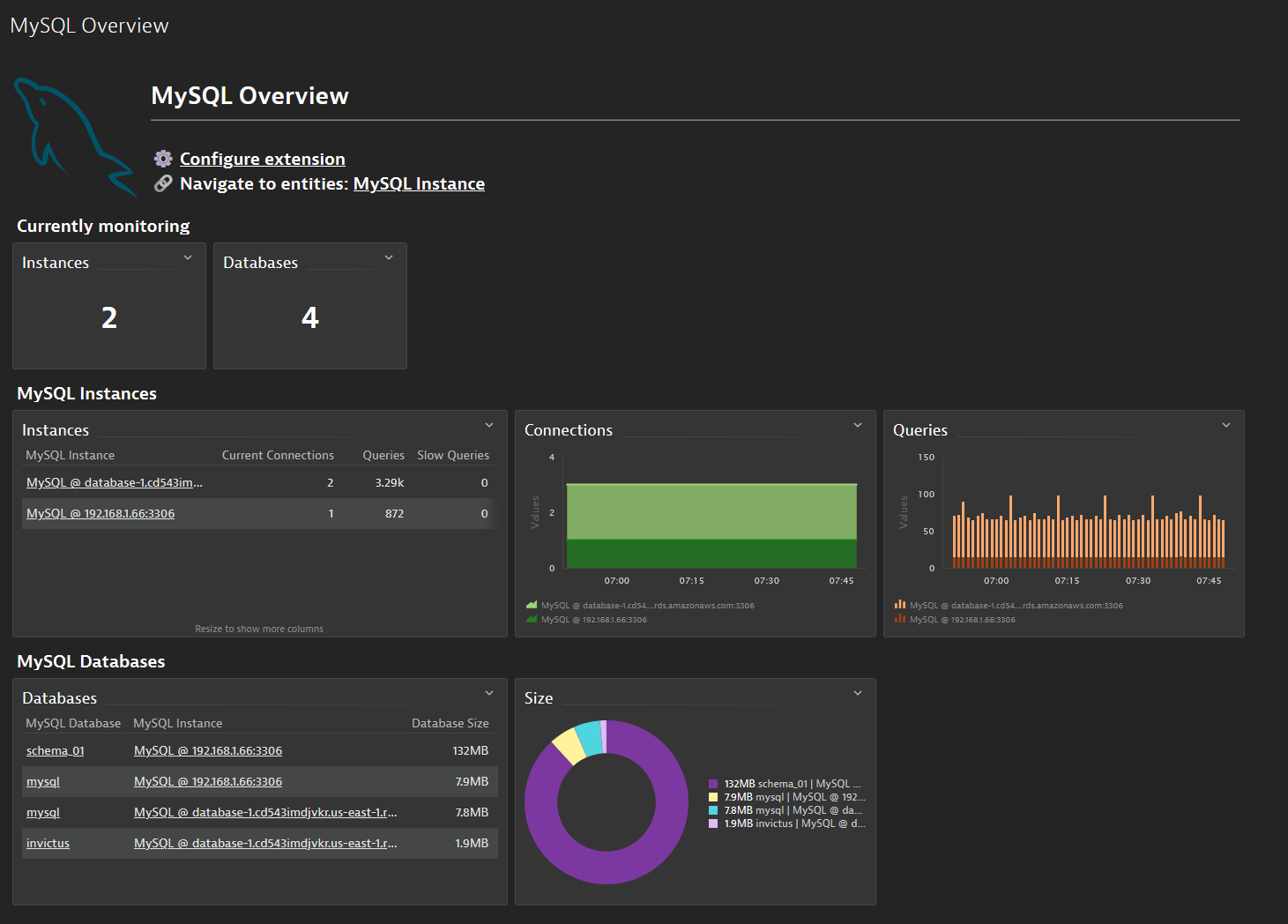
Remotely monitor your MySQL instances, collect key KPIs and slow queries details
ExtensionRemotely monitor MySQL databases where you cannot install an OneAgent.
For more information on the installation and configuration, please see MySQL (remote monitoring) extension in the Dynatrace Documentation.
Below is a complete list of the feature sets provided in this version. To ensure a good fit for your needs, individual feature sets can be activated and deactivated by your administrator during configuration.
| Metric name | Metric key | Description | Unit |
|---|---|---|---|
| Commits | mysql.statements.commit.count | The number of COMMIT statements executed by this server | Count |
| Deletes | mysql.statements.delete.count | The number of DELETE statements executed by this server | Count |
| Multi-Table Deletes | mysql.statements.delete_multi.count | The number of multi-table DELETE statements executed by this server | Count |
| Inserts | mysql.statements.insert.count | The number of INSERT statements executed by this server | Count |
| Insert Selects | mysql.statements.insert_select.count | The number of INSERT ... SELECT statements executed by this server | Count |
| Selects | mysql.statements.select.count | The number of SELECT statements executed by this server | Count |
| Updates | mysql.statements.update.count | The number of UPDATE statements executed by this server | Count |
| Executes | mysql.statements.execute.count | The number of EXECUTE statements executed by this server | Count |
| Multi-Table Updates | mysql.statements.update_multi.count | The number of multi-table UPDATE statements executed by this server | Count |
| Bytes Sent | mysql.statements.bytes_sent.count | The number of bytes sent to all clients | Byte |
| Bytes Received | mysql.statements.bytes_received.count | The number of bytes received from all clients | Byte |
| Rollbacks | mysql.statements.rollback.count | The number of ROLLBACK statements executed by this server | Count |
| Replace Selects | mysql.statements.replace_select.count | The number of REPLACE ... SELECT statements executed by this server | Count |
| Metric name | Metric key | Description | Unit |
|---|---|---|---|
| Database Size | mysql.databases.size | The size of the Database | MegaByte |
| Metric name | Metric key | Description | Unit |
|---|---|---|---|
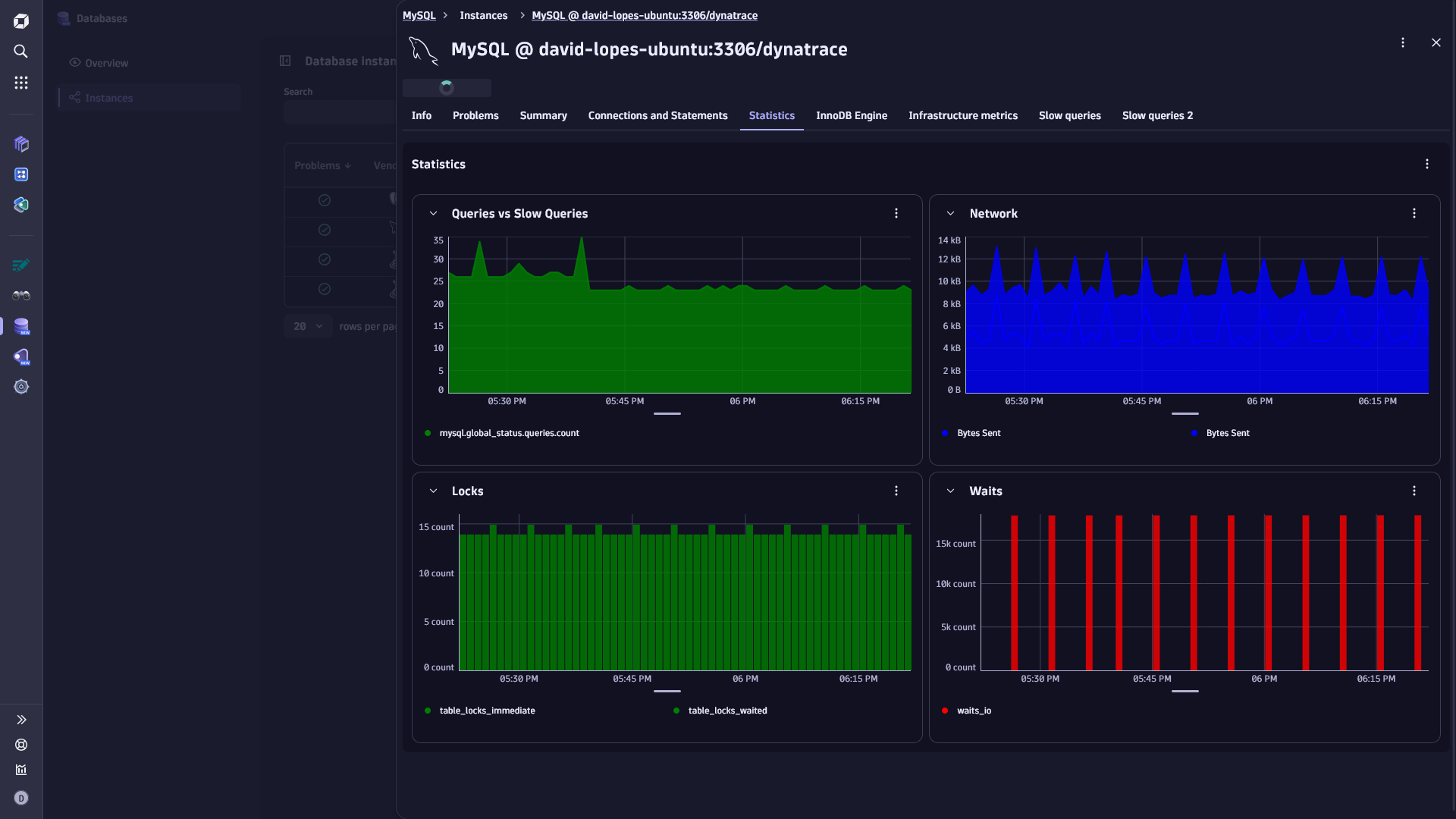
| Queries | mysql.global_status.queries.count | The total number of queries executed by the server. This includes statements executed within stored procedures, unlike the Questions variable. | Count |
| Slow Queries | mysql.global_status.slow_queries.count | The number of queries that have taken more than long_query_time seconds. This counter increments regardless of whether the slow query log is enabled. For information about that log, see Section 5.4.5, The Slow Query Log. | Count |
| Table Locks Waited | mysql.global_status.table_locks_waited.count | The number of times that a request for a table lock could not be granted immediately and a wait was needed. If this is high and you have performance problems, you should first optimize your queries, and then either split your table or tables or use replication. | Count |
| Table Locks Immediate | mysql.global_status.table_locks_immediate.count | The number of times that a request for a table lock could be granted immediately. | Count |
| Current Connections | mysql.global_status.current_connections | The number of currently open connections. | Count |
| Threads Running | mysql.global_status.threads_running | The number of threads that are not sleeping. | Count |
| Innodb Buffer Pool Pages Data | mysql.global_status.innodb_buffer_pool_pages_data | The number of pages in the InnoDB buffer pool containing data. The number includes both dirty and clean pages. When using compressed tables, the reported Innodb_buffer_pool_pages_data value may be larger than Innodb_buffer_pool_pages_total | Count |
| Innodb Buffer Pool Pages Dirty | mysql.global_status.innodb_buffer_pool_pages_dirty | The current number of dirty pages in the InnoDB buffer pool. | Count |
| Innodb Buffer Pool Pages Free | mysql.global_status.innodb_buffer_pool_pages_free | The number of free pages in the InnoDB buffer pool. | Count |
| Innodb Buffer Pool Pages Total | mysql.global_status.innodb_buffer_pool_pages_total | The total size of the InnoDB buffer pool, in pages. When using compressed tables, the reported Innodb_buffer_pool_pages_data value may be larger than Innodb_buffer_pool_pages_total | Count |
| Innodb Data Reads | mysql.global_status.innodb_data_reads.count | The total number of data reads (OS file reads). | Count |
| Innodb Data Writes | mysql.global_status.innodb_data_writes.count | The total number of data writes. | Count |
| Innodb Data Read | mysql.global_status.innodb_data_read.count | The total amount of data read from files. | Byte |
| Innodb Data Written | mysql.global_status.innodb_data_written.count | The total amount of data written. | Byte |
| Innodb Buffer Pool Reads | mysql.global_status.innodb_buffer_pool_reads | The number of logical reads that InnoDB could not satisfy from the buffer pool, and had to read directly from disk. | Count |
| Innodb Buffer Pool Read Requests | mysql.global_status.innodb_buffer_pool_read_requests | The number of logical read requests. | Count |
| Availability | mysql.global_status.availability | Whether or not a connection can be made to the database | Percent |
| Status | mysql.global_status.status | A status of AVAILABLE is returned if we can query the database | State |
| Uptime | mysql.global_status.uptime | The time in seconds that the MySQL server has been running since it was started. | Second |
| Metric name | Metric key | Description | Unit |
|---|---|---|---|
| CPU User | mysql.infrastructure.cpu.user | The percentage of CPU time spent in user mode. | Percent |
| CPU System | mysql.infrastructure.cpu.system | The percentage of CPU time spent in system mode. | Percent |
| Memory | mysql.infrastructure.memory | The amount of memory used per each code area. | Byte |
| Metric name | Metric key | Description | Unit |
|---|---|---|---|
| Waits IO | mysql.waits.waits_io.count | The number of times that the server has waited for an I/O operation to complete. | Count |
| Waits IO Time | mysql.waits.waits_io_time.count | The total time the server has waited for I/O operations to complete. | MilliSecond |
| Waits Sync | mysql.waits.waits_sync.count | The number of times that the server has waited for a synchronization operation to complete. | Count |
| Waits Sync Time | mysql.waits.waits_sync_time.count | The total time the server has waited for synchronization operations to complete. | MilliSecond |
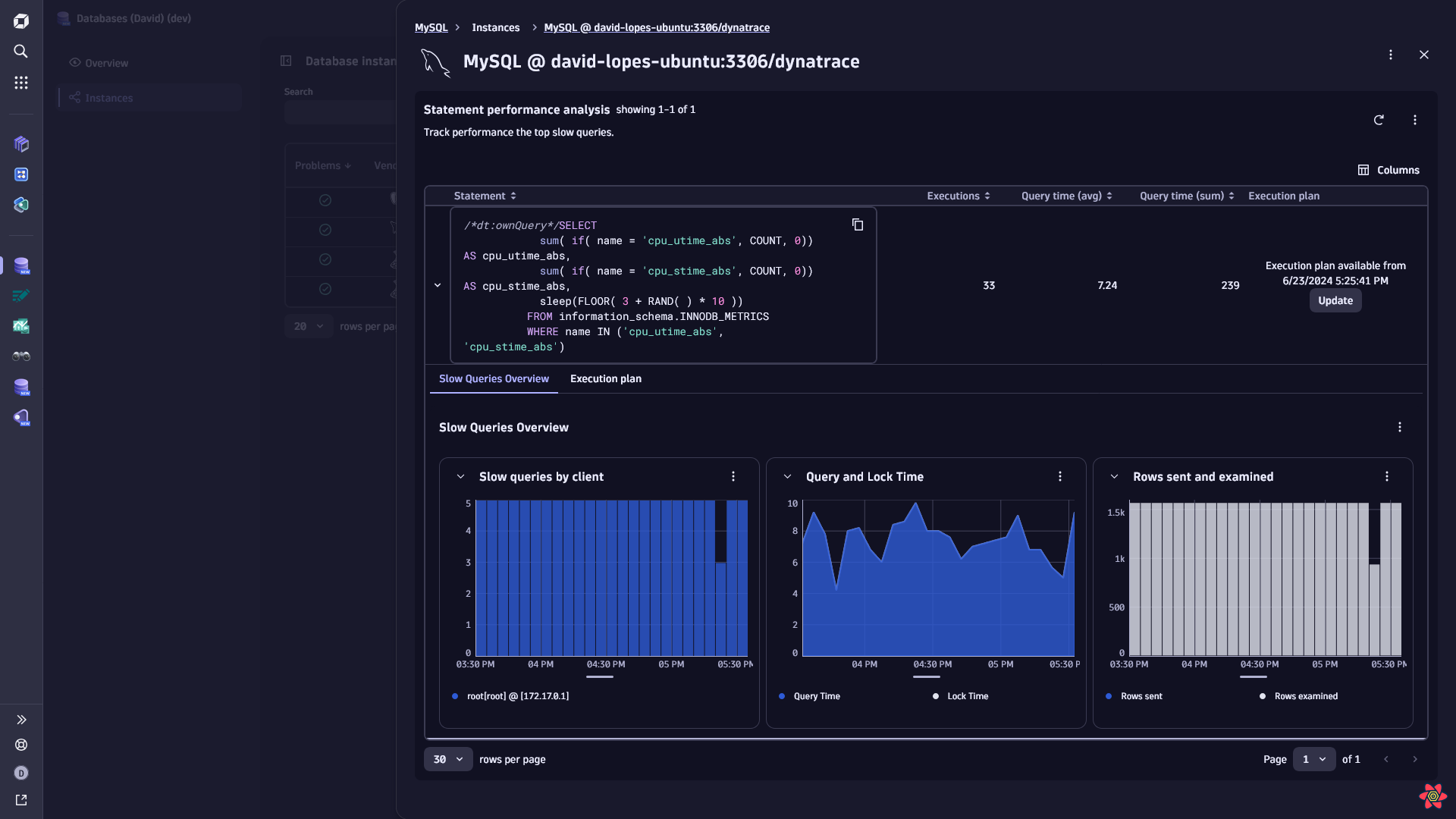
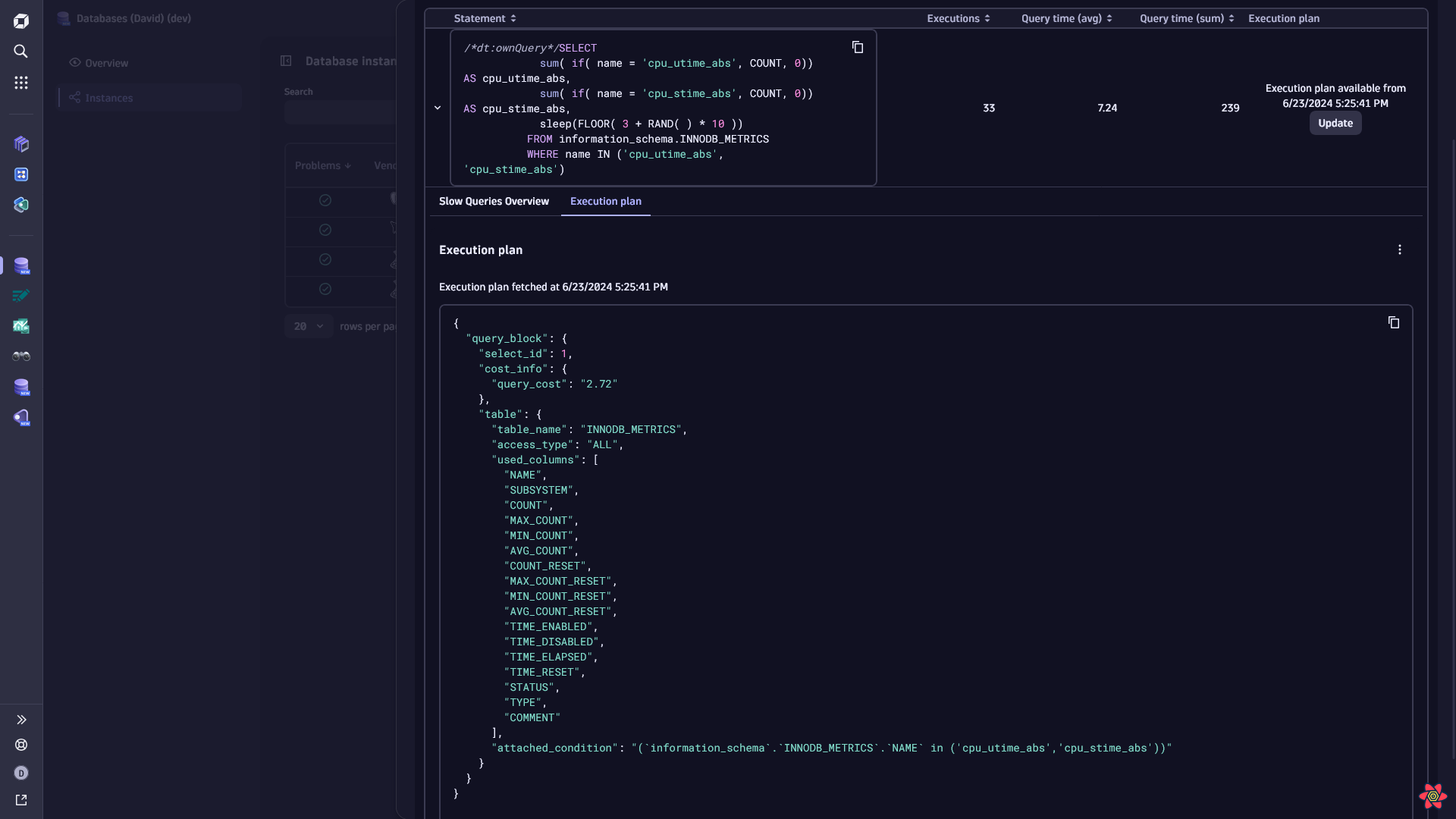
mysql.statements.insert_select.countmysql.statements.replace_select.countmysql.statements.rollback.countcpu_utime_abs and cpu_system_abs with cpu_utime_pct and cpu_system_pct to accurately represent the average CPU usage taking in consideration the amount of CPU cores in the machine.Added new top_queries feature set to collect slow query data via performance schema.
Please see "Collecting Top Slow Queries" section of Hub documentation for instructions to enable monitoring.
Existing feature set slow_queries will be deprecated in a future release.
mysql.global_status.innodb_buffer_pool_reads, mysql.global_status.innodb_buffer_pool_read_requestsserver_version instance attribute to "DB Instance Version"dt.security_context attribute to entities created by this extensionNote: these features require Activegate 1.293+
Add metrics: