

Leading the evolution from CNAPP to Cloud Application Detection and Response
We’re excited to announce that Dynatrace has been recognized as a Cloud Security Innovator in the Latio Pulse 2025 Cloud Security Market Report, authored by James Berthoty. This recognition validates the Dynatrace approach to bridging observability and security, and underscores our commitment to providing the runtime visibility and application-layer insights that modern cloud security demands.
Why we love this recognition
The cloud security landscape is undergoing a fundamental shift. According to the Latio report, traditional Cloud Native Application Protection Platforms (CNAPP) are evolving into more specialized categories, and runtime visibility is at the heart of this transformation.
The report highlights a critical insight: “Report after report has indicated that most cloud breaches are now beginning with web application attacks.” This validates what Dynatrace has been building toward for a while now: a Cloud Application Detection and Response (CADR) solution that understands applications at runtime, not just infrastructure in isolation.
As the report states, teams increasingly need “visibility into the application layer” to allow “meaningful runtime protection in the cloud.” And this is exactly where Dynatrace excels.
The application layer: Cloud security’s missing piece
For too long, cloud security platforms have focused primarily on infrastructure—containers, instances, and configurations, while overlooking the application layer where most attacks actually begin. The Latio report identifies this gap explicitly, saying that CNAPPs “didn’t pay enough attention to the Application part.”
Dynatrace brings deep application-layer visibility that traditional security tools simply lack. Our foundation in observability gives Dynatrace unique insights into:
- Function-level execution visibility through OneAgent® and eBPF technology, helping teams to distinguish theoretical risks from real threats based on what actually runs in production
- Runtime telemetry that contextualizes security alerts with application performance data
- End-to-end traces that show exactly how attacks traverse through your environment
- Real-time monitoring of APIs, microservices, and serverless functions in dynamic cloud environments
All of this feeds into our Davis® Security Score (DSS), which translates observed application behavior into actionable insights by individually adjusting CVSS scores based on the actual risk of exposure for each vulnerability.
Observability-powered security: A natural evolution
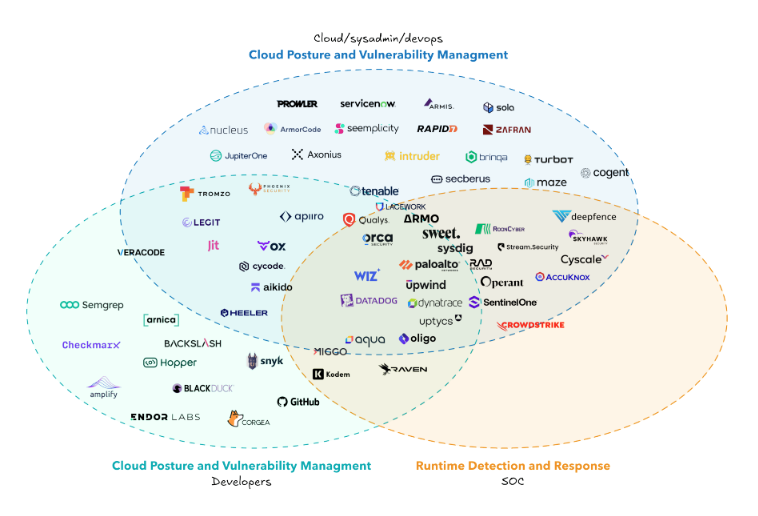
The convergence of observability and security isn’t just a trend—it’s a necessity. As highlighted in the Latio report, over 60% of survey respondents identified Application Detection and Response (ADR) capabilities as the most exciting emerging feature for cloud security solutions.
This aligns perfectly with the Dynatrace approach. Traditional application security tools, like static AST, SCA, or vulnerability management platforms, still generate long lists of potential issues, leaving teams unsure which vulnerabilities truly matter in production. ADR and Cloud Application Detection and Response (CADR) bridge this gap by providing runtime and production insights, helping organizations focus on the vulnerabilities that actually create risk.
Dynatrace Cloud Security provides:
- Complete visibility into digital environments with automatic dependency mapping and topology insights
- Rich application context including function-level execution data, end-to-end traces, runtime telemetry, and API/microservice interactions, allowing security operations to understand the full story behind incidents and prioritize what truly matters
- Real-time runtime protection that empowers teams to take immediate, autonomous action
- Unified data brings security events, logs, traces, and user behavior into a single platform to prioritize, automate, and share information to those who need to act for more autonomous security processes.
What the Latio report says about Dynatrace
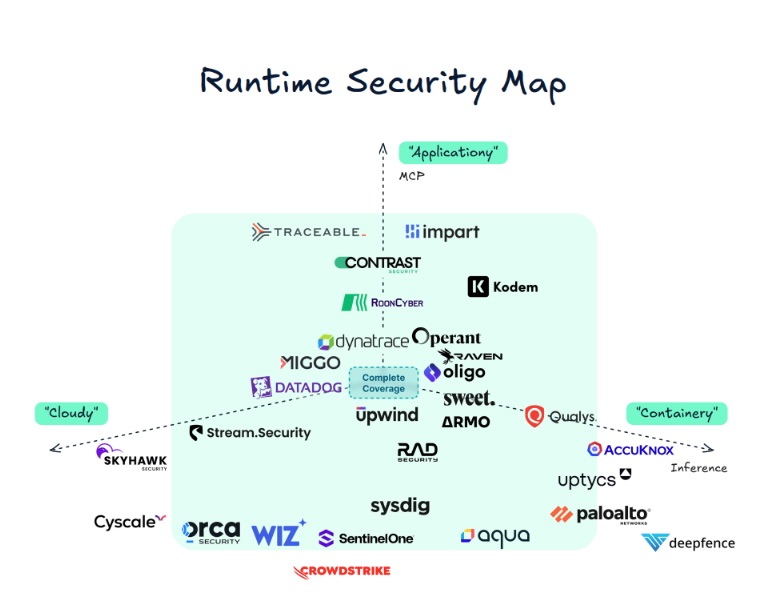
The Latio report specifically recognizes Dynatrace among vendors “expanding early functionality” in providing function-level reachability insights through OneAgent capabilities. This technology represents the cutting edge of runtime security, allowing teams to:
- Reduce false positives by identifying which vulnerabilities are actually reachable and exploitable in production
- Prioritize remediation efforts based on real risk, not theoretical severity scores
- Automatically detect and block attacks at the application layer without breaking functionality
The report emphasizes that “the difference these capabilities make within a tool are massive, and their relative importance will continue into 2026.”
Runtime Vulnerability Analytics: Prioritize what matters
One of the biggest challenges security teams face is the overwhelming volume of alerts that lack context and actionability. As we covered in our post on Runtime Vulnerability Analytics, traditional tools “overload you with data, making it challenging to identify which vulnerabilities actually put your environment at risk.”
Dynatrace takes this a step further, transforming vulnerability management from a manual process into an autonomous platform capability that not only prioritizes risks but actively drives remediation.
Here’s how Dynatrace solves this:
- Davis Security Score (DSS) adapts to your specific environment segments.
- Exposure-based prioritization focuses on assets vulnerable to internet-based threats or linked to sensitive data.
- Automated context enrichment eliminates noise and surfaces genuine threats.
- Cross-platform segmentation allows teams to focus on specific areas like payment processing systems.
- Integration of third-party findings (from tools like SCA, AST, or CNAPPs) applies Dynatrace prioritization intelligence across sources, reducing redundant findings and focusing on what truly matters.
- Closed-loop collaboration with developers operationalizes vulnerability management by automatically routing prioritized issues to the right owners—eliminating “man-in-the-middle” friction and accelerating resolution.
The Latio report’s emphasis on “runtime insights to prioritize reducing real risks” perfectly captures our approach. Dynatrace extends this further by making vulnerability management an integral, automated part of cloud operations.
Cloud Security Posture Management (CSPM) with real-time context
Beyond runtime detection, the Latio report highlights the continued importance of posture management—but with a critical evolution. As noted in our Cloud Security Posture Management announcement, “30% of all cloud environment attacks during the first half of 2024 used misconfigurations as the initial access vector.”
Dynatrace CSPM provides:
- Continuous monitoring across hybrid and multicloud environments.
- Automated remediation through workflow automation.
- Continuous compliance monitoring that helps meet strict regulatory timeframes.
- Centralized visibility that breaks down silos between SecOps and DevOps teams.
Protect AI workloads: The next frontier
The Latio report identifies AI security as a critical emerging capability, with 65% of survey respondents expressing strong interest in AI posture management. As AI adoption accelerates, so do the risks.
Our recent work on protecting Agentic AI applications demonstrates how the Dynatrace multi-layered approach, combining runtime vulnerability analytics, security posture management, and deep log investigation, provides robust defense for these dynamic AI environments.
This builds on Dynatrace AI observability innovations, which deliver deep visibility into AI pipelines, model interactions, and even prompt-level activity. These insights not only enhance reliability but also establish the foundation for agentic AI security, where taint tracking across AI agents helps detect and prevent unwanted data propagation or malicious behavior between systems.
The path forward: CADR represents the future
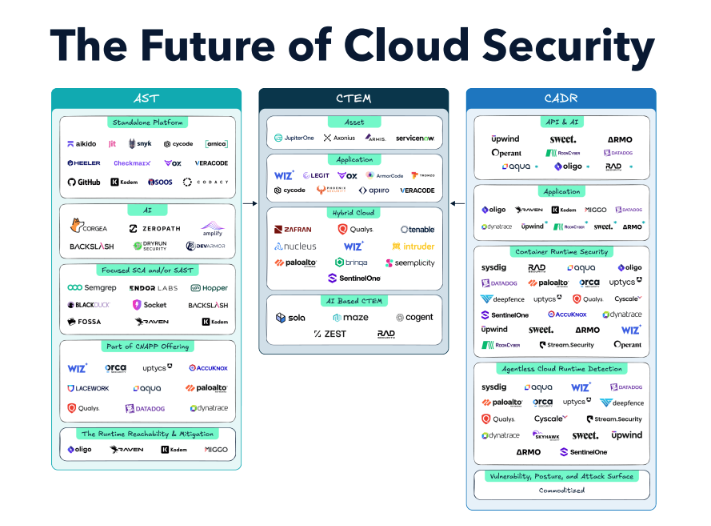
The Latio report introduces a new framework for understanding cloud security, moving beyond the “everything platform” approach of traditional CNAPPs to three specialized categories:
- Application Security Testing (AST) for developer-focused code security
- Continuous Threat Exposure Management (CTEM) for unified vulnerability management
- Cloud Application Detection and Response (CADR) for advanced runtime workload protection
At Dynatrace, we see CTEM not just as another tool category, but as a holistic program that requires process and organizational adaptation to be successful. CADR provides the technological foundation to make CTEM actionable: delivering the runtime insights, prioritization, and automation needed to continuously manage real-world exposure in dynamic cloud environments.
Dynatrace is recognized as an innovator in the CADR category, representing the future of runtime security. As the report states, CADR provides “the best runtime solution to protect cloud environments, and surface runtime telemetry for prioritization and threat detection.”
What this means for your security program
If you’re evaluating cloud security solutions, the Latio report provides guidance: architecture matters. For organizations running containerized workloads with complex microservices architectures, runtime visibility isn’t optional; it’s essential.
The report’s survey found that:
- Over 70% of respondents found posture findings to be most valuable when enriched with runtime context.
- Over 50% split their security tooling between posture and runtime capabilities.
- 64% indicated that their SOC team responds to runtime cloud security alerts.
This highlights the importance of solutions like Dynatrace that bridge security operations and development teams with unified, actionable insights.
Get started with Dynatrace Cloud Security
Whether you’re looking to:
- Consolidate security and observability into a single platform
- Use OneAgent for both observability and security capabilities
- Gain deeper visibility into your runtime environment
- Reduce vulnerability noise with context-aware prioritization
- Detect and respond to application-layer attacks in real time
- Or, secure AI workloads and agentic applications…
Dynatrace Cloud Security provides the comprehensive, context-driven protection your modern cloud environment demands.
As noted in our executive perspective on security compliance, “The benefits of cloud native architecture for IT systems come with the complexity of maintaining real-time visibility into security compliance and risk posture.” Dynatrace makes this complexity manageable through intelligent automation, unified data, and actionable insights.
Recognition driven by customer success
This recognition from Latio reflects the real-world impact Dynatrace Cloud Security delivers for customers. As we continue to innovate and expand our capabilities—from enriching Microsoft Defender findings to breaking down security silos with runtime context—we remain focused on solving the challenges our customers face every day.
It’s worth noting that Dynatrace pioneered this evolution back in 2019, introducing Runtime Vulnerability Analytics (RVA) long before runtime security became an industry trend. What has changed since then is not our vision, but the market’s recognition of the importance of our vision. Organizations are increasingly realizing that runtime visibility and application context are essential to effective cloud security.
With the third generation of Dynatrace Cloud Security, we’ve taken RVA even further, operationalizing it through automated workflows, developer integration, and cross-tool vulnerability ingestion and prioritization. These capabilities are critical for making runtime vulnerability analytics truly usable within customer organizations, turning insights into action at scale.
The evolution from traditional CNAPP to specialized categories like CADR isn’t just about new acronyms—it’s about recognizing that different teams need different capabilities, and that runtime visibility with application context represents the future of cloud security.
Ready to see how Dynatrace can transform your cloud security posture?
- Explore Dynatrace Cloud Security
- Start a free trial
- Contact us to discuss your specific security needs
Additional Resources
- Cloud Security and CADR: Revolutionizing cloud security with observability context
- Empowering SREs with Runtime Vulnerability Analytics
- Discover the new Runtime Vulnerability Analytics experience
- Elevate cloud security with real-time compliance
Dynatrace is proud to be recognized as a Cloud Security Innovator and remains committed to advancing the convergence of observability and security for the modern cloud era.
About Latio: Latio is a modern security analyst firm redefining how organizations evaluate and select security solutions. Latio conducts hands-on testing, engages with stakeholders across all personas, and consolidates market insights to ensure organizations find the right security solutions for their needs.
About the Cloud Security Market Report: The Cloud Security Market report delivers a comprehensive analysis of industry solutions, based on hands-on research and insights from practitioners and security leaders. It outlines critical functionality requirements, provides strategic buyer guidance, and examines emerging trends and innovation trajectories across the cloud security landscape.



Looking for answers?
Start a new discussion or ask for help in our Q&A forum.
Go to forum