
AI that acts on certainty, not probability
Dynatrace Intelligence combines deterministic causation-based analysis with generative AI and agentic AI to deliver precise, contextual answers. It powers automated root cause analysis, anomaly detection, and autonomous agentic operations.
AI you can trust to act on your behalf
Dynatrace Intelligence grounds every action in real-time context, not statistical guesswork, so it gets the right answer before it takes action, all while working within the guardrails that you define.
Intelligence that runs from detection to resolution automatically
Dynatrace Intelligence isn't layered on your observability. It's woven into it. Grail places every signal in one place and in full context. Smartscape attaches impact, ownership, and blast radius to every finding. Dynatrace Intelligence then turns that foundation into action under your oversight, expanding at a pace you set, with every decision traceable.
Ask anything. Get answers with context already attached
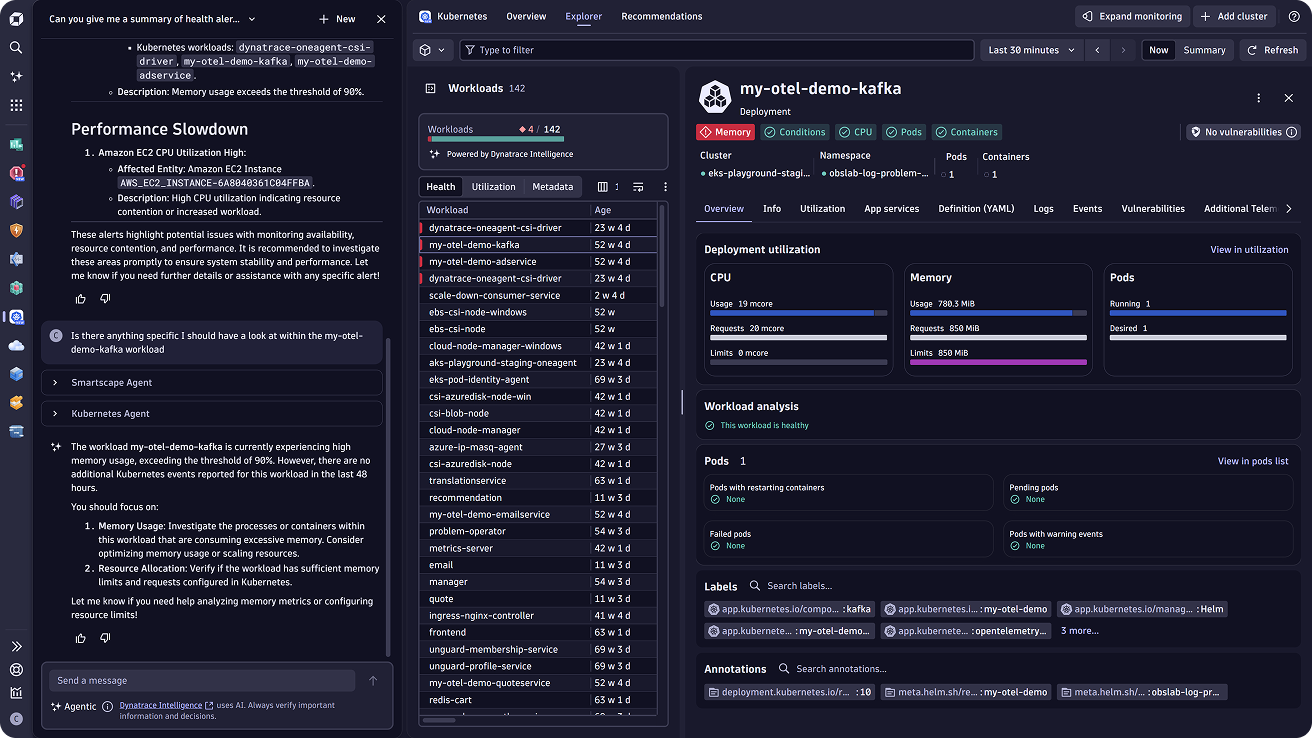
Dynatrace Assist lets your teams explore data, investigate incidents, and drive remediation through natural language, without having to build prompts or add context manually. The platform already knows your environment.
Build and run your own AI agents
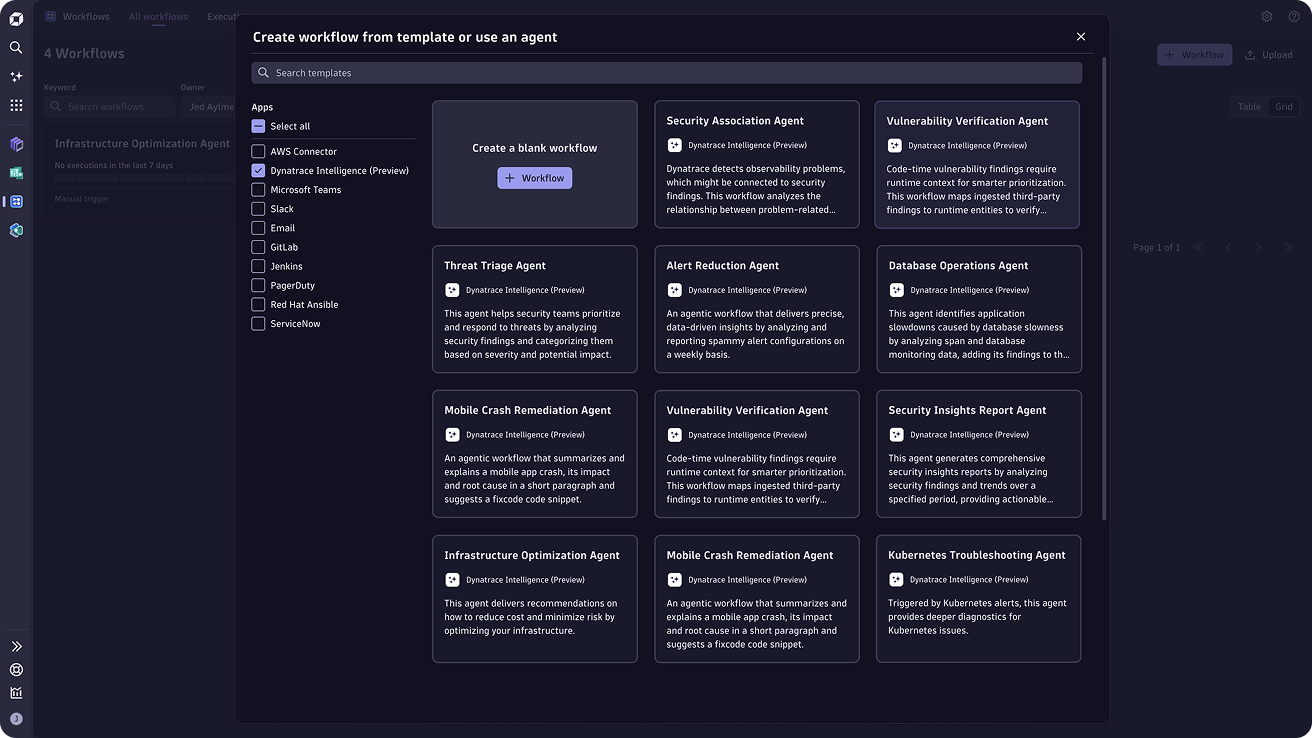
Teams can create custom agents without writing a single line of code, using Dynatrace Intelligence to configure, deploy, and run agents that reason and act autonomously. Every agent starts with your live environment context, so it understands your stack from day one.
Production context directly into developer Workflows
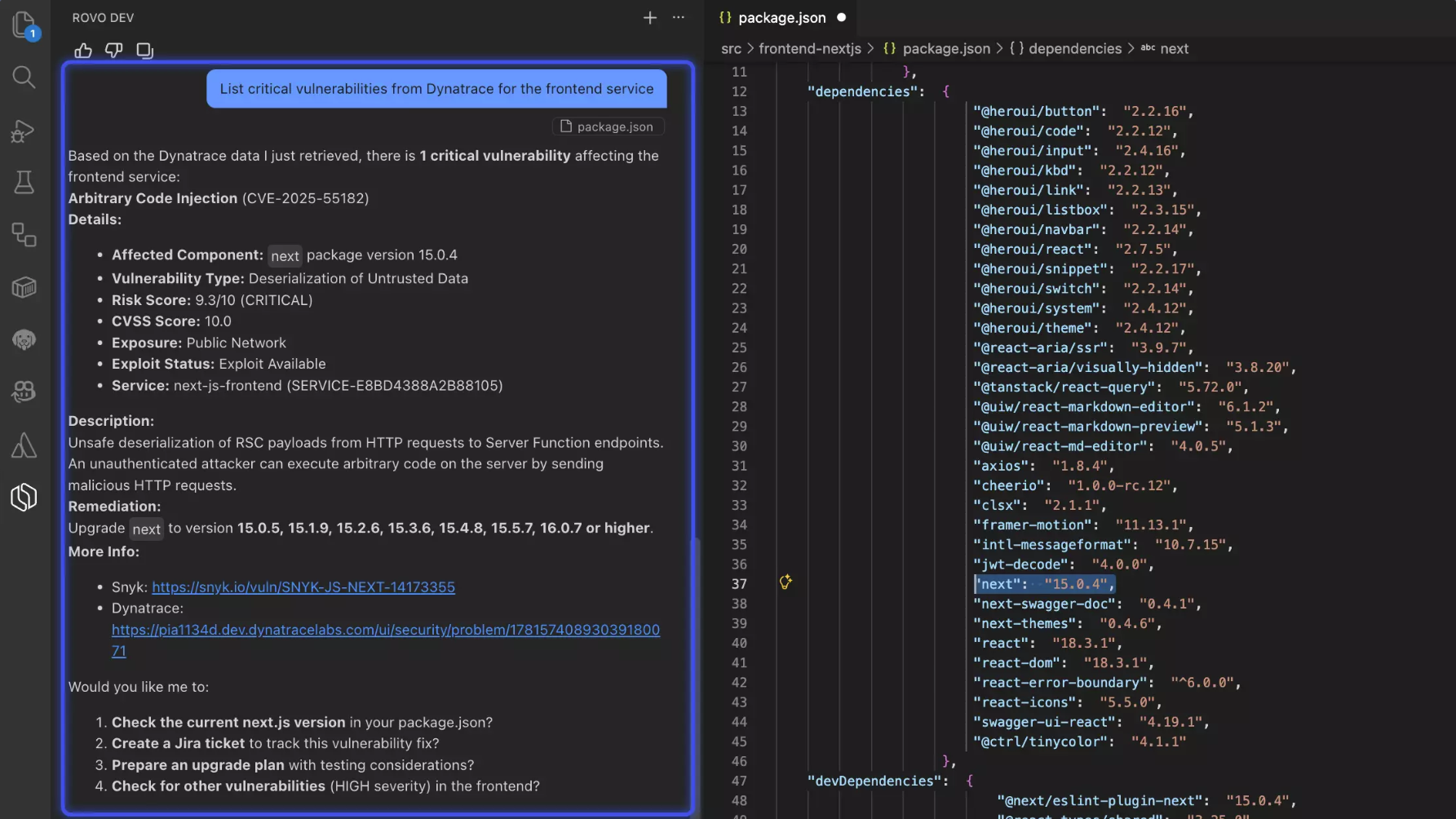
Dynatrace Skills, Dynatrace MCP and dtctl give developers and AI agents the domain-specific context needed to reason correctly about their Dynatrace environment where they already work.
What Dynatrace is outlining with Dynatrace Intelligence aligns with where we want to go...an approach that connects insight to action, while keeping our teams in control, could significantly improve performance and reliability as we scale.
Purpose-built for the teams closest to the work
Each Dynatrace agent is pre-loaded with causal context about your environment — so they don't just surface findings, they take the next step for you.



Frequently Asked Questions: Artificial Intelligence
Dynatrace Intelligence is the industry's first agentic operations system, designed for technology teams that need reliable, autonomous insight and action at enterprise scale. Dynatrace Intelligence fuses deterministic AI grounded in causal analysis, the Grail data lakehouse, and the Smartscape real-time dependency graph — with agentic AI that can reason and act autonomously within defined guardrails. The result is a system that moves beyond reactive alerting to deliver continuous autonomous prevention, remediation, and optimization.
Deterministic AI produces consistent, causally grounded answers and does not guess. Agentic AI takes those reliable answers as inputs and applies autonomous reasoning to turn insight into action. Deterministic AI gives agentic AI a trustworthy foundation to act from, rather than pattern matching.
Three things block teams from letting AI act on production: trust, since an opaque conclusion cannot justify an action; safe operation at scale, which needs real boundaries and oversight; and inconsistent outcomes from probabilistic systems. Dynatrace Intelligence addresses all three.
LLM-based tools rely on probabilistic inference, which introduces inconsistency. Dynatrace Intelligence derives answers from real-time topology, causal dependency mapping, and structured ingestion, so auditability, consistency, and explainability are baseline rather than aspirational.
Auto-remediation investigates root cause, applies a context-aware fix, and validates it. Auto-prevention acts on findings before impact lands. Auto-optimization tunes performance and cost against your goals. All three are traceable.
Dynatrace Intelligence ships with three purpose-built agents covering the most critical operational domains: the Developer agent, the SRE agent, and the Security agent. The Developer agent detects and diagnoses code-level issues, then recommends specific fixes — shortening the feedback loop between detection and resolution. The SRE agent focuses on stabilizing cloud and Kubernetes environments, applying autonomous corrective actions within approved boundaries. The Security agent triages and prioritizes vulnerabilities and threats, then initiates proactive remediation to reduce exposure before incidents escalate. Beyond these built-in agents, Dynatrace Intelligence supports an expanding ecosystem of partner agents that collaborate bidirectionally within the same operational context.
Yes. Teams build production-ready agentic workflows without an engineering dependency. Each workflow starts from your live environment context rather than a blank prompt, combines deterministic analysis with platform actions, chains into systems you already run, and operates under the same guardrails and audit trail as the shipped agents.
MCP integration delivers live insight into IDEs, Slack, GitHub Copilot, and ServiceNow. A CLI supports real-time querying, debugging, and workflow automation for humans and agents. A Skills knowledge base gives coding agents context to act on live Dynatrace data. Partner and cloud agents, including AWS DevOps agent and Azure SRE Agent, work from the same findings.
Dynatrace Assist is an in-context natural language interface for asking questions and exploring observability data without writing queries or assembling prompt context. Assist answers where the user is already working, so the system already knows the relevant topology, services, and incident state.
Dynatrace Intelligence is architected as a progressive path, not a single switch. Early phases focus on automated root cause analysis and corrective actions — replacing manual triage with system-initiated responses while keeping engineering teams informed and in control. As confidence and coverage increase, operations shift toward fuller autonomy, where Dynatrace Intelligence proactively prevents incidents and optimizes systems before problems surface. Team oversight remains embedded throughout, allowing organizations to expand the scope of autonomous action at a pace that matches their risk tolerance and operational maturity.
No agent takes consequential action outside sanctioned boundaries. The deterministic AI foundation means every action recommendation is traceable — teams can inspect why a decision was made and which data points drove it. This architecture directly addresses the enterprise concern that AI autonomy introduces unpredictable behavior: because Dynatrace Intelligence derives answers rather than generates them, the reasoning chain is auditable at every step. Organizations retain the ability to configure the scope and confidence thresholds at which autonomous actions are permitted to execute.
The Security agent within Dynatrace Intelligence continuously monitors for vulnerabilities and active threats, then triages and prioritizes them based on real-time context from across the environment — not static severity scores alone. By understanding the live topology and blast radius through Smartscape, the Security agent can identify which exposures represent the greatest actual risk at a given moment and initiate proactive remediation steps accordingly. This shifts security operations from reactive incident response toward continuous, context-aware risk reduction, without requiring security analysts to manually correlate signals from disparate tools.
Autodesk, a global design software company, has publicly described deploying Dynatrace Intelligence to achieve observability that "doesn't just detect problems — it understands them and acts on them reliably." This reflects the core design goal of the platform: to close the gap between detection and resolution by grounding autonomous action in causal, deterministic insight rather than alert noise. The system is built for organizations operating complex, distributed cloud environments where the volume and velocity of signals have outpaced human capacity to respond manually.
Dynatrace Intelligence is part of the Dynatrace platform, which means organizations already running Dynatrace observability have direct access to the agentic capabilities as they are enabled. For teams evaluating the platform, the starting point is to establish baseline coverage through Dynatrace's Grail data lakehouse and Smartscape dependency mapping — the deterministic foundation that makes agentic operations reliable. From there, organizations can activate individual agents (Developer, SRE, Security) based on the operational domains where autonomous action delivers the most immediate value.