
Dynatrace MCP server
Connect AI assistants to Dynatrace to interact with real-time observability and production data, and enhance reliability through autonomous operations.

Level-up your agents with real-time observability intel
Securely access and interact with real-time data, supercharging your AI stack with live production context and precise observability intelligence.






Enable AI assistants to interact with Dynatrace
Connect AI assistants with Dynatrace and provide them with reliable, real-time production insights.
Benefit from the best observability insights available
LLM-powered agents are only as smart as the data they were trained on. Without deep observability data, they can’t solve ops issues, miss root causes, or fail to remediate.
Tame the integration complexity
As tools multiply and execute actions, integrations and orchestration become difficult and unstable.
MCP is to AI what HTTP is to the web: a reliable protocol
MCP standardizes safe, reliable agent interaction, grounding AI answers in your data.

How Dynatrace MCP Powers Autonomous Operations
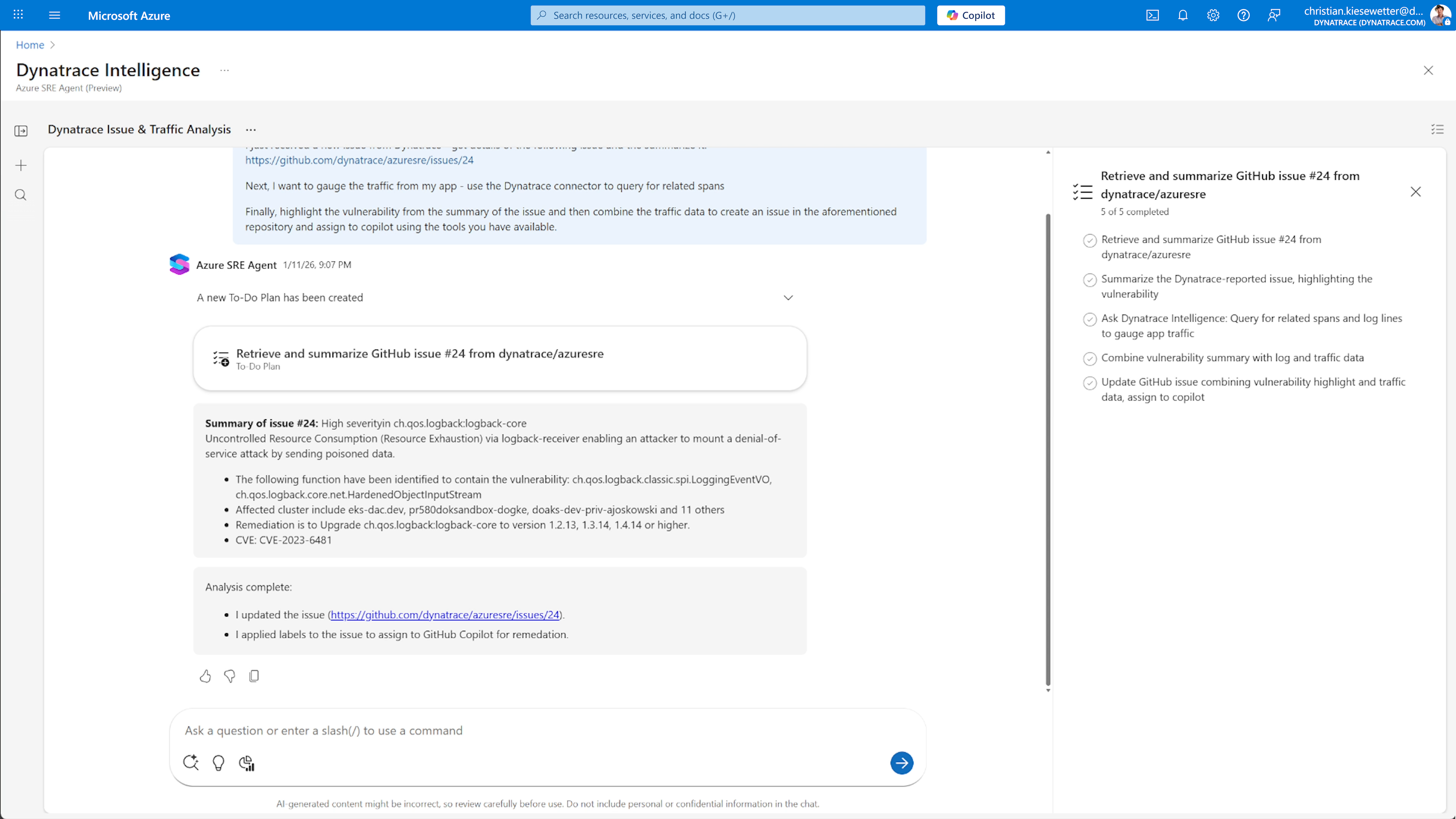
Stay on track of your SLOs with agentic remediation
When anomalies surface, Dynatrace MCP pinpoints the exact root cause and blast radius with explainable, traceable context — then initiates the right remediation flow automatically, so SLO breaches become the exception, not the norm.
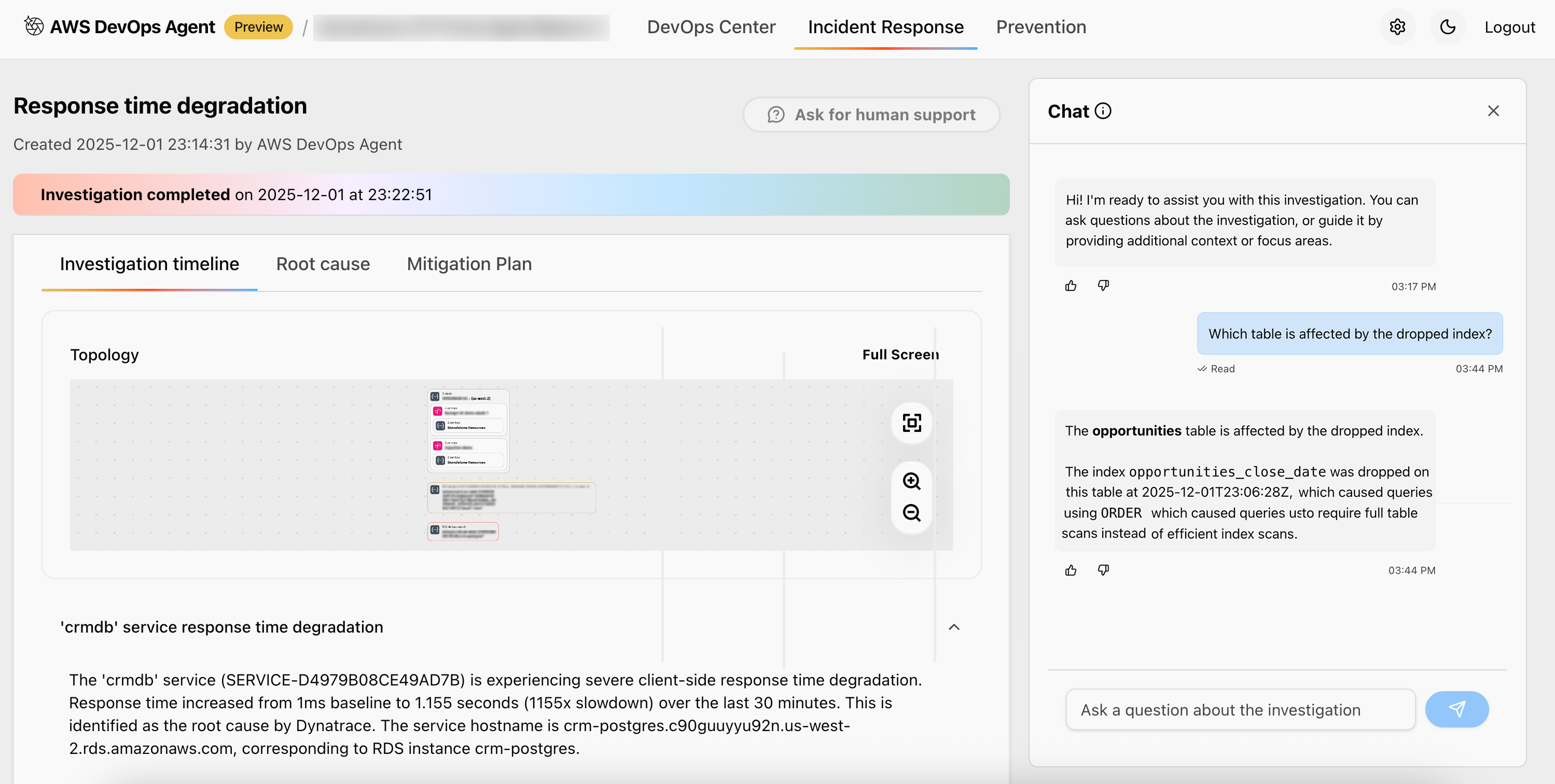
Contain incidents before they escalate
Dynatrace MCP links telemetry, configuration changes, and deployment history to isolate true root cause — then generates pre- and post-validated remediation plans with automatic rollback on risk, creating a full audit trail as it goes.
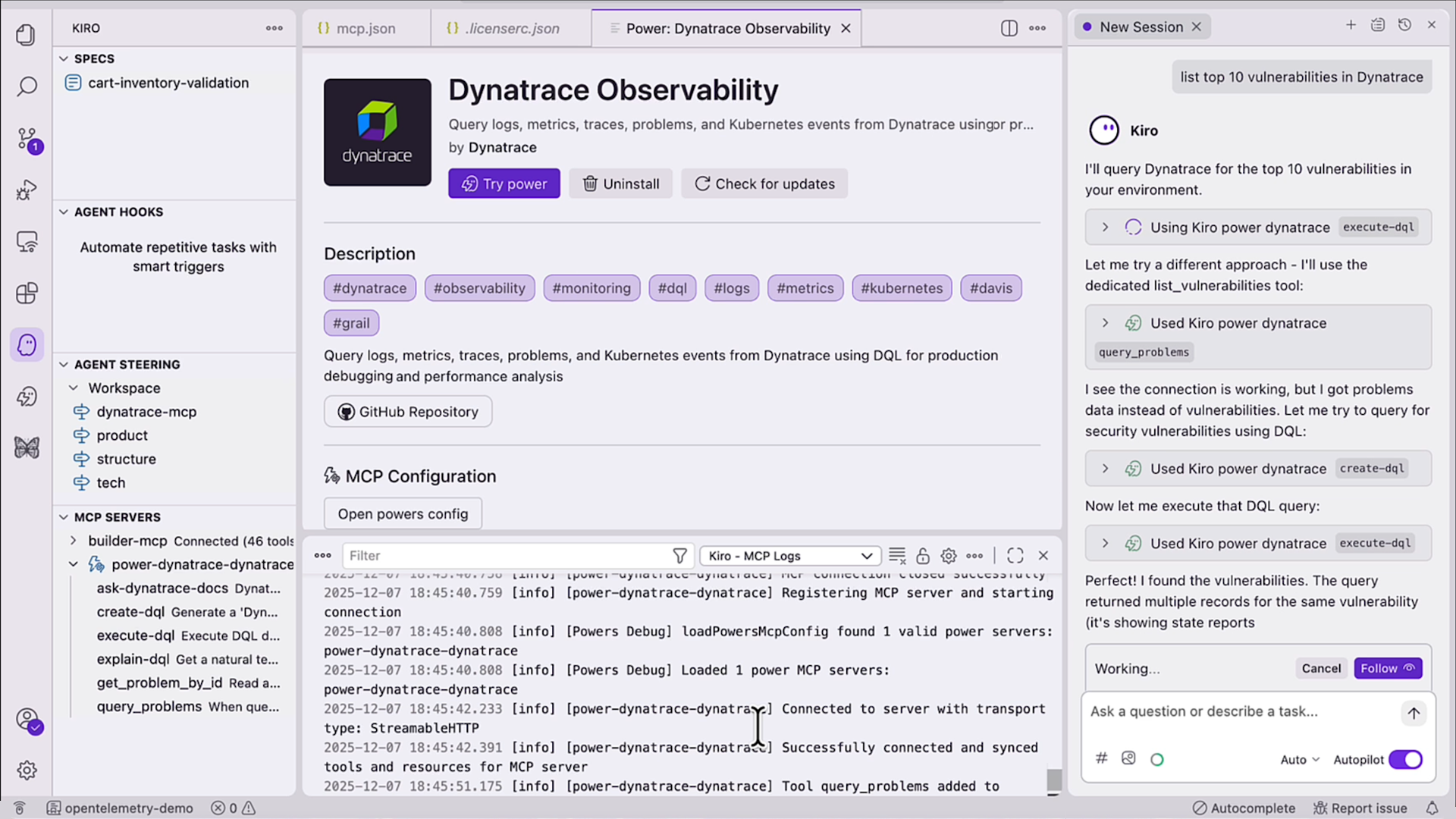
Empower developers to fix issues without leaving their IDE
Developers can query live production data and logs directly from their coding environment, apply AI-driven fixes in real time, and share context-rich insights across teams — no context-switching, no waiting on ops.






Related resources
 BlogDynatrace MCP Server: Empower your AI assistants to interact with Dynatrace and access live production insights
- BlogReal-time insights: Leverage Dynatrace observability capabilities within Kiro powered by AWS
- BlogBoost cloud reliability: Dynatrace and Azure SRE Agent unite for autonomous operations


MCP Server FAQs
LLM-powered agents operating without real-time observability data tend to miss root causes, misdiagnose incidents, and fail to execute correct remediation steps because they reason from static training knowledge rather than live system state. Production environments change continuously — deployments, configuration shifts, load patterns — and none of that context exists in a model's weights at inference time. The Dynatrace MCP Server closes this gap by grounding every agent response in current telemetry, topology maps, change logs, and dependency data from Dynatrace.
The Model Context Protocol (MCP) is a standardized communication layer for AI agents — often described as "MCP is to AI what HTTP is to the web: a reliable protocol." MCP defines a consistent, safe way for AI assistants to query external systems, receive structured data, and take grounded actions without ad hoc integrations or brittle API wrappers. For operations teams, MCP matters because it removes the ambiguity from AI-driven workflows: agents interact with production systems through a vetted protocol rather than unstructured inference alone.
The Dynatrace MCP Server is an MCP-compliant interface that connects AI assistants directly to Dynatrace's real-time observability and production data. When an AI agent sends a query through the MCP protocol, the Dynatrace MCP Server authenticates the session, retrieves the relevant telemetry, topology, or log data from Dynatrace, and returns structured context the AI can act on. The result is that LLM-powered agents stop generating answers from training data alone and instead operate on live, grounded production signals.
The Dynatrace MCP Server is compatible with a broad range of enterprise AI tools, including AWS DevOps Agent, Azure SRE Agent, ServiceNow Assist, Kiro (by AWS), GitHub Copilot, and Atlassian Rovo Ops. This breadth of compatibility means engineering and operations teams can adopt the Dynatrace MCP Server alongside the AI toolchain they already use, rather than replacing existing workflows. New integrations can be added as the MCP ecosystem expands, because the protocol itself is standardized.
The Dynatrace MCP Server includes enterprise-grade security controls built into the protocol layer, covering built-in authentication and session isolation for every AI interaction. Each agent session is scoped and isolated, which prevents cross-session data leakage and ensures that AI-driven actions are attributable and auditable. These guardrails allow platform engineers to extend AI access to production environments without exposing raw infrastructure credentials or bypassing existing identity and access management policies.
The Dynatrace MCP Server enables SRE teams to run autonomous incident investigations that surface blast radius, correlate telemetry with configuration changes and release events, and generate guardrail-bounded remediation plans — all with a comprehensive audit trail. The Dynatrace MCP Server also supports SLO-driven agentic remediation workflows: agents can diagnose fast, triage effectively using explainable context, and respond with precision calibrated to business impact rather than raw alert volume. These workflows reduce mean time to resolution by eliminating the manual context-gathering steps that typically slow SRE response.
The Dynatrace MCP Server enables developers to query production data, logs, and distributed traces directly from their IDE without switching to a separate observability console. An AI coding assistant connected to the Dynatrace MCP Server can surface the exact log lines, error rates, and dependency paths relevant to the code a developer is actively editing, then suggest AI-driven solutions grounded in real behavior rather than generic patterns. Teams can also share context-rich insights across squads, reducing the friction of handoffs between development and operations.
Traditional observability integrations for AI tools typically rely on custom webhooks, polling scripts, or manually curated dashboards exported as context — all of which degrade quickly as system topology changes. The Dynatrace MCP Server replaces these point-in-time integrations with a live, protocol-standard connection that always reflects current production state. Because MCP standardizes the interaction contract, the Dynatrace MCP Server works consistently across every compatible AI tool without requiring teams to maintain separate integration logic per platform.
Agentic incident management refers to the use of AI agents to autonomously enrich, triage, and route incidents within ITSM workflows — moving beyond simple alerting to contextual understanding. The Dynatrace MCP Server enables agentic incident management by supplying AI agents with incident context, topology data, dependency maps, and recent release information so that tickets are automatically enriched before a human reviews them. Agents can then prioritize incidents based on business impact and fuse Dynatrace causation insights with historical ITSM data, speeding up triaging and reducing noise for on-call engineers.
Getting started with the Dynatrace MCP Server begins at the Dynatrace platform page, where documentation covers supported AI tool connections, authentication setup, and first-run configuration. Because the Dynatrace MCP Server follows the MCP standard, any MCP-compatible AI tool — including GitHub Copilot, AWS DevOps Agent, and ServiceNow Assist — can connect using the published protocol without custom development work.