

AI ambition is outpacing operational proof
Observability must close the gap.
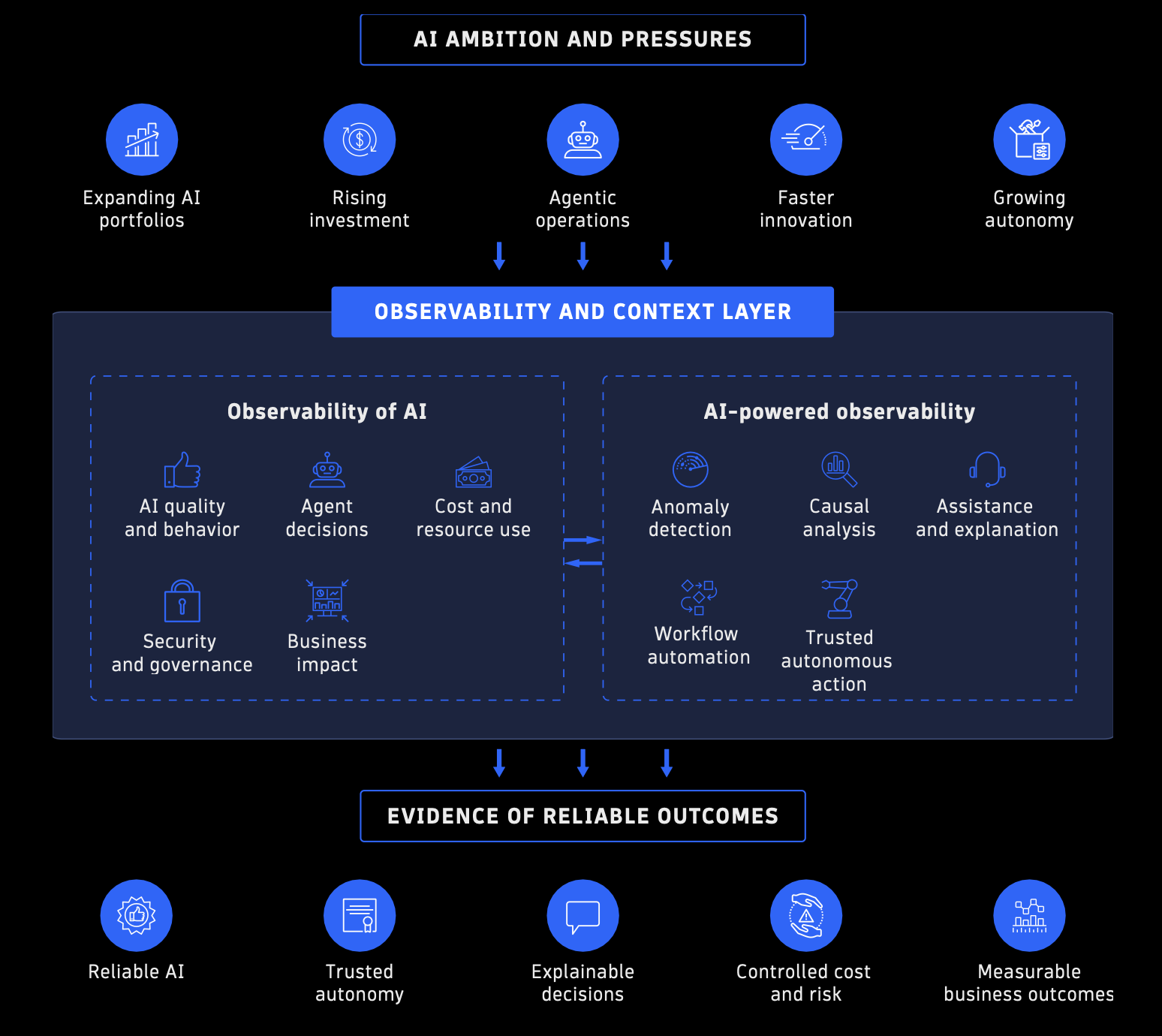
AI is fast becoming the most mission-critical software many organizations operate. But ambition is moving ahead of operational proof: organizations must demonstrate that AI behaves as intended and delivers reliable, secure, governed, cost-effective results. Observability must evolve accordingly, providing the comprehensive visibility, context, intelligence, and control required to operate AI confidently at enterprise scale.
Observability must establish the evidence AI ambition requires
Observability should connect signals across the technology environment in real-time so organizations can understand, govern, and act on system behavior.
As AI gains traction, that mandate takes on two dimensions.
- Observability of AI: Uses continuous evaluation and operational evidence to verify AI behavior, quality, security, cost, and business impact.
- AI-powered observability: Uses causal analysis, assistance, automation, and agents to improve operations and advance autonomy.
Together, these capabilities provide the operational proof required to run AI more reliably at scale.
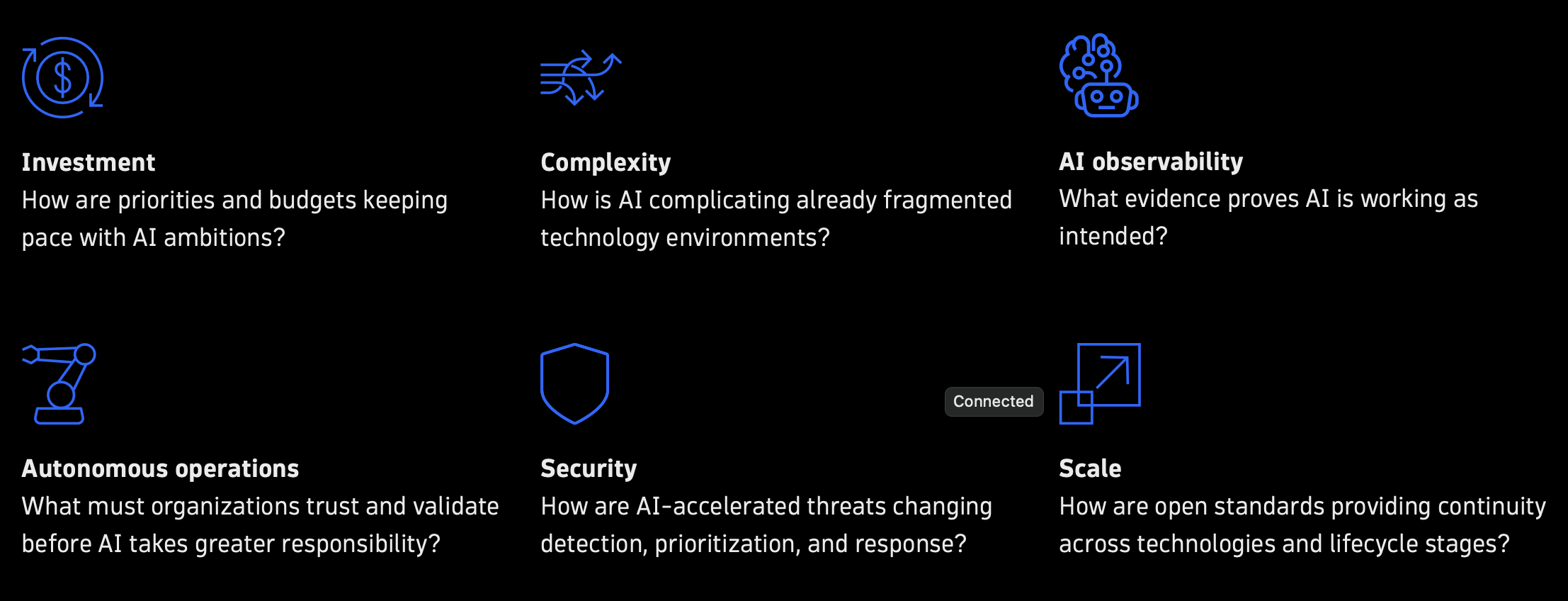
Based on an August 2026 survey of 1,202 technology leaders at enterprise companies across 12 countries, the research explores what stands between AI ambition and operational proof:
METHODOLOGY
Survey conducted: August 10 – August 24, 2026 Total respondents: 1,202
Countries: United States, Brazil, Mexico, United Kingdom, Germany, France, Italy, UAE, Saudi Arabia, India, Japan, Australia
Qualifying criteria: C-suite (CIO, COO, CTO, CISO, CAIO, etc.) high-level exec (VP, SVP, EVP, etc.), mid-level-exec (Director, Senior Director, Department head, etc.) for organizations with annual revenue of $100M or more
Responsible for: Observability and/ or AI observability, application security, resource optimization and sustainability, AI governance, software engineering, AI engineering, datadriven rules-based automation, or AIdriven autonomous operations
Question bases vary by topic: All 1,202 respondents completed the core survey, while specialized questions on autonomous operations, security, and OpenTelemetry were presented only to respondents who met relevant screening or routing criteria.
Research partner: Qualtrics with partner Y2 Analytics
Margin of error: ±2.8 with 95% confidence
AI is resetting the observability agenda
AI is now embedded across enterprise technology, resetting what organizations expect from observability.
Priorities and buying criteria are shifting, budgets are rising, and ambitions are advancing toward autonomous operations. Observability now has a broader mandate: support growing AI adoption while demonstrating the reliability and business outcomes organizations depend on.

Proof points

Agentic and generative AI are embedded across enterprise technology
Respondents report near universal AI adoption, spanning data management, cloud operations, security, observability, and other functions.

Most organizations are building AI portfolios on existing models, APIs, and development capabilities, and agent deployments rather than starting from scratch.

And these AI portfolios are expanding: 49% now report running 6–25 projects, up from 42% a year ago.

AI workloads and agentic operations are reshaping observability priorities and buying criteria
Organizations report that observability priorities now span conventional infrastructure, application security, multi-cloud environments, and generative AI.
Next-year investment is distributed evenly across those leading use cases at 40%, suggesting AI is expanding the observability mandate rather than displacing established priorities.

AI also leads solution criteria: 57% prioritize AI-powered capabilities and 49% AI observability, followed by security vulnerability management (44%). Observability priorities increasingly reflect the need to understand and manage conventional and AI workloads together.

AI adoption is driving the next wave of observability investment
AI adoption is expanding the observability mandate and reshaping the investment required to support it.
Nearly half of organizations (46%) spend $1 million or more annually on observability. Investment is set to rise further: 78% expect their observability budgets to increase next year, and among them, 96% say AI adoption is at least a moderate driver of that increase.

Organizations report broad business value from observability, led by operational outcomes
Organizations report improvements from observability across every business outcome measured, with each cited by at least 42% of organizations.
Faster issue detection and resolution and improved reliability rise to the top. The breadth of reported outcomes demonstrates the reach of observability beyond IT operations, and reinforces its core value: keeping complex systems reliable and problems from becoming business disruptions.

Supervised autonomy leads today, but full autonomy leads five-year ambitions
Thirty-eight percent of organizations report reaching supervised autonomy, where AI executes within human-defined guardrails, compared with 12% at fully autonomous operations, where agents can act, investigate, predict, and optimize on their own or on human approval. Another 24% operate predictively and 22% use AI-powered observability, while just 4% remain primarily reactive.
Yet 44% aim for fully autonomous operations within five years. The finding reflects organizational ambition, not which workloads respondents consider appropriate for full autonomy. This ambition rises with organizational scale: half of organizations with annual revenues of $10 billion or more target full autonomy, compared with 29% of those with revenues of $100–499 million.

Build observability around business outcomes
As AI adoption grows, observability should connect technology and AI performance with evidence of business outcomes leaders need their investments to deliver.
- Measure what AI changes. Connect technology performance to revenue, customer experience, reliability, and operational resilience.
- Invest in shared context. Connect AI behavior, applications, infrastructure, security, and business data to move from “it’s up,” to “it’s working,” to “it’s worth it.”
- Manage AI economics. Balance performance, resource costs, and sustainability as usage expands.
- Build for autonomy selectively. Increase AI decision authority on appropriate workloads as the system demonstrates reliability, explainability, and adherence to governance.
AI adoption is resetting what organizations expect from observability. But turning those ambitions into reliable results means confronting the complexity AI compounds across already fragmented environments.
Generative and agentic AI compound complexity and dominate visibility gaps
AI is adding new complexity to technology environments already stretched across multiple clouds and modern application architectures.
It’s also increasing skills requirements, creating visibility gaps, and driving resource costs higher. Organizations now face a dual challenge: managing AI-driven complexity while gaining the visibility and expertise needed to control its operational and business impact.

Proof points

AI is compounding complexity across the operating environment
AI, LLM, and agentic workload expansion now leads reported sources of technology complexity, ahead of multi-cloud environments and security threats.
The pattern suggests AI is adding to the complexity, cloud, and security pressures organizations are already managing.
The effects are felt across operations. Nearly half say AI workloads have increased the complexity of their technology environment and the skills required to manage observability, while 45% cite unpredictable AI behavior.
The findings point to a dual challenge: AI is making technology environments more complex while increasing the expertise required to understand and manage them.

AI initiatives add to an already fragmented technology estate
Organizations already operate across highly distributed environments: 62% use three or more cloud providers, while 56% use six or more observability tools.
AI workloads have a narrower footprint, with 37% using three or more cloud providers and 24% using six or more observability tools. As AI adoption expands, organizations must integrate these workloads into an already fragmented cloud and observability landscape.

Rapid technology changes are testing observability readiness
Keeping pace with technology change emerges as the leading reported observability challenge, but the pressures span integration, multi-cloud visibility, and skills.
Together, they show that observability readiness depends on both the technology estate and the teams responsible for it.

Visibility gaps are dominated by AI workloads
That growing complexity is showing up as blind spots. Only 6% report no significant visibility gaps, and AI-related areas dominate the top five deficits.
All AI-related visibility gaps rank above 40%, clustered tightly between 41% and 45%. By comparison, non-AI-specific gaps rank at 36% or below, pointing to AI infrastructure, agents, interactions, and costs as the new center of visibility challenges, making their behavior harder to verify across systems.

The data challenge is broader than volume
Organizations report challenges with data ingest and management issues that span cost, integration, instrumentation, quality, correlation, and governance.
To establish the evidence required to verify AI behavior and manage risk, data ingest and management must be consistent, connected, governed, and reliable across the environment.
Observability decision-makers put greater emphasis on governing sensitive data
33% of decision-makers cite governing sensitive data within observability pipelines as a challenge, compared with 19% of purchase influencers.

AI workloads are driving resource costs up without the visibility to manage them
Complexity is also raising resource demands.
AI workloads represent increased compute and infrastructure spending for 81% of organizations, energy costs for 78%, and the need for cost-allocation visibility for 77%. How organizations see these costs varies by deployment model, from token-based consumption charges for managed AI services to infrastructure utilization for AI workloads.

Managing AI and LLM resource demands now leads sustainability priorities at 49%. Yet visibility remains the obstacle: 39% lack insight into energy consumption and emissions, while 39% can’t attribute them to specific workloads. Organizations can’t optimize AI resource consumption they can’t measure and attribute.


Use observability to simplify AI complexity
As AI compounds technology complexity, observability should reduce fragmentation and provide the shared context needed to understand and manage reliability, cost, and risk.
- Work from one shared picture. Connect cloud, applications, AI, security, and business services so context doesn’t have to be rebuilt for every question.
- Use AI to accelerate action. Summarize findings, explain context in plain language, and orchestrate multi-step remediation.
- Connect signals to consequences. Link telemetry with dependencies, ownership, resource consumption, and business impact.
- Govern data consistently. Standardize telemetry, access, quality, and sensitive data controls.
More data and tools won’t solve AI-driven complexity. Closing the visibility gaps requires AI observability that can show how AI actually behaves in production.
AI observability needs are outpacing execution
An AI system can be up and responding but still be wrong. That changes what organizations need from observability: visibility into AI quality, behavior, governance, and business impact.
Organizations recognize these requirements, but heavy reliance on provider-led approaches, fragmented visibility, and skills gaps make it harder to achieve unified AI observability across the enterprise.

Proof points

Provider-native tools lead AI observability today
Nearly all respondents use some sort of AI observability tool.
AI provider tools and platforms dominate: 66% use observability tools built into AI provider platforms and 57% use features built into LLM-provider monitoring.
These tools report token counts, latency, and API errors, but leave it to organizations to figure out how to connect AI behavior and quality across providers and the broader technology environment.
Instrumentation follows the same provider-led pattern, while open and observability-platform approaches are less prevalent. That fragmentation can make end-to-end evidence harder to establish across providers and enterprise systems.
C-suite leaders report greater use of AI-provider observability tools
71% of C-suite leaders use observability tools built into their AI provider platforms, compared with 61% of high-level executives and 63% of mid-level executives.

Organizations are not yet meeting their own AI observability requirements
AI changes what organizations need observability to verify.
Real-time output quality and accuracy leads requirements at 50%, followed by detecting attacks or misuse (49%) and model drift (47%). Across all nine requirements, an average 14-point gap separates importance from current execution.
The gaps are especially pronounced around agent behavior and business impact: 43% prioritize understanding how AI agents reach decisions and actions but only 27% currently address it, while only 24% currently measure business impact compared to 39% who consider it important.

Organizations are prioritizing visibility into AI behavior, but skills and fragmentation constrain progress
Organizations report concentrating near-term attention on AI output quality, agent decisions, and broader system reliability
The leading barriers point beyond monitoring itself, particularly to skills gaps and fragmented tooling across observability data from AI and conventional workloads.
Closing that gap requires early instrumentation, continuous production evaluation, and context that connects AI behavior with infrastructure, applications, and business outcomes.

Build the AI observability foundation that keeps AI accountable
Closing AI observability gaps requires design decisions. Leaders need shared context that connects production signals with engineering, so teams can fix causes, not just symptoms.
- Instrument early. Capture prompts, model versions, agent handoffs, tool calls, tokens, and evaluation scores.
- Set multidimensional service levels. Define ranges for relevance, faithfulness, hallucination, and cost.
- Evaluate continuously. Score production traffic for quality and drift.
- Unify AI and operational data. Connect AI telemetry to application, infrastructure, and business context to trace degraded output to its cause.
- Make AI traceable. Embed access controls, data lineage, and auditability to substantiate what AI did and why.
Understanding and verifying AI behavior is only the first step. As organizations give AI greater decision authority, the challenge shifts from understanding what AI does to determining when it can safely act.
Autonomous operations are moving from ambition to scale
AI is accelerating autonomous operations.
Although 44% have set full autonomy as their five-year goal, only 12% have achieved it. Expanding AI decision authority requires evidence that its actions are reliable and governed, supported by causal intelligence, validation, and appropriate human oversight.

Proof points

AI agents are laying the foundation for autonomous operations
AI agents are already widely used to support observability and IT operations: 87% report moderate or extensive use.
Current use of AI agents to support observability and ITOps

Their importance is also evident in future technology priorities, where agent frameworks and workflows rank highest for advancing autonomous operations.

Organizations report broad AI value across the operational lifecycle
AI’s reported contribution to autonomous operations is broad rather than concentrated in one benefit.
All nine measured impacts fall within a 12-point range, spanning predictive detection, delivery, root-cause analysis, security, optimization, toil reduction, and compliance. Only 1% report no meaningful impact.
Broad AI value by itself doesn’t establish readiness for greater autonomy. As AI influences more of the operational lifecycle, observability must provide context for its decisions and consequences, giving teams the evidence they need to determine where greater AI decision authority is warranted.

Agentic AI is expanding from individual tasks to broader workflows
Organizations report current agentic AI use spans development, security, incident response, and customer-facing operations.
Their future plans broaden that scope further: cross-team orchestration shows the largest expected increase, followed by Kubernetes stabilization and automated SLO monitoring.

Organizations use layered safeguards to govern autonomous action
Organizations report using nearly four methods on average to validate AI outputs in production.
These methods include source-data verification, continuous evaluation, auditability, human review, and automated drift monitoring.

Security, privacy, and data quality lead concerns about using AI for autonomous operations, reinforcing why organizations are retaining substantial oversight as AI assumes greater decision authority.

Broader AI concerns become barriers as autonomy expands
The concerns organizations have about AI reappear as practical constraints on autonomous operations. Integration complexity leads at 31%.
No single issue dominates, reinforcing that greater autonomy depends on technical integration, expertise, verifiable AI decisions, quality data, and appropriate oversight advancing together.

Build the guardrails for expanding autonomous operations
Scaling autonomous operations requires a shift from passive monitoring to intelligent decision making and remediation. Leaders need trusted data, operational context, governance, and evidence that AI actions are reliable.
- Design for integration. Standardize interfaces and context across legacy, cloud, and AI environments.
- Make trusted data foundational. Govern quality, relevance, and context before AI acts.
- Equip teams to oversee AI action. Give operators shared context to validate decisions and manage exceptions.
- Expand autonomy progressively. Increase AI decision authority as reliability, explainability, and governance are demonstrated.
Greater autonomy increases the speed and consequence of machine-driven decisions. AI-accelerated security threats raise the pressure further, making runtime evidence essential to identifying and managing risk.
Runtime context is reshaping protection against AI-accelerated security threats
The window between vulnerability disclosure and weaponized exploitation has collapsed from months to hours, or even before public disclosure.
That compression raises the stakes for detecting and prioritizing known and unknown vulnerabilities. Despite maturing security practices, zero-day exposure persists, driving the need for continuous monitoring, runtime evidence of actual risk, AI-aware threat detection, and closer convergence between security and observability.

Proof points

Zero-day incidents challenge organizations despite advancing security maturity
Two-thirds of respondents responsible for application security describe their organization’s security posture as runtimeconnected or fully integrated.
Yet regardless of maturity, 55% experienced a zero-day incident in the past year, including 20% that reported significant operational or business impact. Another 14% cannot confirm whether they experienced one. Reported security maturity has not eliminated exposure to vulnerabilities exploited before organizations can remediate them.

Detection is moving toward real-time, but prioritizing threats remains the challenge
Respondents report a growing emphasis on methods that incorporate real-time detection of known and unknown threats in production.
And while vulnerability remediation closely tracks organizational service level agreements—28% remediate critical vulnerabilities within 24 hours—faster detection doesn’t resolve the harder question of prioritization: which vulnerabilities present actual risk in the runtime environment?

Runtime context is becoming the new prioritization standard
Nearly half of security respondents (45%) say their organizations continuously monitor runtime environments to identify vulnerabilities that are actually exploitable or actively targeted, while another 22% verify exploitability on demand.
Runtime evidence shifts vulnerability management from theoretical threats to prioritizing actual immediate risk.

AI is reshaping both the attack surface and security response
Organizations report preparing for future exploits with greater AI-aware monitoring and AI-powered detection.
Yet vulnerability-management barriers remain rooted in expertise, organizational silos, and limited visibility into AI workloads.

AI is strengthening the case for converging security and observability
Eighty-two percent describe their technical approach to security and observability as converged, either significantly (with some separation—49%) or fully (shared platforms, data, and workflows—33%).

The strongest reported motivations for this convergence center on detecting AI misuse faster, accelerating incident response, and prioritizing according to business impact.
The leading reported barrier to greater convergence is organizational rather than technical, led by organizational silos, skills gaps, and budget constraints.

Runtime context turns security signals into remediation priorities
AI-accelerated threats require security strategies that test resilience early, continuously evaluate production behavior, and prioritize the risks that matter most.
- Test before production. Use AI debugging and red-teaming to expose weaknesses early.
- Prioritize actual exposure. Focus remediation on runtime exploitability, reachability, and business impact.
- Maintain continuous runtime context. Detect changing behavior and risk beyond pre-production testing.
- Converge security and observability. Give teams shared context to detect, understand, and respond faster.
Runtime context depends on telemetry that moves across technologies and teams. Open standards provide the interoperable foundation needed to extend that intelligence as AI scales across the business.
Open standards create the foundation for AI at scale
AI workloads need evidence and context that can move across technologies, teams, and lifecycle stages.
The Cloud Native Computing Foundation has recognized OpenTelemetry as a production-ready standard for vendor-neutral telemetry, enabling organizations to change analysis tools without reinstrumenting applications. As AI scales, that open foundation can provide continuity from telemetry collection through AI development, evaluation, and production observability.1

Proof points

Most organizations use OpenTelemetry, but strategic standardization lags
More than three-quarters say they’ve moved OpenTelemetry beyond evaluation, but only 20% have made it a strategic standard, indicating that most organizations are still progressing from implementation toward an organization-wide standard.

Open standards are becoming foundational to AI observability
Respondents cite several reasons for adopting OpenTelemetry: standardizing telemetry, supporting AI observability, correlating security events, and avoiding vendor lock-in.
Together, these priorities point toward establishing an interoperable telemetry foundation that can span increasingly diverse cloud, AI, security, and observability environments.

OpenTelemetry is extending deeper into the AI lifecycle
Among OpenTelemetry respondents, most now incorporate it into their AI observability strategy, but its strategic role varies from core pillar to secondary or selective use.
The opportunity is to extend open instrumentation beyond conventional telemetry into AI-specific behavior, maintaining continuity as AI moves from development and evaluation into production.

OpenTelemetry adopters report meaningful value, but scale introduces friction
Eighty-eight percent of adopters report high or moderate value from OpenTelemetry.
But friction emerges as implementations expand: respondents cite skills gaps, telemetry costs, and engineering effort as top barriers to scaling.
Greater OpenTelemetry maturity depends not only on generating telemetry using open instrumentation standards, but on managing it efficiently and turning it into actionable context.

Build open standards into the AI lifecycle
Open standards create flexibility, but reliable AI at scale requires consistent telemetry management, intelligent lifecycle control, and context across AI and production environments.
- Standardize at the source. Apply consistent telemetry and policies across cloud, conventional, and AI environments.
- Control and streamline telemetry before ingest. Automate configuration, filtering, enrichment, routing, and ongoing optimization to control cost and improve signal quality.
- Connect AI across its lifecycle. Link development and evaluation with production behavior and context.
- Invest for comprehensive intelligence. Pair open instrumentation with a flexible backend that connects technology signals to operational and business outcomes.
Open standards provide the foundation, but telemetry alone can’t prove that AI is working as intended. End-to-end observability turns that foundation into the intelligence required to operate AI reliably and deliver better business outcomes.
Reliable AI requires more from observability
AI is expanding what enterprises can automate, optimize, and achieve. But as organizations depend more on AI to deliver consequential outcomes, they need to demonstrate that it behaves as intended. Observability must evolve in response, connecting AI behavior with operational and business context so organizations can scale AI with greater reliability, control, and confidence.

Together, these capabilities help organizations understand AI behavior, verify results, govern action, and connect AI performance to the outcomes the business expects.
Observations and outlooks

Trust enables autonomy to scale
“Most organizations have already introduced AI into their operations. The challenge now is building the trust framework that allows AI to take on greater responsibility over time.
Observability provides the context, governance establishes accountability, and workflows turn intelligence into action. Together, they create the foundation for trusted autonomous operations at scale.”
— Adrian Phillips, Senior Director Marketing, Technology Workflows, ServiceNow
Building trust in AI-driven decisions requires a framework that combines operational context, governance, and workflow orchestration. AI agents can only act reliably when they understand the systems and services around them, operate within clear guardrails, and produce transparent, accountable outcomes.
Observability must provide operational context and a real-time understanding of system behavior, dependencies, business impact, and risk. Connected to workflows and governance, real-time observability is a crucial component to scaling autonomy with trust.

Governance must be designed in
“As models and agents move into production, organizations need visibility into how these systems actually behave, alongside strong identity, policy, security, and evaluation controls.
Open, interoperable observability helps connect runtime behavior with those controls, giving enterprises better evidence to operate, evaluate, and improve AI systems responsibly at scale.”
— Uli Homman, CVP, Distinguished Architect, Cloud + AI, Microsoft
AI governance cannot be retrofitted. When organizations move models and agents into business-critical operations, governance must evolve in parallel. Observability provides evidence of what actually happened across models, agents, tools, applications, infrastructure, and business processes.
Open, interoperable approaches connect runtime signals with security, policy, evaluation, and business context across the technology estate, while runtime enforcement helps ensure policies are applied when actions occur. Governance then becomes a continuous operational capability that helps organizations scale AI responsibly with greater confidence.

Open standards provide continuity
“As AI expands across hybrid and multi-cloud environments, open standards and open platforms become essential for maintaining visibility and control.
By standardizing telemetry on an open foundation, organizations can reduce fragmentation, strengthen governance, retain control of telemetry data, and evolve AI architectures without sacrificing observability or creating dependency on a single vendor ecosystem.”
— Joe Fernandes, Vice President and General Manager, AI Business Unit, Red Hat
Vendor lock-in and tool fragmentation are no longer just efficiency headaches. In the AI era, they’re governance and visibility risks. As enterprises scale AI across hybrid and multi-cloud environments, critical new blind spots emerge.
You cannot govern, secure, or optimize what you cannot see. Open standards such as OpenTelemetry and open platforms allow telemetry, context, and governance to move consistently across hybrid architectures. These standards give IT leaders greater control over their telemetry data, more consistent governance, and the flexibility to evolve their AI strategies without tying visibility to a particular platform or environment.

Operating models must evolve
“As AI dissolves the boundary between building and running systems, enterprises need an operating model that helps navigate that convergence. We see real-time runtime context as foundational: understanding how agents behave, what they depend on, and how their actions affect outcomes.
Combined with mature delivery pipelines and strong governance, that visibility gives organizations the confidence to extend greater decision-making authority to AI.”
— Scott Wintermute, Global Observability Lead, Managing Director — Master Technology
Architect, Accenture
AI is not only accelerating operations, it is dissolving the boundary between building systems and running them. The same agents that write and deploy code increasingly create the autonomation that operates it. Operating models that treat build and run as separate disciplines will create gaps in ownership, context, and control as those boundaries disappear.
From an enterprise transformation perspective, autonomous operations require real-time awareness of how AI behaves in production: what agents do, their dependencies, and their impact on performance, quality, cost, and business outcomes. This runtime context enables better decisions as build and run automation converge

Choosing the right role for AI
“The next phase of enterprise AI is not about deploying more agents, but scaling autonomy where it creates value.
Observability provides the evidence to guide that transition, validate business outcomes, and evolve the controls and operating model required for confident, AI-driven enterprise transformation.”
— Alvaro Martin, Observability Strategy Lead, Technology & Transformation, Deloitte
As organizations modernize their operating models, progress should not be measured by the number of models, agents or automated processes deployed, but by whether AI is improving outcomes, operating within appropriate boundaries and creating sufficient value to justify greater autonomy.
Modernizing operations requires choosing the right role for AI, automation, human expertise, and deterministic methods. Observability provides the evidence to determine where autonomy should scale, where other approaches are more appropriate, and whether those choices are delivering the intended outcomes.

AI economics must be measurable
“The challenge isn’t simply scaling AI. It’s scaling AI efficiently. As organizations expand AI workloads, they need visibility into the relationship between performance, infrastructure consumption, and cost.
We aim to support our customers to treat observability, cloud economics, and resource optimization as a single operational discipline rather than separate initiatives.”
— Mona Chadha, Director, Worldwide Infrastructure Partners, AWS
We are seeing organizations rapidly scaling AI from experimentation into production, but many are discovering that infrastructure costs rise faster than anticipated.
Organizations cannot optimize AI investments they cannot accurately measure or attribute. As AI adoption grows, leaders must understand not only whether AI systems deliver accurate outcomes, but also what those outcomes cost to produce. Cost allocation, workload attribution, capacity planning, and infrastructure efficiency should be treated as foundational architectural requirements rather than post-deployment exercises.
Firmographics and demographics


Regional signals
The research reveals broad consistency in observability priorities and maturity across regions, alongside several meaningful differences in the complexity organizations experience and the outcomes they derive from observability and AI.
Skills gaps and faster problem resolution
US (100), Brazil (100), Mexico (100)
- Organizations in the Americas are more likely to report that AI presents the need for greater skills to manage observability. More than half of respondents in the Americas cite this challenge at 56%, compared with 43% in EMEA and 46% in APAC.
- Organizations in the Americas also report greater growth in the number of monitoring tools required, at 45%, versus 35% in EMEA and 42% in APAC.
- That pressure accompanies strong reported operational outcomes. Faster issue detection and resolution is the leading observability-enabled business outcome in the Americas, cited by 60%, compared with 53% in APAC and 48% in EMEA.
- Automated root-cause analysis and faster issue resolution also lead the ways AI has advanced autonomous operations in the Americas, at 39%.
Less pressure from security threats
United Kingdom, Germany, France, Italy, UAE, Saudi Arabia
- EMEA organizations are less likely to identify the growing frequency and sophistication of security threats as a source of increased technology complexity. Only 29% of EMEA respondents cite this factor, compared with 39% in the Americas and 43% in APAC.
- EMEA also reports fewer challenges related to the complexity and resource demands of managing observability instrumentation at scale. This challenge is cited by 29% in EMEA, compared with 36% in AMER and 38% in APAC.
- For autonomous operations, predictive detection before user or system impact is the leading reported AI contribution in EMEA, at 39%.
- Of the 741 global respondents responsible for application security, 33% in EMEA set more aggressive 24-hour remediation targets than other regions (29% in the Americas and 20% in APAC). But 37% in the Americas report actually meeting the sub-24-hour remediation window versus 28% in EMEA and 22% in APAC.
AI-driven complexity and security impact
India, Japan, Australia
- APAC respondents are more likely to identify expanding AI, LLM, and agentic workloads as a source of technology complexity. 47% cite AI expansion, compared with 41% in both the Americas and EMEA.
- APAC respondents are also more likely to cite the growing frequency and sophistication of security threats, at 43%, versus 39% in the Americas and 29% in EMEA.
- The region reports similar patterns when asked how AI affects operational complexity. Fifty-six percent say AI has increased the complexity of the technology environment, compared with 47% in the Americas and 46% in EMEA.
- More than half of APAC respondents (52%) cite increasingly unpredictable AI application and model behavior, compared with 43% in each of the other regions.
- APAC respondents also report distinctive outcomes. Improved reliability and uptime of business-critical systems leads observability-enabled business outcomes at 58%, compared with 51% in the Americas and 48% in EMEA. Comprehensive security vulnerability detection and remediation is the region’s leading AI contribution to autonomous operations, at 37%.
The influence of company size
Company size differentiates investment and ambition much more than it differentiates the underlying complexity and data-management problems organizations face.

Industry-specific priorities
Industry differences emerge most clearly in how organizations apply and invest in observability, the complexity of their technology environments, and their progress toward operationalizing AI.
APM investment and AI execution
- 36% plan to prioritize APM over the next year, compared with 26% of respondents in other industries. Software respondents are less likely to prioritize log management and analysis, at 22% versus 32% elsewhere. (n=269)
- 35% currently address end-to-end understanding of AI agent decisions and actions, compared with 25% of respondents in other industries. 35% also address AI-related cost management, versus 25% elsewhere. (n=266)
- 32% cite difficulty explaining or auditing AI-driven decisions as a barrier to autonomous operations, compared with 20% of respondents in other industries. (n=212)
Autonomous operations and observability maturity
- 31% use at least four cloud providers across their technology environment, compared with 17% of respondents in other industries. For AI workloads specifically, 21% use at least four providers, versus 11% elsewhere. (n=175)
- 21% say their organizations have reached fully autonomous operations, compared with 11% of respondents in other industries. (n=175)
Narrower multi-cloud footprints
11% use at least four cloud providers, compared with 20% of respondents in other industries. (n=188)
Business context
59% use observability to track business processes and KPIs, compared with 40% of respondents in other industries. (n=87)
Multi-cloud and hyperscaler optimization
- 63% plan to prioritize multi-cloud and hyperscaler optimization over the next year, compared with 38% of respondents in other industries. (n=56)
Turn AI ambition into reliable outcomes
Dynatrace and Arize, now part of Dynatrace, help organizations know what their AI is doing, what it costs, and whether it’s accurate, from evaluation to business outcome.
Explore Dynatrace AI Observability
See how AI observability connects applications, LLMs, agents, and the supporting technology stack with the context needed to understand behavior, quality, reliability, cost, and impact.
- Go from insight to reliable action with Dynatrace Intelligence, an agentic operations system that fuses deterministic insight with agentic action. Explore Dynatrace Intelligence.
- Learn what your agents are actually doing using Arize, the agent observability and evaluation platform. Explore Arize.
- Explore the Dynatrace platform | Start a free trial
Dynatrace named a Leader in the 2026 Gartner® Magic Quadrant™ for Observability Platforms
Read the complimentary report to see why Gartner positioned us highest for Ability to Execute in the latest Magic Quadrant.
This graphic was published by Gartner, Inc. as part of a larger research document and should be evaluated in the context of the entire document. The Gartner document is available upon request from Dynatrace. Dynatrace was recognized as Compuware from 2010-2014.

Trusted by thousands of top global brands



Try it free
