

Executives are looking for successful ways to run their digital ecosystems with AI as cloud and AI adoption reach unprecedented complexity. Organizations are increasingly recognizing that agentic AI on its own can’t deliver the consistent, trustworthy outcomes they expect. With 65% of enterprises investing in AI‑driven monitoring and automation, leaders now need trustworthy AI‑powered observability to shift from human‑driven operations to human‑supervised, autonomous digital ecosystems.
Key executive insights
- Alongside the rapid adoption of agentic AI, Dynatrace is uniquely architected for powering real‑time autonomous operations across organizations’ digital systems while also integrating seamlessly into broader agentic ecosystems.
- Dynatrace – pioneer of large-scale AI-powered root cause analysis – established predictive operations and now further redefines observability, taking the next step from automation to autonomous action by auto-remediating, auto-preventing and auto-optimizing.
- Dynatrace takes the guesswork out of AI by optimizing the balance between deterministic AI, contextual analytics, and stochastic AI to drive precise agentic answers and reliable actions.
- Dynatrace Intelligence is an agentic operations system in the Dynatrace platform, driving autonomous actions through orchestrating ready-made Dynatrace agents as well as external ecosystem agents.
- AI engineering, AI operations, agentic SRE get enabled by Dynatrace with real-time production feedback-loops from trusted AI.
Minimizing hallucinations and avoiding large language model data processing limits
One of the biggest fears of executives who build agentic frameworks is that generative AI can hallucinate and push their agents off course. CTOs also prioritize ensuring agentic systems have instant access to high‑quality information, so multi‑step agent workflows can execute quickly and reliably.
Hallucinations aren’t minor errors – they can trigger wrong actions leading to outages, security risks, and financial exposure. To make it worse, in agentic processing inaccuracies can accumulate and amplify.
The Dynatrace AI approach reduces the risk of hallucinations by maximizing the use of deterministic AI in its agents, allowing Dynatrace to deliver responses based on real-time data rather than probabilistic guesses. Also, Dynatrace continuously observes, maintains, and enriches this context through real-time dependency graphs, real-world context, and high-performance data lakehouse analytics—fueling precise analytics and real-time answers across the entire digital services and business landscape.
This level of contextual precision is critical because large language models cannot directly process petabytes of heterogeneous observability data. Their context windows are limited, and performance often degrades as input approaches the maximum length.
Dumping large amounts of data into AI requests can reduce quality. Models have finite context windows and can underweight important details in very long prompts. Curating and structuring only the most relevant information generally yield better results than providing everything at once.
To overcome these constraints, it’s essential to rapidly distill vast amounts of data into short, high-quality context—this is where contextual analytics, dependency graphs, and the AI-optimized data lakehouse Grail become critical differentiators.
Real-time analytics with instant visualization of dependencies and interactions
Agentic AI depends not only on the model it runs on but on the quality, context, and immediacy of the data it receives—real‑time, fact‑based inputs are essential to keep pace with agentic decision‑making.
Grail, the Dynatrace data lakehouse, provides this foundation by unifying observability, security, and business data at an exabyte scale. Its schema‑on‑read approach removes indexing overhead and enables any‑question, any‑time analytics of Grail data. Grail processes metrics, logs, traces, user behavior, security events, and business signals alongside directed dependency graphs, delivering deep insights instantly through zero‑latency, always-hydrated storage.
Complementing this, Dynatrace Smartscape continuously refines a real-time dependency graph of real-world dependencies across business, teams, digital services, processes, infrastructure, risks, and more. By dynamically uncovering both vertical and horizontal dependencies, Smartscape enables teams to understand how systems, business processes, and organizational structures interact. The latest generation of Smartscape real-time dependency graph can now also be augmented with custom entities, such as business data types, ownership information, and other meta-data and ownership details, so teams immediately know who to notify for fast, fact-based remediation.
Together, Grail and Smartscape provide the technical foundation for Dynatrace Intelligence to let agentic AI act on facts, not guesses, ensuring that AI-powered decisions are accurate, scalable, and actionable, a pre-requisite for reliable autonomous operations.
Dynatrace Intelligence
Dynatrace Intelligence is an agentic operations system at the core of the Dynatrace platform that fuses deterministic AI with agentic AI to drive a new level of reliability across observability and autonomous operations. It provides a unified intelligence layer where humans define the goals, and AI executes them with precision—guided by policies, context, and guardrails.
At the foundation are deterministic agents that create a highly reliable operational core. The Root Cause Agent, powered by deterministic causal AI, delivers answers with far greater speed and precision than LLM‑only approaches. The Analytics Agent distills petabytes of Grail data lakehouse data into concise, contextual intelligence, while the Forecasting Agent scales predictive capabilities across the environment. An Operator Agent oversees, orchestrates, and coordinates agentic team efforts to ensure optimal outcomes. These foundational agents power every other agent operating on the platform.
Building on this foundation are ready‑made, domain‑specific agents designed to extend and augment the work of Development, SRE, and Security teams. This fusion of deterministic AI, agentic AI, and specialized domain agents enables Dynatrace Intelligence to detect anomalies, predict issues, identify root causes, run complementary investigations, and plan and execute corrective actions—ultimately enabling auto‑prevention, auto‑remediation, and auto‑optimization.
Dynatrace already observes customers’ digital services, end‑user experiences, and AI stacks automatically, making these domain agents immediately impactful. As examples, for developers, Dynatrace detects rising mobile‑app crashes, analyzes the code paths, and produces an immediate fix suggestion—turning what used to take hours into seconds. For security teams, Dynatrace continuously monitors emerging threats and instantly checks the environment for related vulnerabilities or indicators of compromise, helping teams respond proactively before attackers can act.
New Assist Agents simplify the adoption and everyday use of Dynatrace, while Agentic Workflows empower customers to build their own agents.
Dynatrace Intelligence is here not only to remediate symptoms—like a production infrastructure overload—but also to detect the underlying root cause and generate actionable plans to fix the source of the issue.
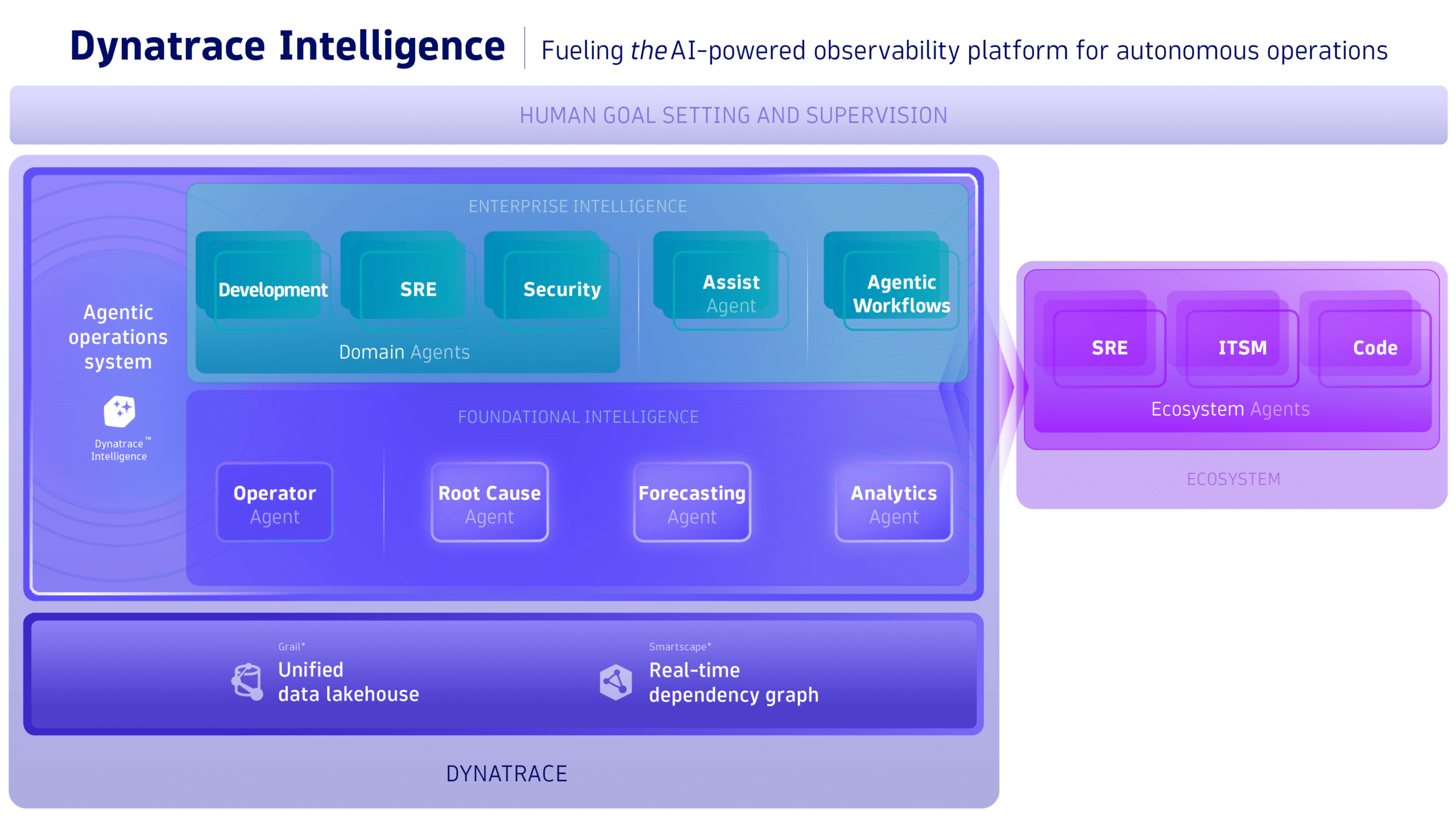
AI-powered observability from Dynatrace enables the next generation software delivery life cycle process with AI engineering, AI operations, agentic SRE, and AI business analytics, through real-time facts from production systems.
Already today, Dynatrace Intelligence agents collectively power a wide range of real‑world use cases, from mobile app crash inspection and front‑end error explanation to infrastructure optimization, Kubernetes operations, and security‑context insights. They also accelerate tasks like anomaly and log‑pattern analysis, vulnerability validation, timeseries analysis, and even dashboard creation, with extensible workflows that let teams expand these capabilities as their needs grow.
Dynatrace Intelligence also coordinates a bi-directional interaction with the agentic ecosystem like AWS Kiro, GitHub Copilot, ServiceNow, Azure SRE agent, Atlassian Rovo and many others – e.g. submitting tickets, invoking a coding agent, assessing the risk of a new deployment, adjusting infrastructure, informing business workflows. It also responds when other systems request, for example, incident details, performance insights, business impact analysis, or resilience risk assessments.
Along with Dynatrace Intelligence, Dynatrace leads customers on a journey toward fully autonomous operations.
Journey to fully autonomous operations
Each organization goes through their own maturity stages and pace on the journey to autonomous operation; for the majority it can look like this:
Automated – a stage when an organization’s digital system executes pre‑defined workflows and actions automatically (based on AI‑generated answers) to support both reactive and predictive operations. I can say that currently, many organizations are striving to get to this stage or are already in it.
Digital systems must be automatable and observable. To validate this, workflows must be testable:
- Can you automate it?
- Can you observe it?
- Can you understand its behavior in real time?
Organizations don’t need to automate every single workflow. Once it’s possible to confirm that key use cases are both automatable and observable, organizations can progress to the next maturity stage.
Supervised Autonomous – in this stage, AI generates execution‑ready action plans with clear reasoning and acts only after human oversight and approval. In a “crawl‑walk‑run” approach, organizations start with small, repetitive tasks that require agentic AI instead of hard-coded workflows.
Key principles in evaluating ability for supervised autonomous operations:
- Reliability: For reliable decisions and actions, rely as much as possible on deterministic AI and analytics, and leverage generative AI for common sense and learned expertise.
- Transparency: Allow people to set goals and guardrails for AI, validate reasoning, review knowledge graphs, improve real-time feedback loops, and assess explanations to build trust.
- Feedback loop: Agentic AI relies on accurate factual inputs to create actionable plans, as well as precise real-time feedback to investigate plan details, refine them and validate execution.
Once the digital system consistently performs with human‑like review discipline, the organization is ready to move toward fully autonomous operations.
Fully Autonomous – in the future, fully autonomous stage, Dynatrace Intelligence acts independently to fulfill business goals and autonomously operates a wide range of aspects in successfully delivering software that end-users expect, requesting human input only when necessary. As much as Dynatrace uses AI to observe other AI within the cloud- and AI-native services customers run, it also continuously observes itself—to self-optimize, ensure compliance, and provide insights that help people set the goals. People still play a crucial role: they review outcomes, adjust goals, and refine instructions. As a result, organizations deliver and operate software with higher resilience, happier customers, and lower cost.
The fusion of deterministic AI and agentic AI sets Dynatrace apart by providing a reliable agentic AI-powered observability. It is an AI that observes other AI and helps organizations to build more resilient applications and better customer experiences.

Looking for answers?
Start a new discussion or ask for help in our Q&A forum.
Go to forum