

Agentic AI and autonomous operations are demanding more from observability data architectures. Agents can't infer missing context, so data must arrive pre-connected, meaningful, and real-time. The AI lakehouse is emerging as the solution to unify data and provide semantic context. But most solutions lack real-time awareness and agility.
Every executive is facing the same challenge: how to build an agentic enterprise where AI amplifies people’s capabilities, enables reliable AI agents across every team, and accelerates business outcomes.
For years, traditional data lakehouses and warehouses were designed for people: they powered dashboards, analytics, and machine learning while humans connected the dots, helping teams to understand dependencies, correlate systems and interpret results.
AI agents are changing that equation. While they can access the data from a lakehouse, they cannot reconstruct context that isn’t there. Today, enterprise data often remains fragmented across business systems, observability tools, and security platforms. Now, this is changing with AI agents needing a unified, real-time data layer that turns raw data into context, meaning, and trusted action. This is driving the emergence of a new category: the AI lakehouse.
Key executive insights
- As AI expands human roles and makes agents active users of enterprise data, precise real-time context becomes business-critical for organizations building agentic digital environments.
- Existing data lakehouses are evolving into a new category — the AI lakehouse — which combines unified data, a semantic layer grounded in an ontology, a live context graph, and trusted governance so AI agents can understand, reason, and act.
- Dynatrace AI lakehouse — Grail — empowers enterprise AI agents for trusted agentic action, while Dynatrace’s real-time observability of digital systems brings exabytes of data and context into the AI lakehouse, driving higher speed, scale and lower cost.
Why real-time context matters more than ever
As enterprises drive their AI transformation and adopt their own agentic platforms, context becomes the foundation for scaling AI from isolated assistance to business execution. Besides company knowledge bases, the most important context for those platforms is the real-time digital feedback from observability data, system behavior, security events, business transactions, and customer success signals.
When real-time data is connected with historical patterns and knowledge graphs, these inputs create the holistic operating picture agents need to gain awareness and reason toward business goals: what is happening, what changed, what is affected, and whether actions improve outcomes. That is why enterprises need new ways to collect, store, connect, and deliver operational feedback fast enough for agents to steer operations and for humans to steer the agents.
Three shifts are driving the increasing criticality of precise context and reshaping what organizations need from their data platforms.
Human roles expand
AI changes the scope of what people do, enabling them to operate beyond traditional boundaries. It elevates roles vertically, allowing individuals to focus on higher-value decisions, judgment, and outcomes—while also expanding them horizontally across domains that were previously separated by specialized expertise. Engineers can shift right toward business outcomes, customer experience, and product decisions, while business teams can shift left, directly influencing digital platforms and processes without always relying on specialized technical resources. As AI enables people and agents to make decisions across traditional team boundaries, they need the same trusted understanding of systems, customers, risks, and business impact. An AI lakehouse provides that common context, helping agents act autonomously while allowing people to verify outcomes, understand decisions, and intervene when necessary.
Agents become active users
Agents can make sense of vast amounts of data many times faster than humans. They can also write and run queries at higher complexity quickly, often uncovering deeper and more hidden insights. That raises the bar and changes the requirements for data analytics in modern software architectures: platforms must deliver precise answers from enormous data volumes, support more demanding query patterns, and keep data, semantics, and ontology connected in one context layer. Traditional datalakes and warehouses fall short because they were not designed for agents that retrieve context continuously, evaluate relationships, and act on the results. The right level of context also helps manage AI cost by reducing unnecessary retrieval, oversized prompts, excessive tool calls, and wasted tokens. Without an AI lakehouse, agents don’t have what they need to connect the dots across systems and may not realize when something is not working properly.
Enterprises increasingly operate on live signals
Enterprises increasingly operate on live signals, from customer behavior and transactions to supply chains and risk exposure, while market conditions can change in hours rather than quarters. Competitive advantage comes from asking more insightful questions, getting precise answers faster, and acting before the opportunity has passed. Enterprises need a data platform that reflects reality as it happens and enables both people and agents to respond at the speed the business demands.
Real-time context becomes the differentiator
As a result of these shifts, precise, real-time context becomes the differentiator. Collecting and connecting data is now table stakes. The real challenge is bringing all relevant data points together so people and agents can reach conclusions that no single team, tool, or individual could reach from a partial view, while ensuring those data-driven conclusions can be trusted and reproducibly verified through deterministic analytics.
What separates a successful agentic platform from a stalled AI initiative is the ability to transform raw data into the most relevant context related to the question or task at hand. This enables agents to reason across complex relationships, assess business impact faster, and act with greater accuracy and consistency.
What is an AI lakehouse?
An AI lakehouse is the context engine for the business’s agentic platforms. It’s a unified, de-siloed, real-time data layer that provides AI with context, not just data, so it can understand, decide, and act. It serves as an infinite memory for AI agents, and its purpose is to analyze enterprise-scale multimodal data within business context, at exabyte scale, and turn raw operational signals into a continuously updated world model for AI to reason from.
Five defining capabilities of an AI lakehouse:
- Data unity. All data and data types together, real-time pipelines, 1,000+ technology integrations, and AI connectors bring operational, security, experience, business, and customer data together in one live enterprise data foundation, so that all dots are connected.
- Semantic store. A graph based semantic layer encompasses topology, dependencies, causality, ownership, risk, business impact, and the underlying ontology that defines entities, relationships, and meaning as durable context for teams, workflows, and agents.
- Context engine. Always-hydrated, indexless, schema-on-read access turns exabytes of enterprise data into instant, agent-ready context for any question, workflow, or action.
- Trusted action. Fine-grained access control, lineage, encryption, masking, auditability, and compliance make automated decisions and agentic actions safe, explainable, and governed.
- AI economics. High-signal agent-optimized context can help reduce data movement, indexing overhead, brute-force retrieval, oversized context windows, excessive tool calls, and wasted AI cycles.
However, while most AI lakehouses provide context derived from existing data, dashboards, and queries, they lack context from real-time discovery and dependencies. At Dynatrace, Grail is our AI lakehouse, purpose-built to provide the trusted, real-time context that powers reliable AI agents at enterprise scale: GRaph, AI, and Lakehouse, built for a limitless scale.
Grail: Dynatrace AI lakehouse and agentic solutions
Dynatrace observability forms the foundation, capturing real-time multimodal data and context from digital systems and bridging it in the AI lakehouse, Grail. Grail is part of Dynatrace Intelligence, the agentic operations system provided by the Dynatrace platform, and becomes the middle layer of an enterprise AI stack. Grail turns identified signals into trusted context to fuel agentic solutions above, empowering enterprise AI agents.
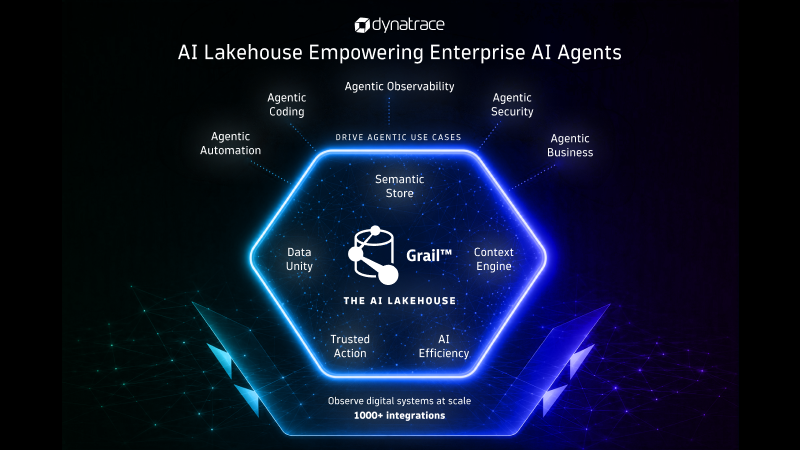
On top of the AI lakehouse sits an expanding set of agentic products and use cases, including agentic automation, agentic security, agentic business, agentic observability, agentic coding, and AI development lifecycle workflows. These solutions orchestrate agents and execute actions; the AI lakehouse provides the foundation that makes the resulting answers, actions, and outcomes cost-efficient, accurate, fast, scalable, and governed.
The Dynatrace platform delivers enterprise-ready agentic solutions through Dynatrace Intelligence, while allowing customers to run their own agentic platforms and workflows on the same trusted context from Grail.
Why the Dynatrace AI lakehouse is different
The Dynatrace AI lakehouse combines real-time data, a live business context graph, a semantic store, and exabyte-scale access to give AI agents a continuously updated view of available operational data and relationships. Rather than relying on static snapshots or predefined warehouse models, agents can reason over fresh information, understand dependencies and business impact through Smartscape, and operate confidently across the scale, complexity, and governance requirements of modern enterprises.
- Real-time context. Agents operate on a continuously updated view of the digital business – not yesterday’s batch data – allowing decisions to reflect what is happening right now.
- A live context graph. Dynatrace Smartscape maps dependencies, ownership, causality, and business impact, enabling agents to understand relationships, assess blast radius, and reason about consequences.
- Exabyte-proven scale. Enterprise AI requires reasoning across enormous volumes of data. Grail delivers the scale and efficiency needed to support agentic AI without unsustainable costs.
- Fresh, continuously evolving data. Deep observability, broad ingestion, and real-time pipelines ensure agents always work from the latest available information rather than static snapshots.
- A trusted foundation for action. Fine-grained access control, lineage, encryption, masking, auditability, and compliance ensure agents operate with the right data, under the right controls, and with clear accountability.
- Better AI economics. Grail provides high-signal context from the start, reducing brute-force retrieval, oversized context windows, unnecessary tool calls, and repeated data movement – , hence it speeds up agents and saves people’s time.
- Built for enterprise complexity. Designed for large, global organizations, Grail handles the scale, dependencies, governance requirements, and operational realities of modern enterprises—not just isolated use cases.
The executive question has changed
In the agentic era, decisions, investigations, recommendations, and actions increasingly happen through AI agents working for people.
The organizations that gain the greatest advantage will not simply have the most data; they will provide people and agents with a shared, trusted feedback loop that enables real-time awareness of how the business operates.
With the Dynatrace AI lakehouse, we are giving businesses building agentic environments the real-time context foundation along with observability they need to turn AI from assistance into trusted action.
Dynatrace, Grail, Smartscape and related marks are trademarks of the Dynatrace group of companies. All other trademarks are property of their respective owners.

Looking for answers?
Start a new discussion or ask for help in our Q&A forum.
Go to forum