

In my frequent interactions with customers implementing agentic AI, the expectations of two key audiences—executives and developers—quickly become apparent.
Executives are actively exploring how to implement agentic AI, with a strong focus on unlocking significant productivity gains. They expect AI automation to free up engineering time, fix software automatically, prevent outages, and take over the majority of 80% of non-feature tasks.
Developers are rapidly adopting AI for convenience and efficiency in their day-to-day work; it’s becoming as essential to them as internet access. For example, GitHub Copilot usage among developers rose from 17% in 2023 to 45% in 2024. They want AI to bring context and suggest precise error repairs, generate tests automatically, auto-collect information to fix vulnerabilities, and recommend optimizations based on real production insights.
The market is embracing agentic AI with growing excitement. KPMG’s AI Pulse Survey, 68% of business leaders plan to invest between $50 million and $250 million in generative and agentic AI technologies this year alone, up from 45% in 2024. Enterprises see it as a strategic priority and as an enabler for smarter automation. While the potential is real, the requirements to make the use of agentic AI robust and secure need a solid foundation.
Key insights
- Agentic AI is powerful, but only as good as its foundation. While rapidly adopting agentic AI for its promise of autonomous action, the market also realizes that it requires more than a prompt-based agent. To be both reliable and precise, agentic AI must combine the creative problem-solving capabilities of probabilistic models like large language models with the rigor and accuracy of deterministic algorithms.
- Agentic AI amplifies the value of Dynatrace AI. Thousands of organizations already benefit from Dynatrace AI capabilities: preventive operations, real-time insights, and improved productivity and reliability. Agentic AI will extend this foundation by enabling more autonomy, accelerating intelligent action and decision-making across cloud-native ecosystems.
- Autonomous intelligence shifts human responsibilities from step-by-step instructions to goal setting and supervision. As Dynatrace is evolving into autonomous intelligence, we enable auto-remediation, auto-protection and auto-optimization, based on business-relevant goals. Rather than scripting every action, humans define high-level objectives and Dynatrace determines and executes the most effective path, while explaining every step and allowing human supervision. This shift requires structured, context-rich knowledge, causal reasoning, and AI agents that operate with trust, clarity, and precision.
- Real-time, contextual data is a non-negotiable prerequisite. Agentic AI must not operate blindly only on its general-purpose model; it needs a fast memory, business-specific context, and the ability to synthesize signals across systems. Dynatrace Grail®, offers the only foundation that provides access to real-time insights from petabytes of structured and unstructured information without predefined schemas or indexing. Grail makes it possible for the user to ask any question, any time, and receive instant answers with organizations’ digital environment context in mind, revealing relationships and dependencies across the digital ecosystem as a directed graph connecting the right dots across tech and business.
- AI-driven autonomy and insights work most effectively when brought across all organization. Dynatrace enables teams (from developers and site reliability engineers to operations and business or administration) to make smarter, faster decisions at every level.
- 2026 update: The fusion of deterministic AI and agentic AI within Dynatrace Intelligence enables organizations to build and employ agentic frameworks that are not only capable but also reliable.
Context as foundation for reliable agentic AI
Imagine your car won’t start, and you ask an online car assistant for help. Most would start by asking you vague questions or suggesting generic fixes (“Try a new battery”) because they don’t understand or know the context of the problem. The next one might tell you: “Your engine is entirely broken. You need a new one.” Now, imagine instead you bring the car to an automotive expert who not only sees the reason for not starting but also instantly analyzes the entire build of your car down to the exact configuration of parts, how they interact, and even what parts were installed in what order. They don’t just know that the motor and screw exist: they know the screw holds the ignition coil to the engine block, and not the other way around.
This is how agentic AI works with Dynatrace. Agentic AI works like a team of experts who know your car inside out: every screw and why and how the vehicle was built. It’s not guessing but rather operating with architectural clarity, automatically pinpointing the root cause because it understands how everything is connected. With Davis® AI Root Cause Analysis, Dynatrace analyzes more than three million problems accurately and at scale every 24 hours, every day.
Instead of fumbling through 100,000 parts, it navigates a precise causal (say, the 50 services that actually influence the outcome) thanks to Dynatrace Smartscape. It doesn’t reach for every tool in the shed, but instead picks the right one for your specific digital system, every time.
So, similarly in IT: instead of general comments (“Your system seems slow, maybe scale your servers”), engineering teams get granular insights: “User slowdown originates from a failed API call in payment service, due to a misconfigured feature flag introduced in deployment of branch ‘calculation update in payment service’.” That’s how Dynatrace delivers context in action.
Today’s AI-powered automation in Dynatrace already shows agentic behavior
Dynatrace has long been operating at the intersection of data, intelligence, and automation. In fact, many capabilities typically associated with agentic AI, such as autonomous root cause detection, preventive operations, causal inference (which today has become causal AI), and self-healing production environments, have already been running across our platform for a decade.
Take this example: Dynatrace automatically detects a capacity issue, anticipates seasonal fluctuations, rates it by customer and business impact, and recalibrates the production environment across a customer’s hyperscaler setup, all end-to-end. It carries out full analytical and planning steps, creates reconfiguration plans, and only then notifies a human for final governance. This isn’t hypothetical: thousands of customers around the world are already leveraging our trusted causal and predictive AI in production workloads that run their businesses. And hundreds are taking the next step, adopting preventive operations by carefully adding generative AI to automatically draft remediation workflows, simulate outcomes, and enhance decision-making, shaping the future of intelligent automation.
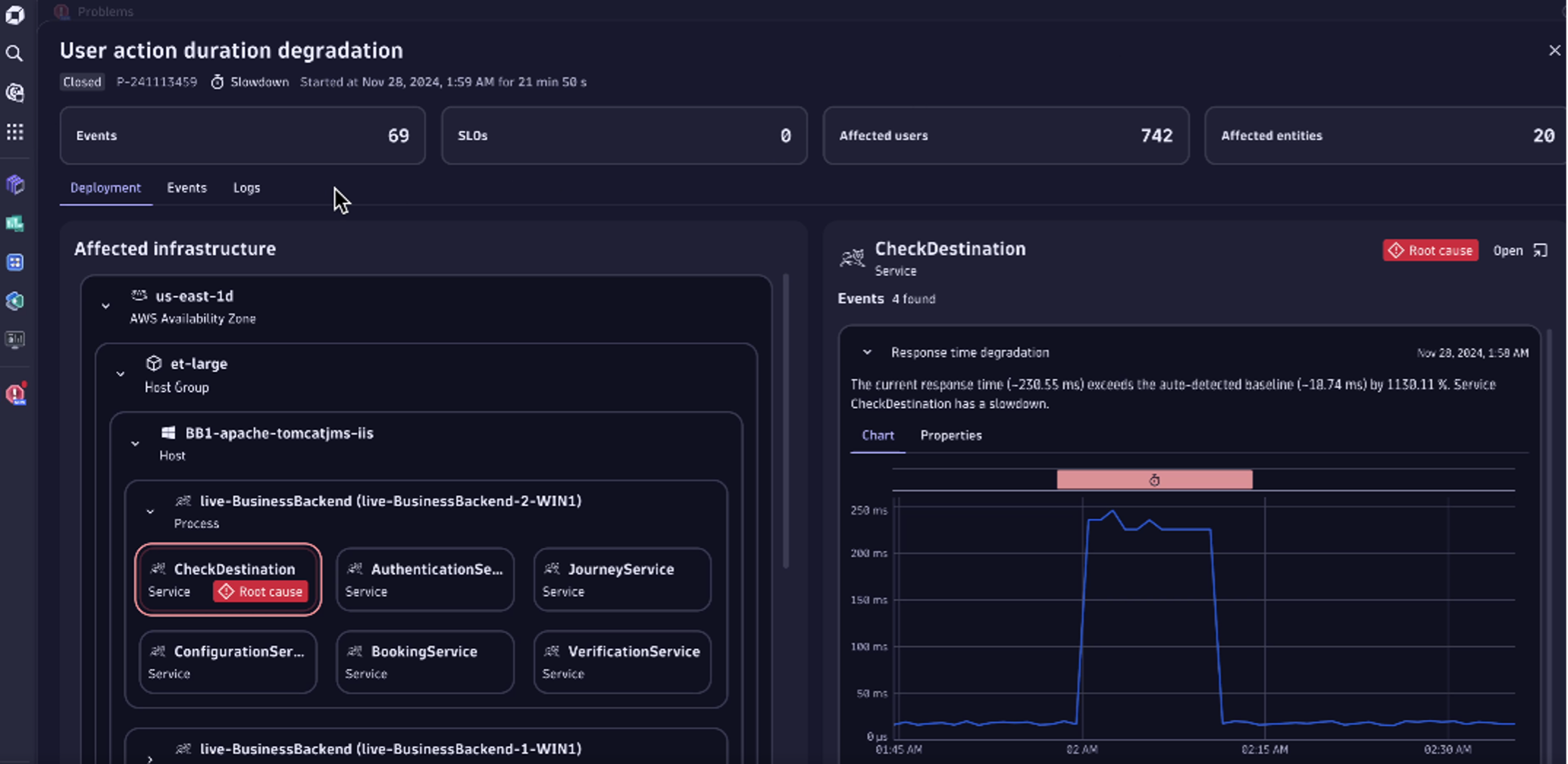
Dynatrace AI capabilities flag and remediate problems, surface insights, and feed them into IDEs. This process triggers ticket creation to the responsible teams and aligns them around automatically planned actions, including learning from past incidents while incorporating real-time facts in context.
To further evolve from automation to autonomy, Dynatrace magnifies its capabilities with agentic AI and delivers three reliable agentic AI requirements through an architecture built for intelligent action.
Leveraging agentic AI for redefined observability with Dynatrace
The future of observability is being redefined by a powerful triad: Knowledge, Reasoning, and Actioning.
- Knowledge. Dynatrace transforms contextual full-stack observability data into fact-based, real-time knowledge optimized for AI access. The Grail massive parallel processing data lakehouse is schema- and index-free, boosting AI agents with limitless query permutations. Grail works in tandem with Dynatrace Smartscape dynamic topology, an auto-discovered, continuously updated knowledge graph. This allows AI to deliver precise insights efficiently and at petabyte scale, eliminating the need for redundant queries (hence, also the increased cost) while maintaining full context and performance integrity.
- Reasoning. Dynatrace unifies causal, predictive, and generative AI to power expert AI agents that optimize the blend of deterministic logic with probabilistic and stochastic models, to provide precision and fact-based trustworthy decision-making, while minimizing risks of hallucinations. This enables context-aware decisions with built-in enterprise-grade safety, compliance, and observability of AI itself, ensuring transparency and trust to not only achieve a capable AI, but also a reliable one.
- Actioning. Dynatrace turns high-level objectives into intelligent, automated actions, where humans define the goals and AI determines the best way to achieve them, both reactively and proactively. With AutomationEngine, AppEngine, and OpenFeature, it remediates, optimizes, and even triggers systemic fixes, transforming observability into a strategic business enabler.
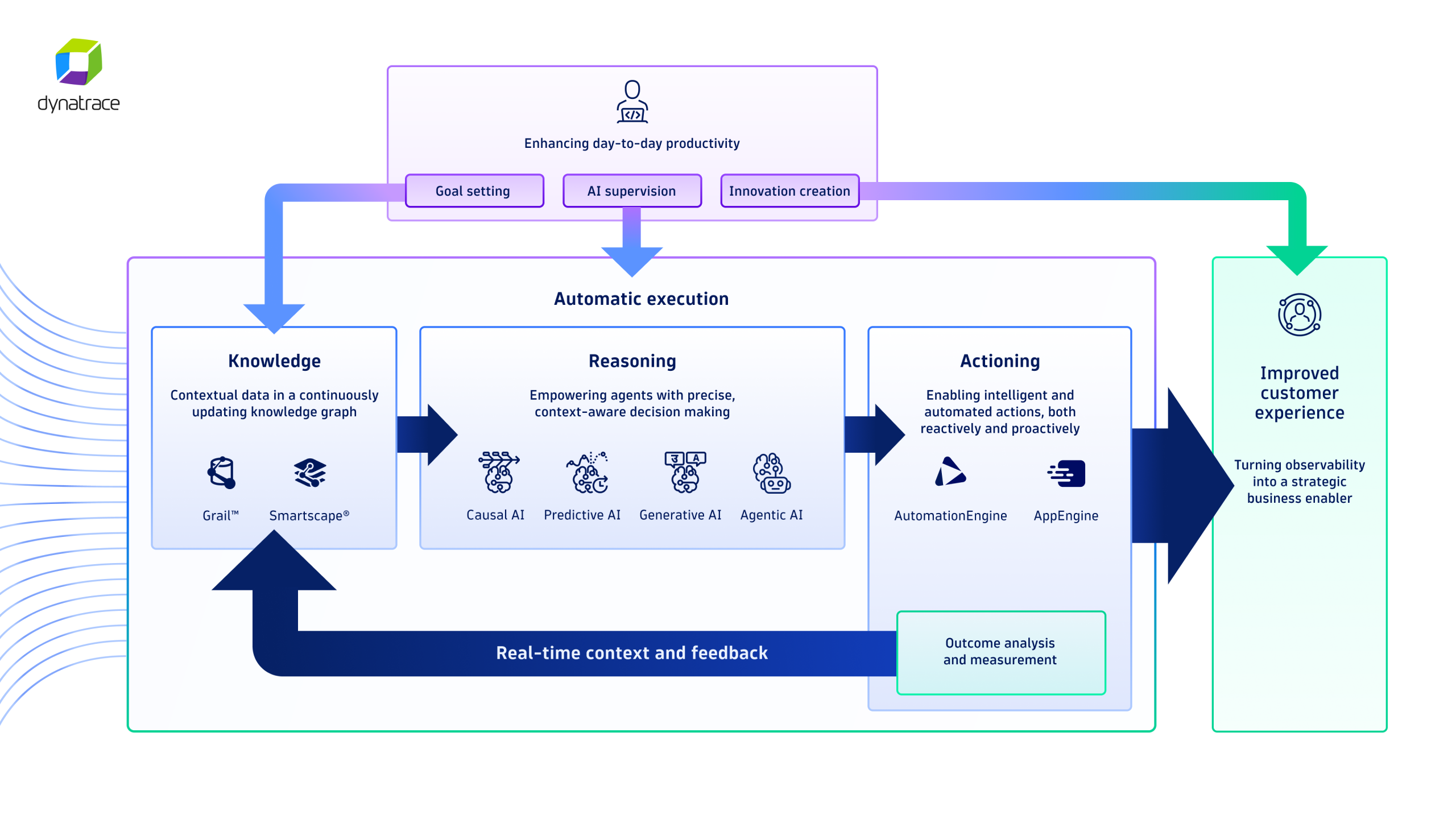
Last, but not least: AI is already powering production workloads across global enterprises, but not all AI is created equal. To deliver real value, it must be reliable, context-aware, and purpose-built for an organization’s digital environment. Dynatrace is engineered to meet those demands, magnified with agentic AI that answers organizations’ specific needs and business outcomes.

Looking for answers?
Start a new discussion or ask for help in our Q&A forum.
Go to forum