

AI workloads are redefining what logs must deliver—and exposing where traditional approaches fall short. New research reveals how rising scale, cost pressures, and missing context are reshaping log management. The path forward is clear: unify logs with traces and other telemetry in context to turn fragmented signals into reliable insight and build the foundation for trusted, scalable AI operations.
New Dynatrace research reveals how logs are becoming the accountability anchor for AI systems and why cost-driven trade-offs (sampling, cold storage, and discarding data) increase operational risk. In fact, with legacy log management tools now consuming 45% of observability budgets, 67% say the costs of these tools outweigh their value, indicating a need to modernize quickly (source: Dynatrace State of Log Management 2026 research).
3 takeaways for engineering and business leaders
- Scale is accelerating. Log and telemetry volume increased 93% on average with 1 in 5 organizations seeing growth above 150%.
- Costs are breaking traditional models. Existing log management tools consume 45% of observability budgets with respondents estimating an average annual spend near $2.5M.
- Context with traces is the path to AI trust. 73% say logs reveal only part of what’s happening with AI workloads, and 70% rank traces as a top source for evaluating AI performance and behavior. But 65% rely heavily on logs because they don’t have easy visibility into other telemetry signals.
Logs capture the precise details of events from cloud, AI, and infrastructure. As AI workloads and agentic systems (AI systems that act autonomously) make up an increasing proportion of technology stacks, logs serve as a crucial shared language for humans and agents to reason and troubleshoot system state and autonomously build and optimize infrastructure and applications.
Accountability depends on placing high-fidelity log telemetry in context: connecting it with traces, metrics, security events, user behavior, and business signals to understand AI behavior and guide remediation at scale.
How is AI breaking the economics of traditional log management?
AI workloads break the financials of traditional logging approaches by driving massive telemetry growth that forces many teams to not collect or discard data to avoid runaway costs.
Over the past year, AI workloads triggered a 93% average increase in log and telemetry volume, with one in five experiencing expansions above 150%. At the same time, teams rely on an average of seven different log and telemetry tools, forcing manual correlation that doesn’t scale.
The financial impact is just as stark. According to the report, existing log management tools now consume 45% of observability budgets, with average annual spend among survey respondents nearing an estimated $2.5M per organization. To contain costs, many teams limit ingestion, sample telemetry, or push logs into cold storage, losing crucial context and increasing security, compliance, and operational risk. In fact, 67% say the cost of existing log management tools now outweighs their value. And even after filtering, masking, and aggregating to reduce volume, the limitations of traditional logging tools force teams into imprecise compromises, resulting in half of organizations not collecting or discarding 86% of logs specifically to manage costs.
Traditional vs. AI-native log management
What changes |
Traditional log management
|
AI-native log management
|
| How teams find answers | Manual stitching slows analysis; teams spend 58% of analysis time correlating telemetry | Automated ingestion, enrichment, and correlation reduces manual work and accelerates time to answers |
| AI trust and validation | Logs alone are incomplete; 73% say logs reveal only part of what’s happening in AI workloads | Context builds trust: logs + traces (top-ranked by 70%) + metrics + events show behavior and causality |
| Readiness for what’s next | 79% worry current ingest/storage won’t meet future needs; instrumentation lags AI requirements | Updated instrumentation starting at the edge and open, automated processing at scale (supported by 81%) for accelerated AI innovation |
| Data strategy | Many teams control spend by reducing ingest using sampling, cold storage, or discarding data | Retain high-fidelity telemetry at scale without rehydration/indexing friction |
| Tooling approach | Fragmented tooling; teams use an average of seven tools, forcing manual correlation | One real-time observability context layer that unifies logs with metrics, traces, security events, and business signals |
| Operational impact | Blind spots and risks grow as half of teams don’t collect or discard 86% of logs | Answers, not guesses; more context preserved for faster diagnosis and safer automation |
What must change in instrumentation and ingestion for autonomous systems?
To build trust in AI workloads and advance the business value of autonomous decision-making, optimizing and streamlining telemetry must start before ingest and be open and automated at a massive scale.
Traditional logging architectures weren’t built for AI‑driven scale or autonomy.
- As AI workloads proliferate, 79% of technical leaders worry their current ingest and storage approaches won’t meet future needs.
- 80% say they must update instrumentation to support new AI‑specific metrics.
The operational toll is significant. Teams spend 58% of their analysis time stitching together logs, metrics, and traces before extracting insight, which slows decisions and delays AI projects from moving into production.
To break this bottleneck, 81% of organizations say log ingestion and processing must be open and automated at massive scale, enabling real‑time analysis without rigid schemas, indexing overhead, or rehydration delays.
Why do logs need an observability ecosystem to build AI trust?
While logs are a crucial component of AI observability, they need context to tell the whole story.
- 73% of organizations say logs reveal only part of what’s happening in AI workloads
- Teams spend 58% of analysis time stitching telemetry together
- 72% say standalone log management tools are obsolete—AI workloads demand a platform approach that combines all types of telemetry in one place to accelerate time to answers
As a result, most organizations rely on logs alongside other telemetry signals—especially traces, which 70% rank as the top source for evaluating AI performance and behavior.
Trust in AI develops when analysis is based on high-fidelity telemetry in context:
- Logs provide the fact basis
- Traces expose flow and causality
- Metrics quantify performance
- Security events surface risk
- Business signals connect system behavior to outcomes
Unified observability turns this telemetry into a coherent narrative—enabling teams to validate AI behavior, assess impact radius, guide remediation, and move from reactive troubleshooting to preventive operations.
What does AI-native log management look like with unified observability?
Unified observability transforms log management for the AI era by optimizing telemetry instrumentation and ingest, unifying telemetry with context, and eliminating crippling cost-cutting measures.
With exponential increase in telemetry volumes due to AI workloads, the path forward can’t just be shrinking log ingest to manage costs. AI innovation depends on leaning into telemetry volume with the right strategy and capabilities. The report points to key actions leaders can take to adopt AI-native log management practices.
- Centralize all telemetry (logs, traces, metrics, events) in a unified, continuously queryable context layer to eliminate silos and scale AI visibility.
- Automatically correlate logs with traces and lifecycle context to establish causation, understand AI behavior end to end, and enable reliable autonomous operations.
- Control log costs before ingest while retaining full-fidelity telemetry in exabyte-capacity storage with no rigid schemas, indexes, cold archives, or rehydration.
- Standardize instrumentation and optimize ingestion to capture high-value, governed telemetry that tracks agent actions, reasoning traces, and lifecycle events.
- Enable preventive operations by detecting early signals and automating remediation to reduce risk, strengthen reliability, and safely scale AI projects.
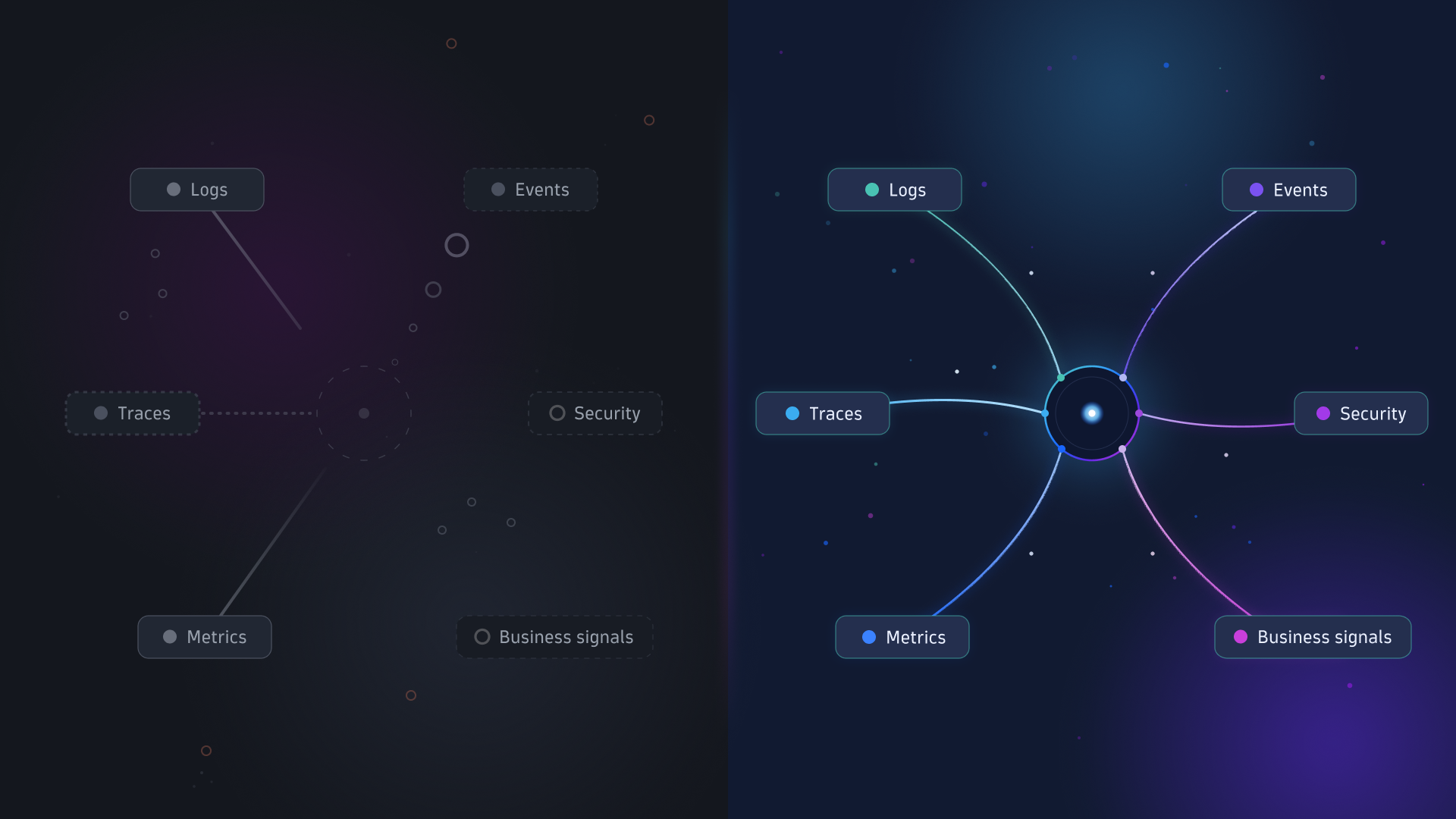
The goal is reliable operations and AI accountability at scale. Together, logs, traces, metrics, and events in context can enable preventive operations, reliable autonomy, and confident decision‑making as AI systems move from pilots into production. Organizations that build this unified foundation will be best positioned to scale AI without sacrificing trust.
FAQ: State of Log management 2026
Why is log management getting harder in the AI era?
Because AI workloads are driving rapid telemetry growth—organizations saw a 93% average increase in log and telemetry volume in the past year.
Why do log management costs feel out of control?
Existing log management tools consume 45% of observability budgets, and average annual spend is nearing $2.5M per organization.
Do teams still see value in log management at today’s price?
Not consistently. 67% of respondents say costs of existing log management tools now outweigh their value.
Why do teams discard so many logs?
Cost pressure. Using existing tools, 50% of organizations don’t collect or discard 86% of their logs on average, often using sampling or limiting ingestion specifically to reduce spend.
What’s the biggest operational bottleneck with today’s tooling?
Manual correlation. Teams spend 58% of analysis time stitching together logs, metrics, and traces before they can extract insight.
Why aren’t standalone log tools enough for AI workloads?
Because logs alone rarely tell the whole story. 72% say standalone log management tools are obsolete, and 73% say logs reveal only part of what’s happening in AI workloads.
What telemetry signal do teams rely on most to evaluate AI behavior?
Traces—70% rank them as the top source for evaluating AI performance and behavior beyond logs alone.



Looking for answers?
Start a new discussion or ask for help in our Q&A forum.
Go to forum