

Digital systems will continue to grow in scale and complexity in 2026, driven by the rapid adoption of agentic AI, unified telemetry, and cloud-native delivery models. These shifts will influence how organizations understand system behavior, prepare for autonomy, and maintain reliability in environments that change in real time. The insights that follow highlight the trends executives should monitor most closely, along with the conditions that will determine whether AI-driven operations deliver reliable, transparent, and resilient outcomes.
Key insights for executives
- Complexity will surge with agentic AI: Digital ecosystems are already complex, but agentic systems are introducing an exponential leap. Each new agent brings its own logic, behavior, and interactions, often acting independently, sometimes unpredictably. Without visibility into how agents interact or what decisions they make, organizations risk losing control over their systems. Guardrails, oversight, and end-to-end observability will be essential to avoid chaos and maintain reliability as the complexity of this new AI layer accelerates system behavior and reshapes the digital environment.
- Autonomous operations will depend on maturity, not ambition: Organizations will not move directly to full autonomy. They will progress through preventive operations and recommendation-driven workflows before adopting supervised autonomy, the final step before full autonomy. AI-assisted automation is where the foundation is built, because this stage forces organizations to expose and harden the services, data sources, and contextual signals that AI depends on. Autonomy is only possible when these components are accessible in real time, performant, and understood in context. With this foundation in place, supervised autonomy will reliably prepare the environment for full autonomous operations.
- Resilience will become a primary measure of digital operations: Customers expect systems to remain available and secure even under stress, and leaders will treat reliability and security as a single requirement. Early detection and rapid recovery will be essential, because failures spread faster across these interconnected systems. As a result, organizations will need unified visibility to protect customer experience and revenue.
- Reliable AI requires strong deterministic foundations: AI can only act dependably when its inputs are accurate, contextual, right-sized, and correctly interpreted. High-quality information must be available in real time and understood in a context-aware view of the broader system. Because large language models can’t reason over raw telemetry at scale, enterprises need mechanisms that distill massive data streams into concise, meaningful context and graph-based representations that show how systems and signals relate. Leaders should prioritize data quality, contextual integrity, and correct interpretation to ensure AI decisions remain reliable and useful.
- Human supervision will remain essential in AI-enabled operations: AI will take on more execution, but humans will continue to set goals, define boundaries, and ensure accountability. Leaders should redesign roles so that human judgment guides the system while AI handles repeatable or time-sensitive tasks.
- AI will become a standard component of newly developed digital services: AI workloads, pipelines, and operational practices will merge with existing cloud development processes, and executives should prepare for closer alignment among AI engineering, platform, SRE, and security teams to support consistent reliability and performance.
Prediction 1: Agentic AI triggers a new era of system complexity

Agentic AI is introducing a new level of system interaction. It’s more powerful, but exponentially harder to manage. As agents coordinate tasks, exchange context, and trigger downstream actions, even well-architected digital environments can spiral into unpredictable behavior. Most organizations are not ready for this shift. Without strong observability and consistent governance, these systems will become increasingly difficult to understand and control.
Think of each AI agent acting autonomously based on instructions and input from not only humans but plenty of first-and third-party agents. A single customer interaction might set off hundreds of background conversations among agents, each taking its own initiative. Roles shift depending on the situation, and some agents may direct others.
Common scenarios show how this plays out. When a vehicle detects an issue, task-specialized agents may check customer information, evaluate service options, estimate timelines, and coordinate a resolution. A travel assistance agent might do something similar, reaching out to agents that compare flights, check loyalty benefits, book transportation, and adjust plans in real time. In both cases, many agents work behind the scenes toward a single outcome, and the interactions between them can multiply in unpredictable ways. Every agent still reports to a human or another agent, and accountability remains with human supervision. This exponential growth in agent-to-agent communication can’t be managed without observability.
Organizations that adopt agentic AI without unified context and clear guardrails will face escalating costs, unpredictable behavior, and higher risk. The challenge is not just improving individual models, but managing the web of autonomous interactions that unfold in real time. In this next phase, observability is no longer a support function: It becomes the foundation for safe, scalable, and governable agentic ecosystems.
Prediction 2: The path to autonomous operations requires several maturity steps

Enterprises will take meaningful steps toward autonomous operations. Maturity, not ambition, will determine who succeeds. AI cannot act independently until the underlying systems, automation, and processes are stable, observable, and well-understood. Agentic systems are coming, but first, the groundwork must be solid. Earlier stages of automation are essential, because they surface the gaps in data access, service performance, and contextual signals that AI depend on. Only after those components are reliable and available in real time will supervised and autonomous operations take hold.
Most enterprises will follow a progression: they will start by ensuring their digital systems are fully automated, with runbooks, APIs, and interfaces in place to support reliable execution. This foundation enables predictive operations, where issues can be identified and remediated before they affect end users. From there, organizations can introduce supervised autonomous operations, using agentic automation with human oversight to build confidence and operational trust. As maturity increases and these systems consistently perform as expected, enterprises can progress naturally toward fully autonomous operations.
The journey toward fully autonomous operations will be gradual. Organizations that invest now in preventive workflows and recommendation-driven automation will be best positioned to introduce autonomous capabilities safely and responsibly.
Prediction 3: Resilience becomes the new benchmark for operational excellence
Resilience will become the defining measure of digital performance. As systems become more distributed and interconnected, small faults can spread quickly across applications, cloud regions, payment systems, and third-party services. Leaders won’t treat reliability, availability, security, and observability as separate practices. They will view them as a single requirement: the ability of a system to absorb disruption, recover quickly, and maintain a consistent customer experience under stress.
Independent research we commissioned with FreedomPay shows why this shift is accelerating. The findings reveal how fragile digital ecosystems have become and how quickly technical failures turn into customer disruption and financial loss. In the United Kingdom, payment outages put an estimated £1.6 billion in annual revenue at risk. In France, the figure rises to €1.9 billion. A single service issue can ripple across connected systems and channels, showing how tightly coupled modern operations have become.
Customers feel these failures immediately. Patience begins to drop within the first few minutes, and many customers leave the transaction if the issue persists for more than fifteen minutes. Yet the average outage lasts more than an hour, which means most of the damage has already occurred. Nearly one in three customers say a single incident is enough to reduce their trust in a business, with younger digital native consumers even more likely to leave.
This environment requires a unified approach to resilience. Organizations need shared visibility into how services behave, how failures propagate, and how recovery affects the customer journey. Resilience will be measured by how systems respond under stress, not just how they perform when digital services run as expected.
Prediction 4: Reliability becomes the foundation of AI progress
Organizations will prioritize building foundations that make AI systems consistently reliable. The next phase of AI progress will depend as much on deterministic grounding and factual signals as on the generative power of stochastic models. Enterprises are recognizing that creativity alone is insufficient. Reliable AI requires both structured inputs and mechanisms that ensure outputs remain trustworthy.
Agentic systems add a new layer of complexity. As agents coordinate tasks, exchange context, and initiate downstream actions, even a small misunderstanding can propagate across the system. Greater capability amplifies this effect because a powerful agent can accelerate outcomes while also accelerating an error. This is how hallucination emerges at system scale—not from a single faulty model, but from inaccuracies that compound across agent interactions. Deterministic grounding and end-to-end observability prevent that inaccuracy by ensuring agents act on the same factual signals and remain accountable to the human operator.
A common scenario shows what this looks like. A vehicle detecting a problem may trigger agents that review customer data, vehicle status information, identify service locations, evaluate schedules, estimate travel time, and plan the full resolution workflow. In each case, many agents collaborate behind the scenes to produce a single outcome. Organizations that want transparent and dependable AI outcomes will prioritize deterministic guardrails, enabling agentic systems to behave safely, act predictably, and collaborate with clarity.
Prediction 5: AI will scale, but human supervision will remain essential

In the next year, agentic AI growth will lead to a new operating model where humans define goals, and AI performs well-defined execution. As systems gain more context and become capable of coordinated action, the human role will shift from performing tasks to setting direction, providing instructions, and ensuring oversight. Organizations will rely on AI to analyze relationships, identify risks, and initiate safe actions, while humans remain accountable for outcomes and cross-domain judgment.
Agentic AI will behave much like a high-speed intern. When given clear goals, good tools, and instructions, and the right context, it will deliver results at a speed that is difficult for teams to match manually. But it will still require guidance. Humans will define the aim, interpret trade-offs, and make decisions where intent is unclear or results are ambiguous. If something goes wrong, accountability stays with the human operator, not the system.
This operating model will help teams manage complexity more predictably. AI will take on repetitive or time-sensitive tasks, and humans will focus on strategic decisions and system-level understanding. Growth in the agentic era will come from organizations that combine human judgment with AI-driven execution in a way that is transparent, governed, and aligned to business objectives.
Prediction 6: AI and cloud teams will converge
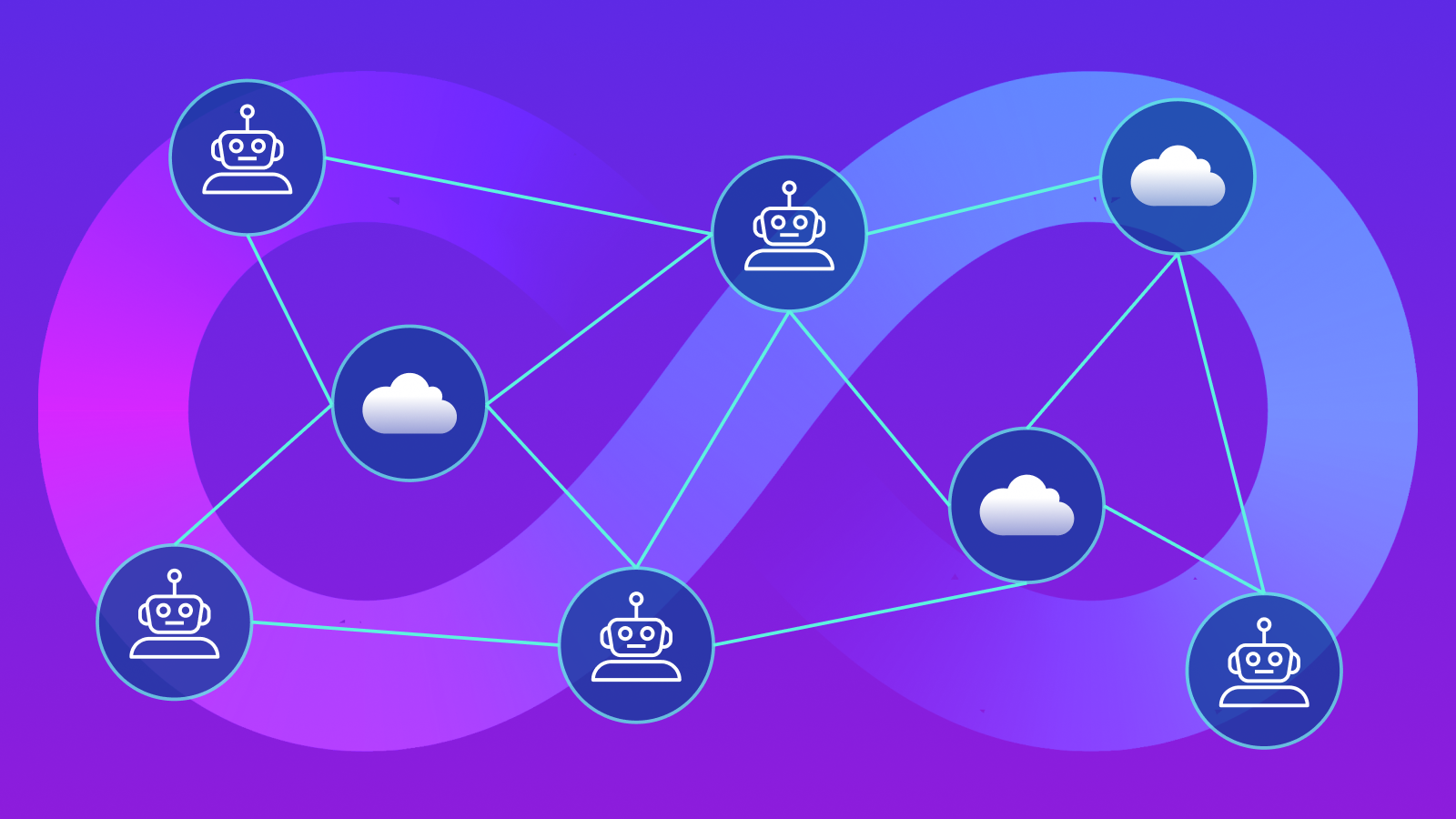
AI will stop operating as an isolated discipline and will become a normal component of cloud-native software delivery. Teams will integrate AI into digital services the same way they integrate databases or other core systems. As a result, AI engineering, cloud engineering, SRE, and security will converge into a shared operating model with common pipelines, shared SLOs, and unified accountability for the full lifecycle of AI-enabled services.
This shift reflects how modern software already behaves. AI features influence cost, latency, behavior, and compliance, and these effects span the entire stack. They can’t be monitored or governed in isolation. To operate reliably in production, AI must run within the same workflows, guardrails, and delivery pipelines used for the rest of the cloud-native system.
End-to-end observability becomes essential because what matters is the complete outcome for the user. The guidance agents receive, the actions they take, the database calls they trigger, and the costs they incur all contribute to the overall user experience. Observability must follow all of these signals together and treat AI components, application logic, and cloud infrastructure as one interconnected system. This removes the distinction between “AI observability” and traditional telemetry and creates a unified view that aligns to how customers experience the service.
Organizations that adopt this model will treat AI as a first-class software component. Central teams will define use cases, establish common stacks, and ensure compliance, while product teams will build AI directly into their delivery pipelines. This practical convergence will allow enterprises to operate AI-driven services with the same discipline and predictability as any other cloud-native system.


Looking for answers?
Start a new discussion or ask for help in our Q&A forum.
Go to forum