

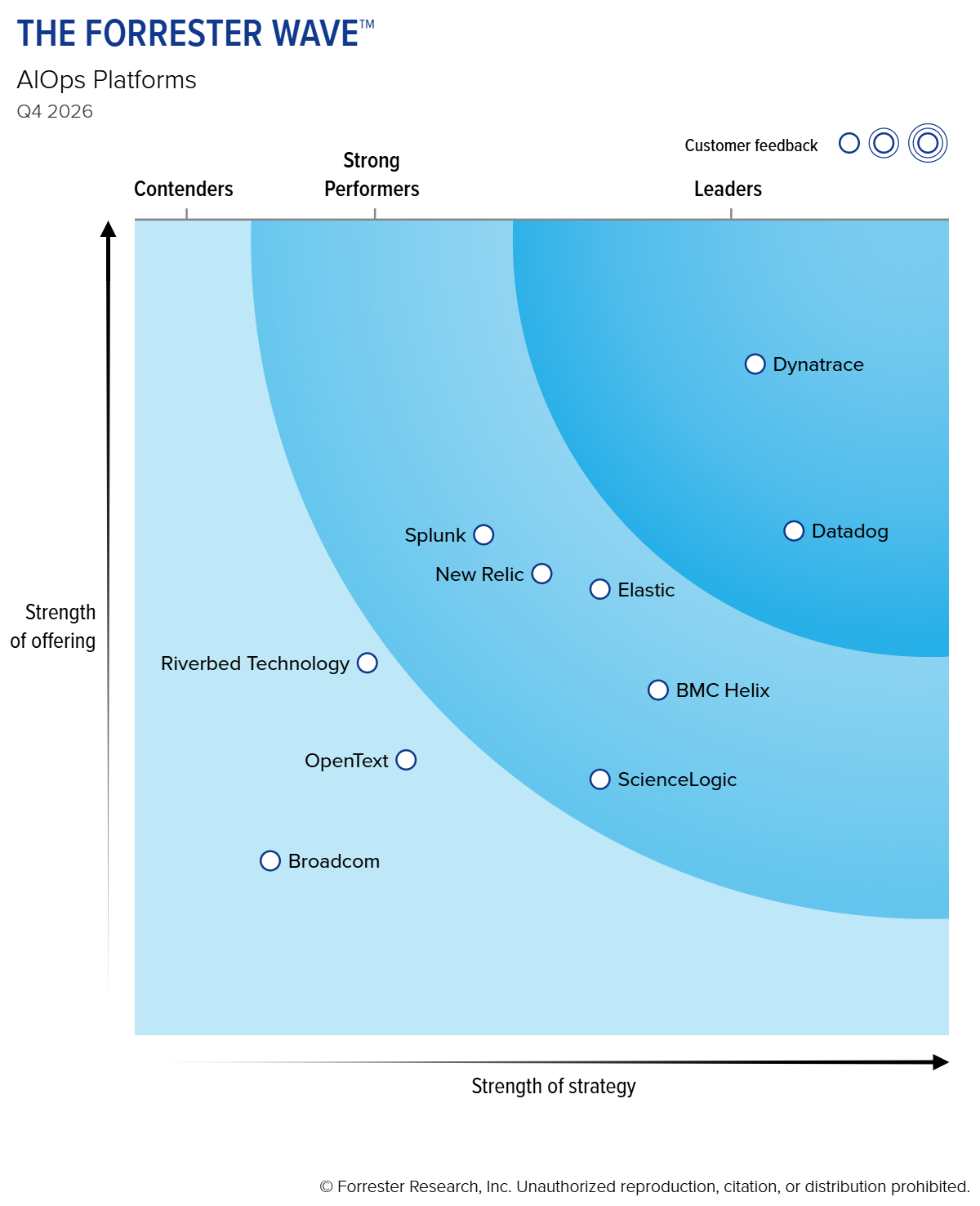
Dynatrace was recognized as a Leader in The Forrester Wave™: AIOps Platforms, Q4 2026, receiving the highest score in the Current Offering category and the highest possible score in 16 criteria.
Operational intelligence connects telemetry with topology, business context, actionable insights, and governed action to help teams decide what to do next. AIOps is moving beyond alerts toward this approach. Dynatrace believes the Forrester Wave™: AIOps Platforms, Q4 2026 reflects that shift, with prevention, causal intelligence, and AI governance emerging as important areas of differentiation.
What sets Dynatrace apart is how it builds that intelligence. The platform brings telemetry from across the environment together in one place, continuously maps causal relationships between signals, systems and services, and applies AI that uses that shared context to govern action. We believe this combination helps teams move from seeing a problem to knowing what caused, what the impact is, and what to do about it.
Enterprise operations teams have more visibility than ever before.
Monitoring detects issues across infrastructure and applications; observability platforms collect telemetry; AI surfaces anomalies, suggests root causes, and accelerates investigations. Yet many organizations continue to face the same challenge: deciding what action to take next.
As environments become more dynamic, distributed, and AI-driven, the bottleneck is no longer access to data. It’s trusting data and turning that data into trusted decisions.
Why does AIOps need more than monitoring and observability?
Finding an issue, understanding why it happened, and deciding what to do next are different tasks. Organizations have invested heavily in monitoring and observability to improve operational awareness, but those necessary investments often addressed only part of that progression.
According to Forrester’s report, AIOps platforms are evolving beyond detection, diagnosis, and reactive notifications. Instead, they are increasingly expected to function as operational intelligence systems. These systems assess conditions across interconnected technologies, reason about impact, and help guide decisions. Forrester likens these platforms to an air traffic control tower: they continuously sense, reason, and respond as conditions change, orchestrating decisions across thousands of interconnected systems, often autonomously.
This evolution reflects a broader operational reality.
Cloud-native architectures, microservices, AI applications, hybrid environments, and rapidly changing software landscapes have created levels of complexity that increasingly exceed human-scale analysis. Teams can no longer rely exclusively on manual investigation and operational intuition.
How can AIOps help teams identify risks before incidents occur?
The report notes that AIOps full-stack platform customers using the evaluation to inform a purchase decision should consider the ability to prevent, not just detecting incidents.
Increasingly, differentiation comes from the ability to identify emerging risks before they become business-impacting incidents. In Forrester’s view, this is where causal analysis combines with predictive forecasting, business context, topology awareness, and automation to shift an IT organization’s operational posture from reactive to preventative. Forrester advises buyers to evaluate whether a platform can recommend and initiate remediation or mitigation before services are impacted.
That shift requires more than additional telemetry or better dashboards. It requires the ability to connect signals across systems, understand dependencies, identify causal relationships, and assess potential consequences before a disruption occurs.
An on-call engineer shouldn’t need to write complex queries to find the root cause at 2am, and a developer shouldn’t need to be an observability expert to understand how their service is behaving.
This is what Dynatrace Intelligence was built for. It’s the intelligence layer that runs through the entire Dynatrace platform, allowing agents to reason, act, and resolve problems on your behalf.
In the evaluation, Dynatrace received the highest possible score in the criteria of predictive risk forecasting, real-time change impact control, and business event extraction and financial prioritization. We believe prevention depends on all three: a forecast is most useful when teams can see which change introduced the risk and which business process it puts in jeopardy.
Why does shared context matter for AIOps decisions?
AI needs context to support operational decisions: processing enormous amounts of information faster does not necessarily improve outcomes.
In its evaluation, Forrester notes that Dynatrace’s unified platform architecture differentiates with its context-aware causal intelligence layer, noting the role of Grail, Smartscape, Dynatrace Intelligence, and agentic operations within a single architectural story. Forrester observes that Grail and Smartscape provide a common context layer across metrics, logs, traces, events, security, and application dependencies. Dynatrace received the highest possible score in the causal root cause analysis and in dynamic entity topology and temporal graph criteria.
Smartscape is a real-time topology graph that continuously discovers and maps relationships between AI entities, hosts, services, processes, applications, and cloud infrastructure, giving agents an up-to-date world model of your environment. Combined with the data in Grail, it’s the reason Dynatrace can tell you that there’s a problem, what it’s affecting, and why.
Why governed autonomy builds trust
Much of the conversation around AI operations focuses on autonomy. How quickly can systems recommend actions? How effectively can they automate tasks? How much operational work can they perform without human involvement?
AI governance requires controls for permissions, policies, explainability, auditing, workflows, and human oversight. The Forrester report notes this issue as organizations grapple with AI agents becoming more involved in diagnostics, recommendations, and remediation workflows, and it goes further: in its words, “Governance matters more than autonomy”. Its guidance is to adopt a Zero Trust, least agency mindset and to decide which actions agents may execute on their own and which require human oversight, based on business, operational, regulatory, or corporate risk. These requirements are especially relevant in regulated industries, large-scale environments, and mission-critical systems.
Forrester describes Dynatrace Intelligence as combining deterministic AI with agentic AI for supervised autonomous operations. Dynatrace received the highest possible score in algorithmic trust and explainability and in ModelOps and AI governance. Dynatrace also received the highest possible score in the autonomous remediation and orchestration, and autonomous AI SRE and orchestration criteria.
“Customers want to put AI to work across their operations, but they need answers they can trust before they act,” said Steve Tack, Dynatrace Chief Product Officer. “We believe Forrester’s recognition reflects the confidence customers place in Dynatrace to deliver precise answers grounded in real-time context, so they can automate reliably across their most critical systems.”
Today’s production agentic AI systems are increasingly embedded in mission critical business applications. A hallucination or agent error can propagate at machine speed, putting business, brand reputation and regulatory adherence at risk. An observability platform that operates at machine speed can better stop errors in their tracks, eliminate or minimize a potential blast radius, and protect business interests far better than platforms that rely on inferred relationships and human interpretation of relational data.
When evaluating AIOps platforms, look for the quality of shared data context, platform architectural maturity, and controls that keep teams in charge. Forrester notes that native capabilities often provide more consistent experiences, governance models, and smoother operational flows, and that millisecond delays or telemetry gaps from an integration buffer matter to causal AI engines.
Forrester does not endorse any company, product, brand, or service included in its research publications and does not advise any person to select the products or services of any company or brand based on the ratings included in such publications. Information is based on the best available resources. Opinions reflect judgment at the time and are subject to change. This report is part of a broader collection of Forrester resources, including interactive models, frameworks, tools, data, and access to analyst guidance. For more information, read about Forrester’s objectivity here.
Frequently asked questions
What is AIOps?
According to Forrester, AIOps builds on monitoring and observability by adding a causal intelligence layer that enables AI-assisted decisions. Where monitoring is reactive and observability is investigative, AIOps platforms are evolving beyond detection, diagnosis, and reactive notifications into operational intelligence systems that help teams anticipate risks and prevent incidents before customers are affected.
Why does context matter during an investigation?
Connecting telemetry with service dependencies and recent changes helps teams understand what happened, which services are affected, and where to investigate next. Look for relationships that are deterministic rather that inferred relationships based upon service labels that may or may not be trustworthy.
What controls should teams look for in AI-assisted remediation?
Look for policy guardrails, approved actions, auditable records, and human oversight so teams can review findings and control what automation can execute. Forrester recommends a Zero Trust, least agency mindset: define which actions agents may take on their own and which require human approval.

Looking for answers?
Start a new discussion or ask for help in our Q&A forum.
Go to forum