

AI adoption is universal, but its business impact is not. The Dynatrace annual research report on the state of observability reveals the effects of wider trends in AI adoption. This year’s report shows how observability, once a reactive IT tool, has evolved into the central control plane for AI transformation.
Executives and technology leaders are prioritizing AI observability to reduce risk, lower unit cost, and accelerate delivery, aligning to business objectives.
The State of Observability 2025 report reveals how organizations are moving from experimenting with AI to integrating it into core operations. Not surprisingly, 100% of responding organizations now use AI in some capacity. But this universal adoption isn’t uniform. Data management, AI governance, and security are the most common AI use cases, with observability growing significantly.
As organizations seek to realize ROI on their overall AI investments, observability is clearly emerging as the key to unlocking AI value while mitigating its inherent risks. In other words, AI observability is becoming a prerequisite for the success of AI initiatives.
Why observability is now a C-suite imperative
Executives now recognize that a comprehensive observability strategy is essential for reducing AI risk, lowering unit costs, and accelerating service delivery. Observability is emerging as a vital intelligence layer for managing complex AI initiatives and aligning them with strategic business goals. Further, AI capabilities within observability platforms are becoming a determining factor for selecting an observability vendor.
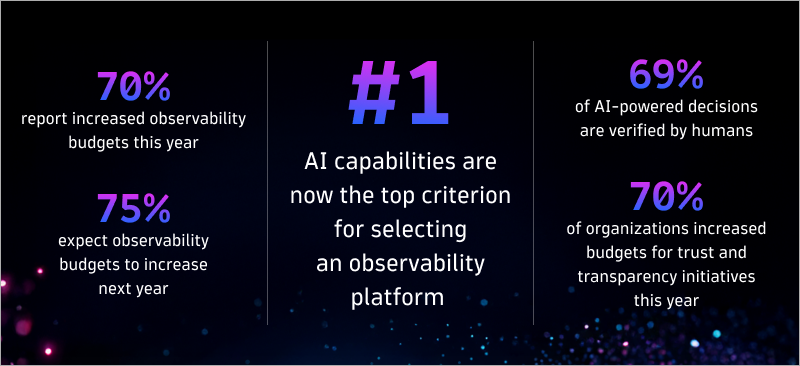
The report’s findings underscore this shift:
- Observability budgets are increasing: 70% of organizations increased their observability budgets this year, and 75% plan to increase them again next year. These increases signal the importance and value leaders are placing on this capability for the success of their business goals.
- AI capabilities are now the #1 criterion for choosing an observability platform: For the first time, AI capabilities (29%) have surpassed cloud compatibility as the primary criterion for selecting an observability platform. This highlights the market’s demand for intelligent, automated solutions.
- The AI trust gap is real: Despite widespread AI adoption, a significant trust gap remains. Humans verify 69% of all AI-driven decisions, and 70% of organizations increased budgets for trust and transparency initiatives this year. This indicates that while leaders are eager to use AI, they require guardrails designed to enhance its reliability.
AI is expanding the value of observability across security, sustainability, DevOps, and more
Using AI for security compliance, sustainability, and real-time DevOps automation initiatives is on the rise, fueling the evolution of agentic AI—autonomous systems that plan and execute tasks.
AI-powered threat detection is influencing budget priorities
Security is a prime example of how AI and observability are converging. A staggering 98% of security leaders report using AI to manage security compliance, and 69% are increasing budgets for AI-powered threat detection. Enhancing threat visibility is the top expected growth area for AI over the next five years. By converging security data with observability telemetry, organizations gain faster time-to-contain and fewer customer-impacting incidents.
AI pays dividends for sustainability and managing costs
The scope of observability is also expanding to include environmental sustainability. Our research shows that 70% of organizations use observability to monitor and manage their sustainability initiatives, which in most cases also drives cost reductions. A full 64% report growing budgets for observability-aligned sustainability efforts. Correlating telemetry with resource consumption reduces cost per request and CO₂ emissions by linking telemetry to spend and energy.
Real-time DevSecOps automation is giving rise to agentic AI
The ongoing expansion of AI into combined DevOps and security (DevSecOps) automation represents another powerful shift. Up to 50% of DevSecOps leaders currently use real-time automation, with adoption expected to grow to 70% in five years, driven by use cases like security risk mitigation and anomaly detection. The focus on agentic AI promises high ROI (41%) and is reshaping incident response, infrastructure management, and debugging. Real-time observability with natural language interaction results in AI systems with a shorter time to value through safe, policy-gated actions.
From data to business impact: Closing the KPI gap
While the potential is clear, many organizations are still working to connect observability data to tangible business outcomes. Currently, only 28% use AI to align observability data with key performance indicators (KPIs). This “KPI gap” represents a significant opportunity.
Leaders who successfully bridge this gap can transform their operations. About 22% of leaders report that converging real-time data and AI-driven automation with observability positively impacts business agility, so they can respond more quickly to market changes and customer demands. By tying technical performance metrics like mean time to resolution (MTTR) and service level objectives (SLOs) directly to business metrics like cost per request, revenue at risk, and customer experience scores, leaders can gain real-time insight into how technology performance affects business agility and financial efficiency.
The mandate for observability in the AI era
As organizations increasingly rely on AI, they are also turning to observability to make these complex systems more explainable, reliable, and auditable. Observability is no longer just about monitoring systems. It’s about providing the intelligence and control needed to steer the enterprise through AI transformation. AI-driven observability provides the foundation for lowering risk, strengthening security, and aligning every technological decision with strategic business value.
To explore these findings in greater detail and build a comprehensive strategy, get the State of Observability Report 2025 below.

Looking for answers?
Start a new discussion or ask for help in our Q&A forum.
Go to forum