




Modern businesses are sitting on a goldmine of information. Your observability data can help you understand what is breaking, what is underperforming, and where your next improvement should come from.
The gap isn’t data – it is the distance between seeing something and being able to do something about it
That’s exactly what Kiro Crew, Dynatrace, and Amazon Web Services (AWS) are making possible together.
A partnership built on possibility
Dynatrace and AWS have spent years helping customers operate with confidence at scale. Dynatrace delivers deep, continuous intelligence across entire environments, including cloud infrastructure and applications. Not just alerts, but real understanding of how every service, application, and infrastructure component is performing and evolving. AWS provides cloud computing services that provide teams the flexibility and scale to build without limits.
Together, they give organizations a complete, living picture of their ecosystem. What’s running, how it’s performing, and where the opportunities are. Kiro Crew puts that picture to work.
Intelligence that builds, not just fixes
Most conversations about operational tooling start with problems. That’s understandable. When something breaks, it hurts. But the most forward-looking teams aren’t just using their observability data to detect and resolve issues. They’re using it to build better.
With a complete view of how services behave across your entire landscape, you can identify patterns that point to new opportunities. You can understand how customers are actually using your applications, not how you assumed they would, and use that to enhance what you offer. You can see where services are underperforming and apply targeted improvements, not guesswork.
Kiro Crew makes this kind of data-driven innovation accessible to any team. It continuously learns from the full breadth of your environment, maintaining context and institutional knowledge that would otherwise live only in the heads of your most experienced engineers. That intelligence doesn’t just help you respond. It helps you create, refine, and grow.
Your ecosystem, amplified
Every organization has invested in tools, processes, and platforms that reflect how they work. Kiro Crew doesn’t ask you to abandon that investment. It integrates with what you’ve built and makes it more powerful, surfacing insights from Dynatrace, operating across AWS infrastructure, and connecting the dots between signals that would otherwise stay siloed.
The result is an environment where teams can move with both speed and precision. Where a new service idea doesn’t have to wait months for manual capacity planning. Where an enhancement to an existing service can be validated, tested, and shipped with confidence. Where the full richness of your operational data is always available, not just to answer questions, but to drive action.
The opportunity is there. We wanted to explore what happens when operational intelligence, agentic workflows, and cloud-scale infrastructure come together in a practical engineering workflow. Here’s what we built.
What we built
When you open the Dynatrace app for Kiro Crew, you land on a Kanban board of problems found by Dynatrace Intelligence arranged by lifecycle: New, Ongoing, Under Maintenance, and Recently Closed. Two more views switch the board to services and applications, grouped into Unhealthy, Watch, and Healthy health signals derived by correlating each entity with the active problems referencing it.
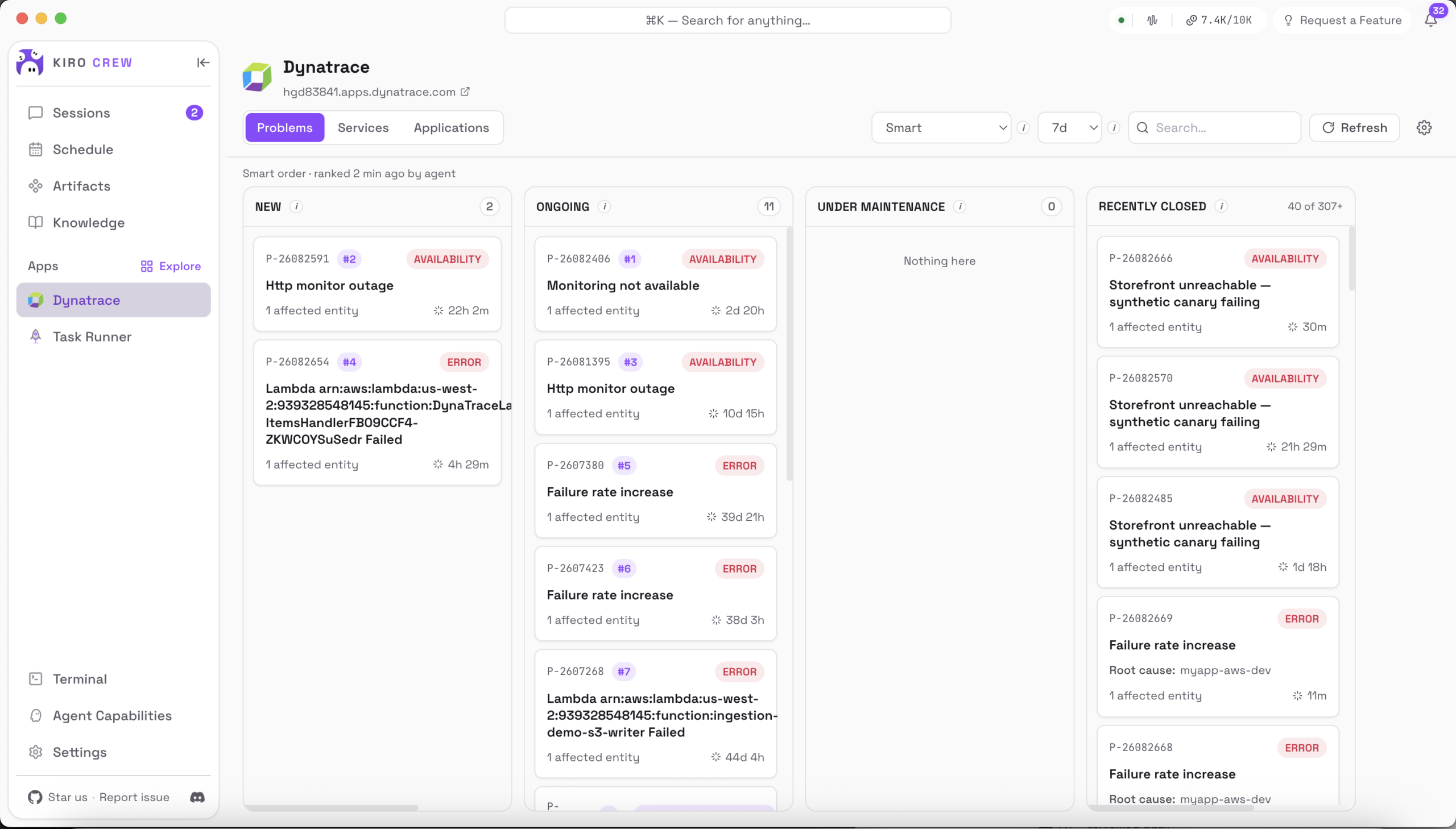
Everything on the board is read through dtctl, the open-source Dynatrace CLI, using DQL queries against Grail. That keeps the integration surface deliberately small: if you already use dtctl there are no new credentials to mint; there is no bespoke API client to maintain. One code path covers problems, entities, and the relationships between them. The app is read-only by design. It never closes a problem and never changes configuration. Anything that acts either links to Dynatrace or hands the work to an agent with a human in the loop.
The agentic part: Ranking that explains itself
A board of fifteen open problems is still just a list. What teams actually need to know is: “which one do I open first?”
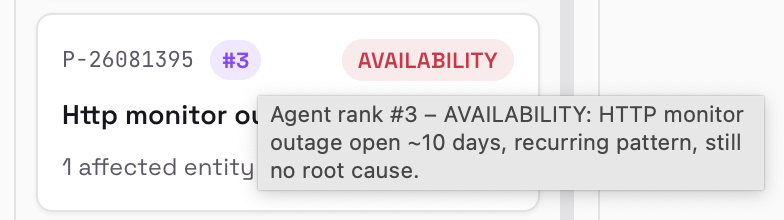
A Kiro Crew agent reads the board and returns a ranked list of active problems, each with a one-line rationale. It weighs the same factors an experienced responder would: problem category, blast radius across affected entities, whether Dynatrace Intelligence has identified a root cause, how long the problem has been open, and whether the same issues keep reappearing. It also draws on the context Kiro Crew has accumulated about your environment, so the ranking reflects your estate rather than a generic severity scale.
The ranking is a suggestion, not a mandate. However, a rank badge shows the reasoning behind that position. Deterministic sorts by severity, age, blast radius, or duration stay one click away, and the board is explicit on screen about which ordering you are looking at. The engineer decides what to work on. The agent does the reading.
From board to investigation
Opening a problem card reveals the full record: status, category, timing, affected entities, root cause where Dynatrace Intelligence has identified one, and a deep link straight into the Dynatrace Problems app.
Two buttons carry it forward:
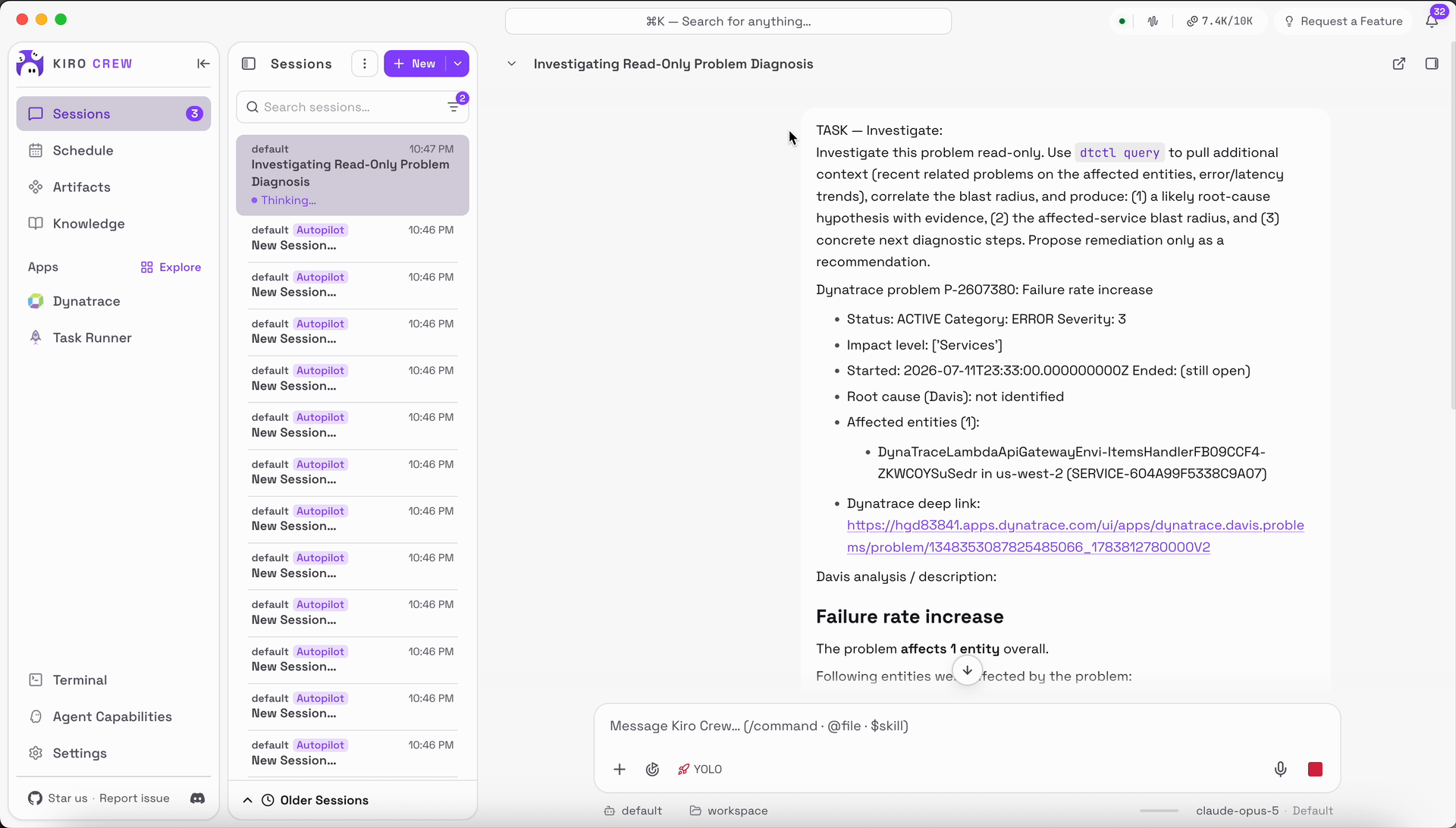
- Investigate opens a pre-populated Kiro Crew chat seeded with the problem’s facts and read-only instruction. The investigation starts with the evidence already in hand.
- Summarize composes a short write-up for a standup or an incident channel.
In both cases, the session stays in front of a human who approves anything that touches a live system.

Getting started in three steps
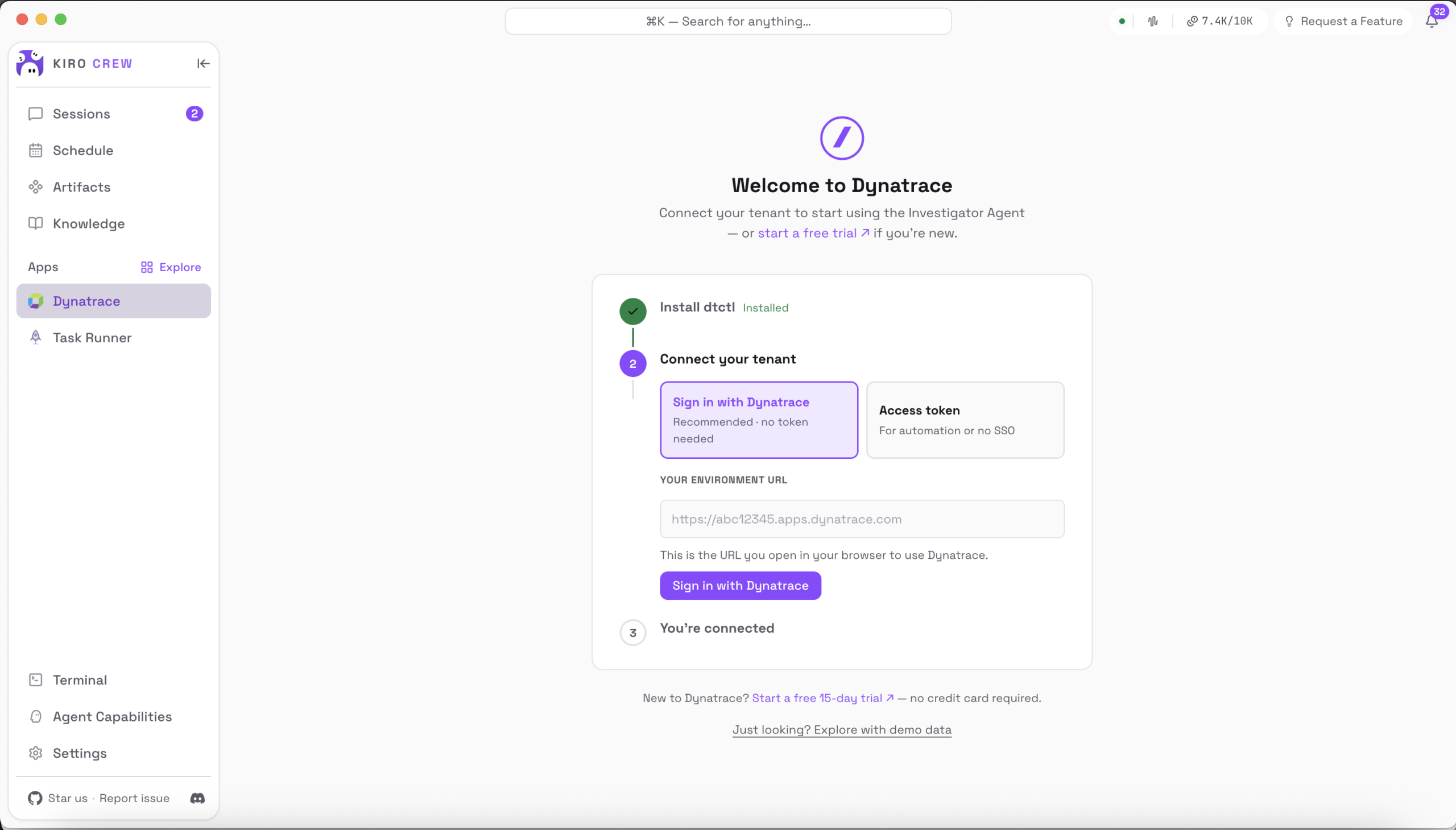
The first-run onboarding is intentionally simple:
- Confirm dtctl is installed
- Connect your Dynatrace environment, either browser SSO (where one button runs the OAuth flow and pins the tenant) or a platform token with its environment URL
- Get started
Tokens are stored owner-only and never echoed back; the app reports only the source and the last four characters. If you work across several tenants, you choose which context the board reads.
No credentials yet? The app runs on a built-in demo dataset, labelled as demo in every response, so you can try, test, and evaluate the whole experience before connecting anything real.
The app is open source at github.com/dynatrace- oss/dynatrace-kirocrew-app, and it runs on your machine against your tenant.
Why this matters beyond problem triage
The interesting part is not the board. It is how little it takes to put an agent in front of production intelligence that is already there.
Dynatrace had the data model. Dynatrace Intelligence had the analysis. dtctl had the access. Kiro Crew supplied the memory, the scheduling, and the chat surface. A few hundred lines of glue turned all of that into something an engineer opens in the morning and acts on.
That pattern generalizes well beyond problem triage. It points to a broader direction that the partnership is working toward: the intelligence is already in your environment, and the distance between seeing it and acting on it keeps getting shorter.
The next chapter
The Dynatrace and AWS partnership has always been about more than technology. It’s about giving teams the confidence to aim higher. Kiro Crew is the next expression of that commitment; a tool that brings the intelligence, the infrastructure, and the autonomy together in a way that turns ambition into outcomes.
Whether you’re building something new, enhancing something existing, or simply trying to make sure your customers always have the best experience possible, this is the foundation that makes it real.
See it
Check out the demonstration of Kiro Crew and Dynatrace in action.
Try it
The app is open source at github.com/dynatrace-oss/dynatrace-kirocrew-app and runs on your machine against your tenant.

Looking for answers?
Start a new discussion or ask for help in our Q&A forum.
Go to forum