



Dynatrace is expanding AI Observability data ingestion options across coding agents, Python-based LLM applications through OneAgent, and OpenInference-instrumented frameworks, so teams can bring all their AI telemetry into one place. That means faster setup, no forced standardization, and full-stack visibility into AI systems without extra plumbing or code changes.
Teams building AI applications rarely stick to one stack. A platform team might run Claude Code and GitHub Copilot for engineering; a product team might ship a Python service on AWS Bedrock; and a third team might already be standardized on OpenInference because that’s what their framework ships with. Each tool produces telemetry in a different format, and by default, each would typically need its own path into observability.
Whatever a team is already using to build or instrument their AI application, that telemetry should now have a direct path into Dynatrace, normalized into the same gen_ai.* data model, so your team’s effort can focus on building AI applications, not plumbing.
OneAgent Python support: LLM observability without touching your instrumentation
A large share of production LLM applications are written in Python and call AWS Bedrock, OpenAI, or Azure OpenAI, or they’re built with LangChain. OneAgent now instruments these applications directly, capturing logs, traces, and LLM-specific telemetry with a setting, not a code change.
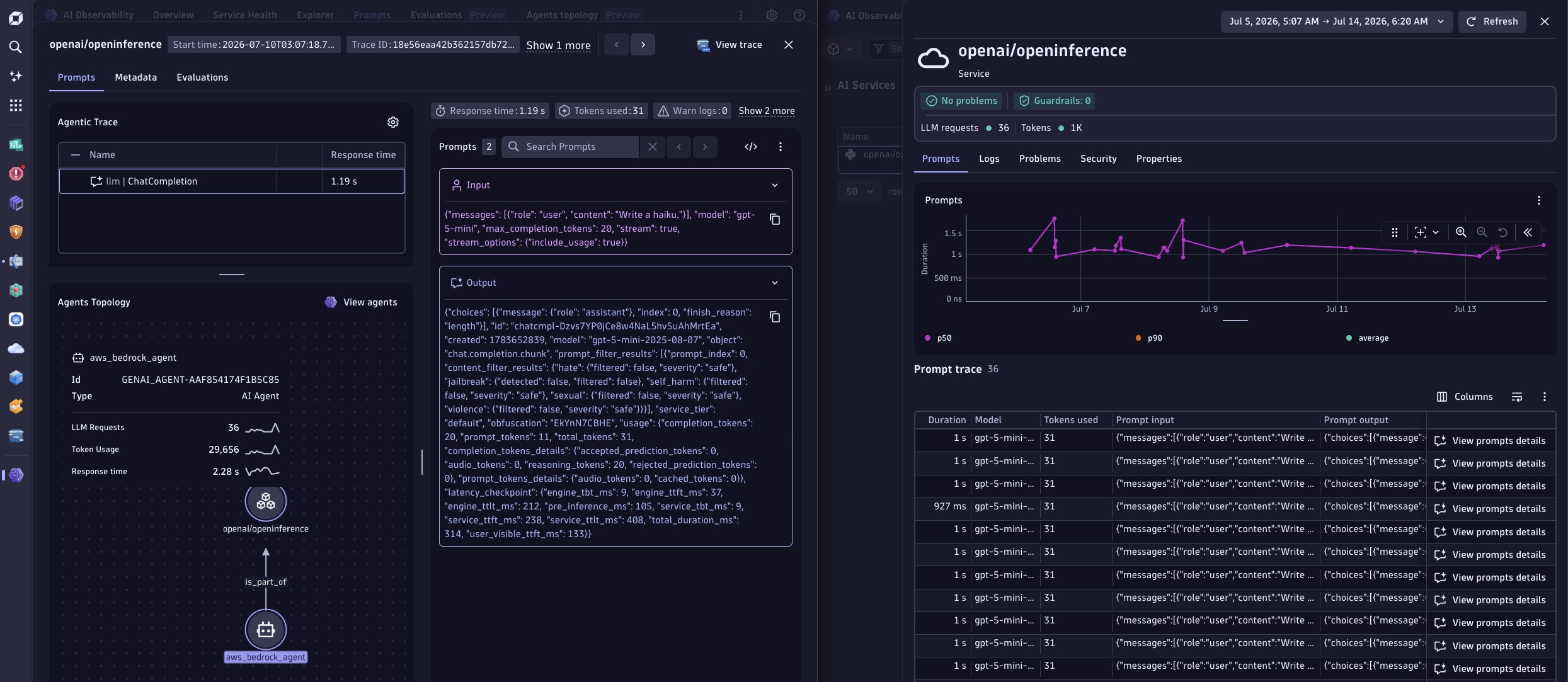
Once turned on, teams can capture prompt and completion content to debug AI and LLM interactions, analyze model behavior, and analyze the performance and cost impact of LLM calls. That data lands in Dynatrace next to the rest of your application telemetry, so an LLM call is just another span in a trace, not a separate system to check.
Experimental Python sensors: Broader and faster provider coverage
Alongside the generally available integrations, OneAgent now ships experimental Python sensors for a wider set of AI providers and frameworks:
- Anthropic
- OpenAI agents
- Google ADK
- Claude Agent SDK
- Microsoft Foundry
- Mistral AI
- LangChain/LangGraph
- Pydantic AI
- LiteLLM
- Cohere
- CrewAI
- Groq
- Haystack
- Ollama
Each sensor is turned on individually via its own feature controller in OneAgent settings, so teams can allow only the providers they use. These sensors are available today in an experimental state, shipping on an accelerated schedule to quickly extend GenAI observability to more providers. Note that attribute collection is best-effort, and completeness and schema might change in future releases without prior notice. If you’re building on one of these providers now, this is a way to gain visibility ahead of general availability, with the understanding that the details are still being finalized. Read more about OneAgent.
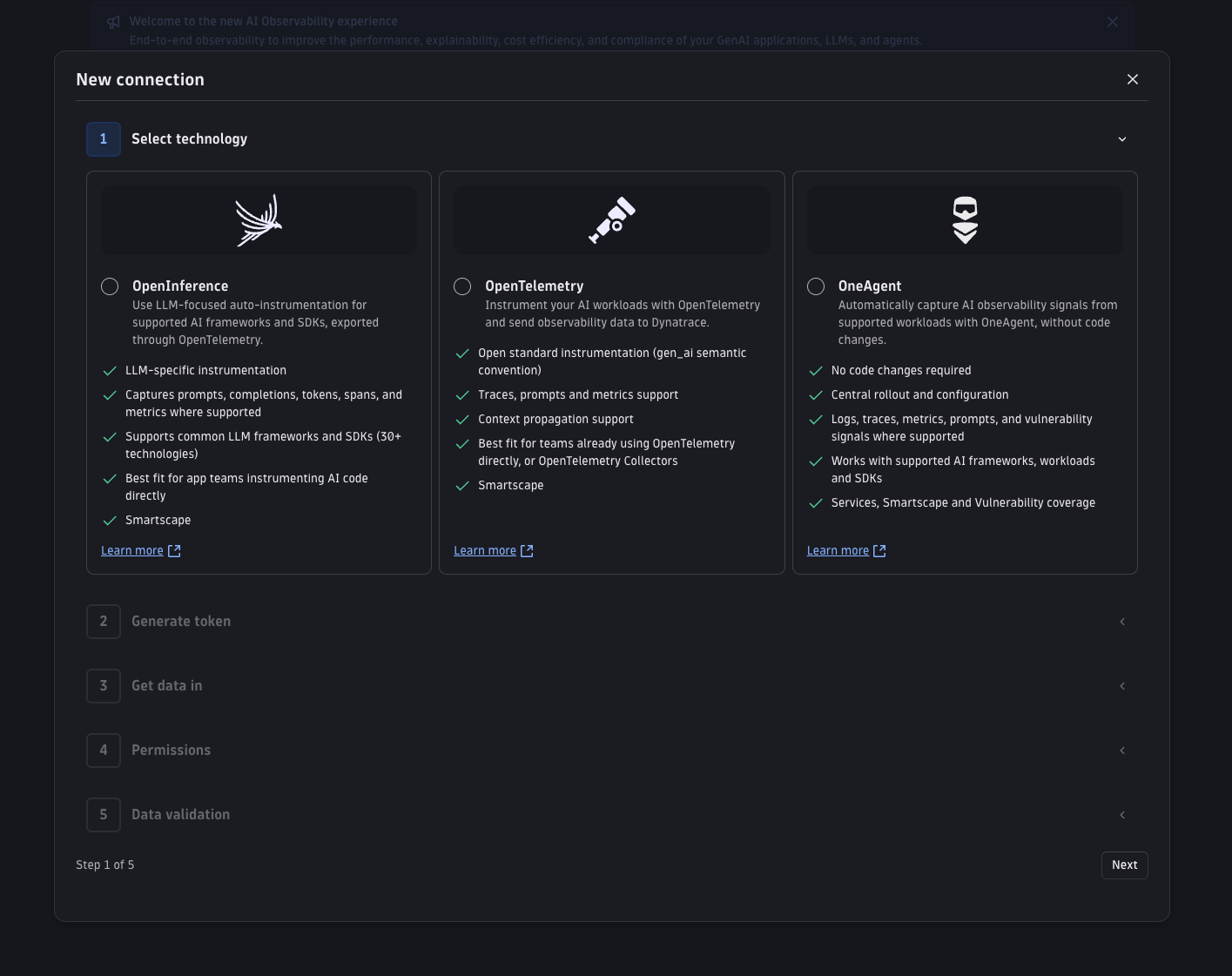
What is the OpenInference project, and how does Dynatrace support it?
The OpenInference specification is an open semantic convention and instrumentation standard for AI applications, built on OpenTelemetry standards and originally developed by Arize. It auto-instruments 33+ frameworks, including LangChain, LlamaIndex, CrewAI, AutoGen, OpenAI, and Anthropic, capturing LLM calls, agent runs, tool calls, and retrieval steps as distributed traces without code changes.
In late May 2026, Arize donated the OpenInference specification to the OpenTelemetry project. The OpenTelemetry governance board accepted the donation, and the merge landed in mid-June. As a result, the instrumentation – both the SDK and the framework – is now part of the OpenTelemetry project itself, governed the same way as any other OTel instrumentation.
Dynatrace support for OpenInference telemetry means teams gain vendor independence today, while supporting the same conventions the broader OpenTelemetry ecosystem is converging on.
Dynatrace ingests OpenInference telemetry directly, normalizing its attribute conventions to the gen_ai.* attribute Dynatrace AI Observability is built on. This gives you full-stack visibility into your AI workloads and lets you reduce duplicate instrumentation effort while keeping your options open.
If your team already ships OpenInference spans, that instrumentation now also works in Dynatrace, unmodified. Once it lands in Dynatrace, that telemetry powers the same performance and cost monitoring, root cause analysis across agent and tool chains, and dt-evals quality scoring, as telemetry that originally arrived as native gen_ai.* attributes. Have a look at our documentation and learn how to get started with the OpenInference specification in AI Observability.
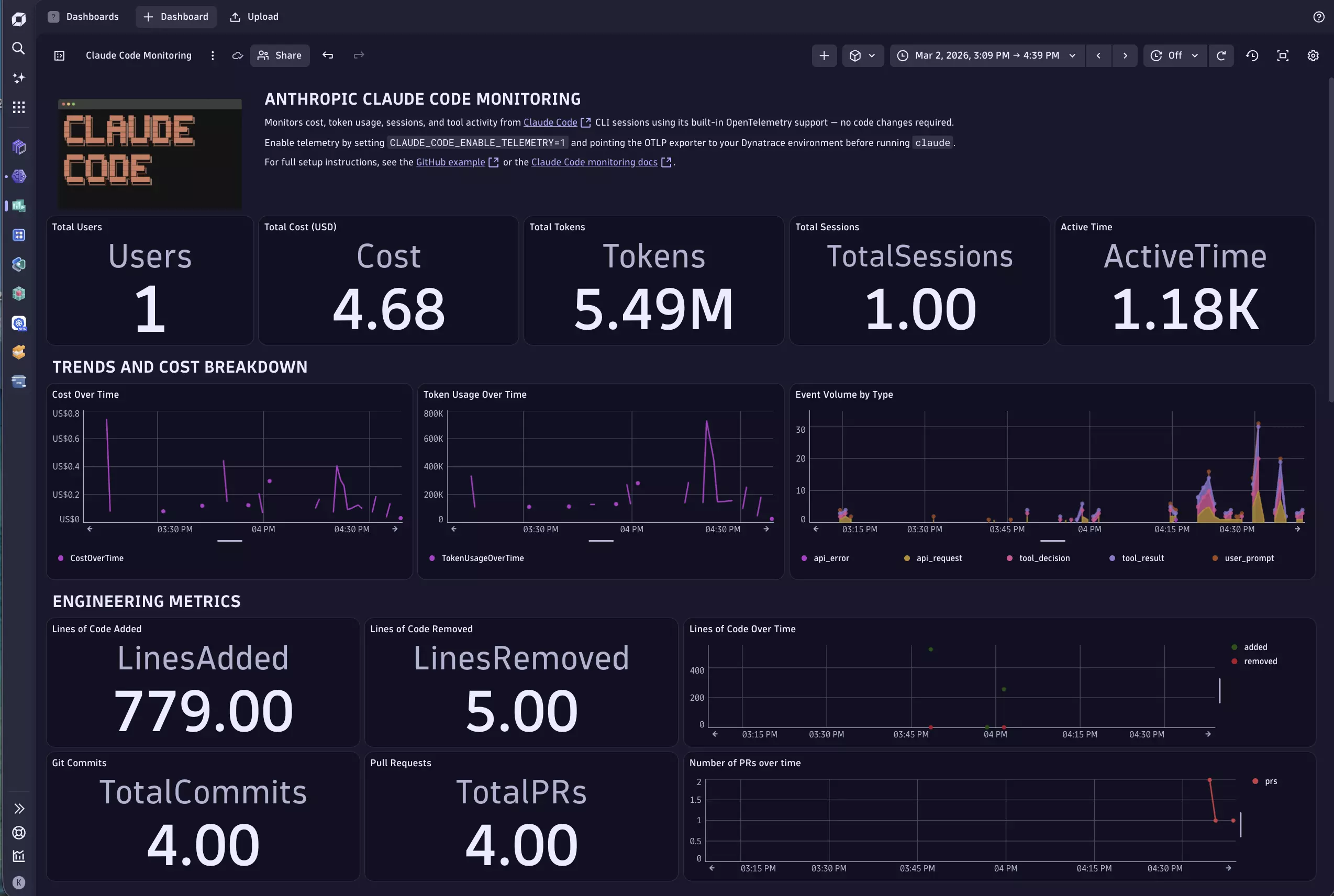
How can I monitor AI coding agents in real workflows?
Coding agents such as Claude Code, Codex (OpenAI), Cursor, Google Antigravity, and GitHub Copilot have moved from experiments to essential daily tools for many engineering teams. This raises questions that platform and engineering leaders can’t answer: which agents are actually being used, what they cost, how reliable they are in real workflows, and where they slow down or fail.
Additionally, Dynatrace now supports Claude Managed Agents and Claude Platform tracing and is officially listed as an observability partner on the Claude Platform. With native OpenTelemetry export, teams can send traces directly from the Claude Console to Dynatrace without code changes, gaining visibility into agent sessions, model calls, tool execution, token consumption, and latency alongside their application telemetry. Learn how to get started with Claude Platform and Dynatrace.
AI Observability can capture OpenTelemetry signals from these agents to monitor token consumption, cost, session activity, and tool behavior in real time. That gives teams a centralized view of agent usage across the organization, rather than piecing it together from separate terminals, SDKs, and vendor dashboards.
This is where Dynatrace goes further than other tools that are built primarily to debug a coding agent’s own output. Because agent telemetry lands in the same platform as your production traces, services, and infrastructure, you’re not limited to asking whether the agent’s suggestion was good. You can connect coding-agent activity to what actually shipped: the commits, pull requests, and downstream production behavior that followed.
For a closer look at supported agents, including Cursor, Claude Code, Google Antigravity, Codex , OpenCode, and GitHub Copilot, see our blog, Dynatrace expands AI Coding Agent monitoring.
Plan your move from OpenLLMetry
Dynatrace is announcing end of life (EOL) for OpenLLMetry support. Dynatrace will continue to support OpenLLMetry through the end of January. Beginning February 1, AI Observability supports three ingest paths: OpenTelemetry-based instrumentation, OpenInference-instrumented applications, and OneAgent.
If your applications use OpenLLMetry today, the options in this post give you a clear path forward. OneAgent captures telemetry from Python-based LLM applications with a setting, not a code change. OpenInference-instrumented frameworks send telemetry that Dynatrace normalizes into the same gen_ai.* data model. Teams that prefer to instrument directly can also use OpenTelemetry-based libraries. Because support runs through the end of January, we recommend choosing a path and planning your migration now.
An EOL notice for OpenLLMetry will be published in the Dynatrace documentation soon, with more details on the transition.
Broader ingest unlocks the full value of AI Observability
Coding agents, Python frameworks, and OpenInference specification-instrumented applications each generate telemetry differently. What they share is what happens after ingestion: Dynatrace brings these different telemetry sources into a single, consistent AI Observability experience to help teams understand AI application behavior in the context of the rest of their stack.
Dynatrace provides a common foundation across supported telemetry sources without forcing teams to standardize on a single vendor format. All the newly introduced capabilities mentioned are available to Dynatrace customers as of today.

Looking for answers?
Start a new discussion or ask for help in our Q&A forum.
Go to forum