Skip Navigation Links

Are you prepared for exploding SOA complexity?

Service-Oriented Architecture (SOA) is radically reshaping application design with its ability to re-use components to quickly create more flexible and powerful applications at potentially lower cost. These benefits, however, come with a cost - exploding complexity. As SOA use grows, corresponding application complexity grows exponentially. Analyzing SOA Communication Overhead You now need to model services in test as mock-ups that you do not build or control, a very challenging task when you consider that these 3rd party services may be constantly changing. You need to guarantee performance and transaction integrity in applications that you only control a portion of and where you only have limited insights into configuration and service dependencies. And while SOA is broadly accepted and used you will likely run into integration issues as you need to integrate technologies from different vendors over which you have no control. The old ways of monitoring applications for availability and health no longer go far enough to help you when SOA issues arise.

dynaTrace has been built from the ground up to address the complexities of next-generation architectures such as SOA. The only true way to model and manage SOA applications is using real runtime data, transaction by transaction. Unlike other approaches which collect statistics and supply averages with heavy overhead penalties, dynaTrace traces and captures the true transactions, end-to-end, across all logical and physical tiers in even the most complex distributed SOA environments. Because we do no analytics at point of instrumentation, offloading all transaction reconstruction to our dynaTrace Server, and we identify and instrument only those methods that contribute to application performance, we are lightweight enough to run comfortably in even the most sensitive high performance environments.

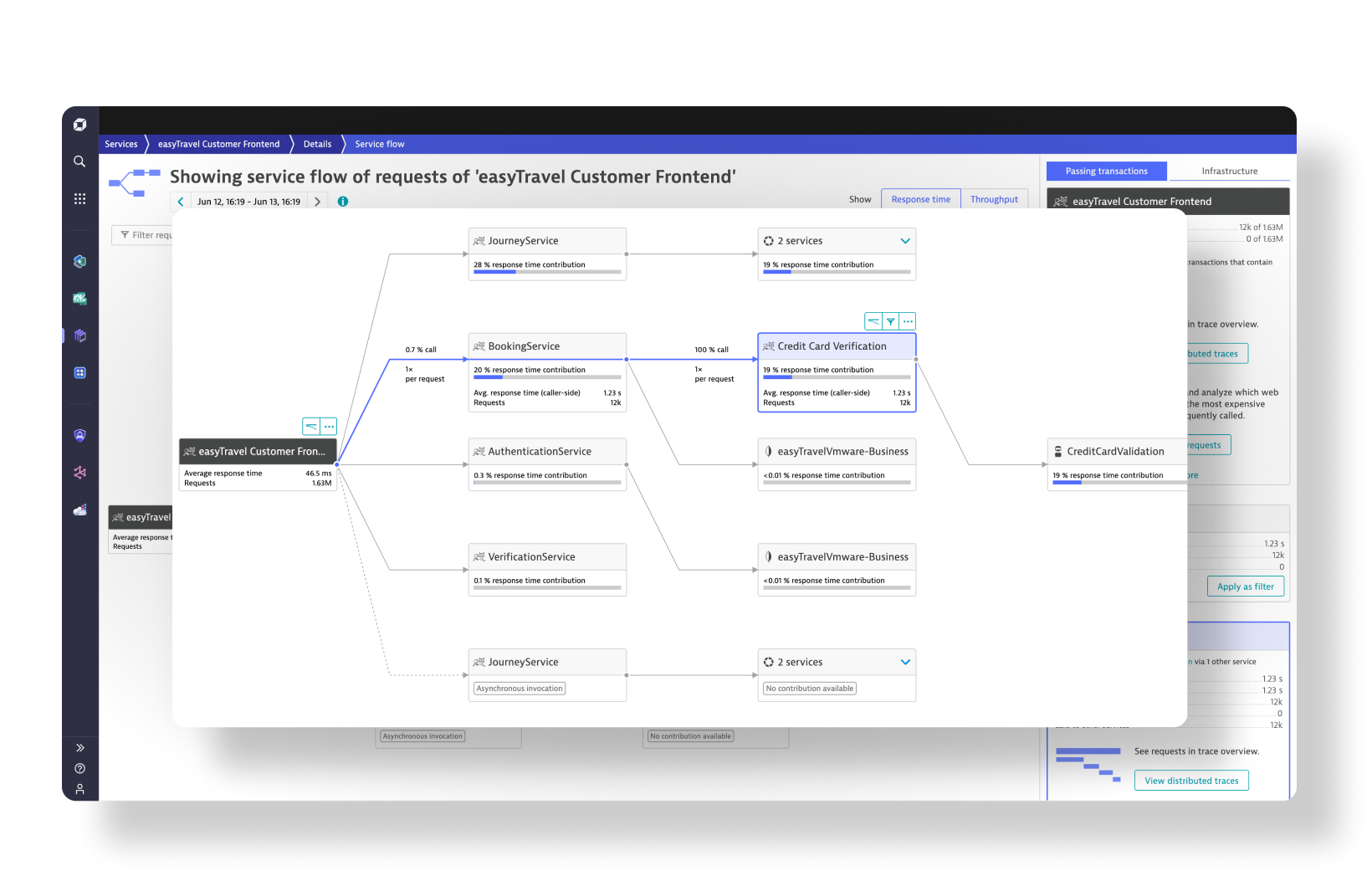
The combination of dynaTrace’s 24x7 production capability, coupled with our real transaction-by–transaction-level detail, allow us to provide architects, developers and performance specialists unprecedented visibility into the true behavior of their dynamic SOA applications – going far beyond what SOA runtime governance and traditional APM solutions provide. Armed with the PurePath details, dynaTrace can map service dependencies in detail at runtime providing the necessary insights to avoid side effects when changing Enterprise Service Bus (ESB) configurations to adapt service orchestrations. Moreover, PurePath lets you isolate and diagnose specific integration issues and can be used to capture true production behavior to better model mock-up services for test. And perhaps the most significant breakthrough unique to dynaTrace is the ability to display each transaction’s execution down to code-level in a UML flow diagram allowing development to see the true dynamic behavior of their application, end to end, often for the first time.

Here’s what some of our customers have to say about the value they’re getting from our unique ability to provide them unprecedented visibility into their most complex applications:

Johannes Mayr, Software Engineering, GRZ IT Centre Linz GmbH

In the area of SOA the complexity has now become so great that debugging is almost impossible without a tool such as dynaTrace...

Jim Nichols, Performance Engineer, EnerNOC (NASD: ENOC)

... we significantly expanded our production architecture, and made it more service-oriented. As we did that, it was really a no-brainer to expand the dynaTrace deployment to monitor all the new services we added in the production environment.

Marc Pinder, Senior System Designer, BUPA:

Another important feature of dynaTrace Diagnostics that we use a lot is its ability to drill down through related views of the method, web-service and database calls all of which can be output to an incredibly useful UML sequence diagram. We have now started to save these diagrams and use them as a quick way to document our application design.

So, if you’ve already embraced a service-based architecture or plan to integrate SOA elements into your applications, and you are looking to maintain order in the face of certain chaos, you might want to take dynaTrace for a test drive sooner rather than later. It just might be the ideal companion for your SOA efforts.

In the area of SOA the complexity has now become so great that debugging is almost impossible without a tool such as dynaTrace...

Johannes Mayr, Software Engineering, GRZ IT Centre Linz GmbH


Success Stories

Test Drive?

Contact