
What is business observability?
Businesses run on technology stacks that are more connected (and more complex) than ever. The challenge is maintaining reliability while still moving at the speed customers expect. Delivering seamless experiences and operational excellence requires more than uptime monitoring; it demands visibility into how systems and processes perform in real time.
How can organizations verify that critical systems are meeting expectations? How can they trace the impact of interconnected services on business performance, detect issues before they affect customers, and trigger automated remediation when necessary?
This is where business observability becomes essential. Business observability is the practice of gaining real-time, end-to-end visibility into the health, performance, and outcomes of business KPIs, processes, and underlying IT infrastructure, as well as gaining the ability to drive remediation steps on the customer and system levels.
Why is business observability important?
Modern businesses operate in highly dynamic and interconnected environments. From ecommerce to financial services, every industry relies on digital systems to deliver value to customers. However, these systems are often complex, involving multiple applications, microservices, and third-party integrations.
Without proper visibility, it becomes nearly impossible to:
- Make real-time data-driven decisions to drive growth and innovation.
- Track and optimize business processes.
- Understand the impact of technical issues on business outcomes.
- Optimize customer journeys and improve satisfaction.
- Reduce IT cost and accelerate sustainability efforts.
- Automate tasks and remediate issues
Business observability addresses these challenges by providing a holistic view of how digital systems impact business performance, combined with deep technical monitoring data that covers the needs of executives, application owners, engineers, site reliability engineers, IT operations, and more at once.
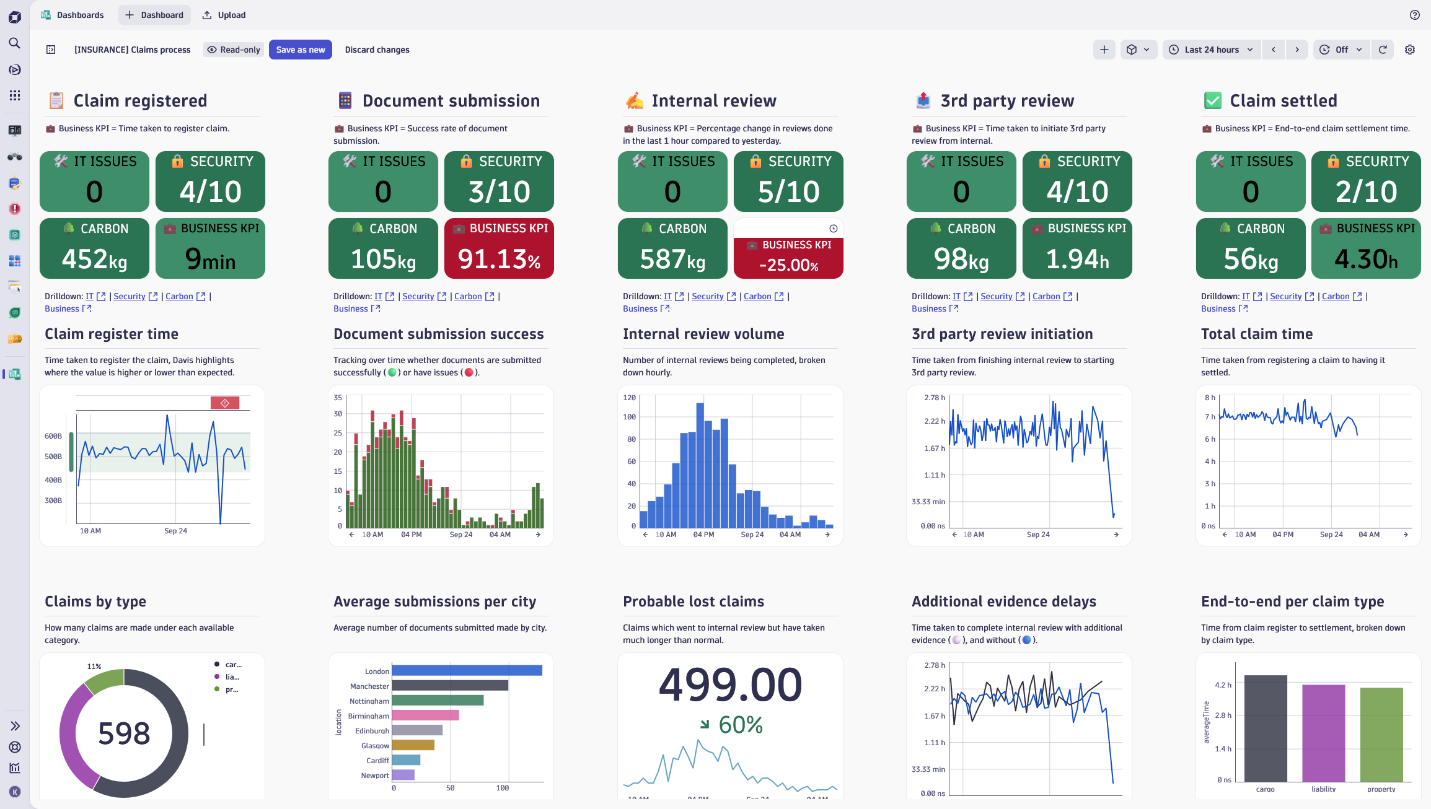
Key components of business observability
To achieve effective business observability, organizations need to focus on three key components:
- Data collection and integration
- Contextual insights
- Actionable intelligence
1. Data collection and integration
Business observability starts with collecting data from various sources, including application logs, metrics, traces, and business events. This data needs to be integrated into a unified platform to provide a comprehensive view of the system and the organization. Here are some key capabilities to keep in mind:
- Flexibility of ingest mechanisms: A strong platform should support both legacy log data and modern telemetry (i.e., OpenTelemetry spans). Look for REST endpoints, agent technology for convenience, and collectors or gateways that optimize data traffic while ensuring encrypted data transfer.
- Real-time data ingest: Delayed ingest undermines business observability. Traditional batch-based ingest (monthly, weekly, or even hourly) and slow ETL pipelines can’t deliver the real-time insights modern systems demand. Advanced observability solutions are designed to avoid these bottlenecks.
- Access to data and time to first insights: Historically, log-based data required engineers to add code and wait through release cycles before insights became available. Modern, agent-based solutions often reduce this to a simple configuration change, enabling first insights in minutes.
- Cleaning of data and permission handling: When executives and engineers share the same data environment, access control becomes critical. True business observability separates business data from technical data while keeping them connected. For example, in Dynatrace, business events are stored within the common Grail™ data lakehouse, ensuring separation of concerns without losing context.
2. Contextual insights
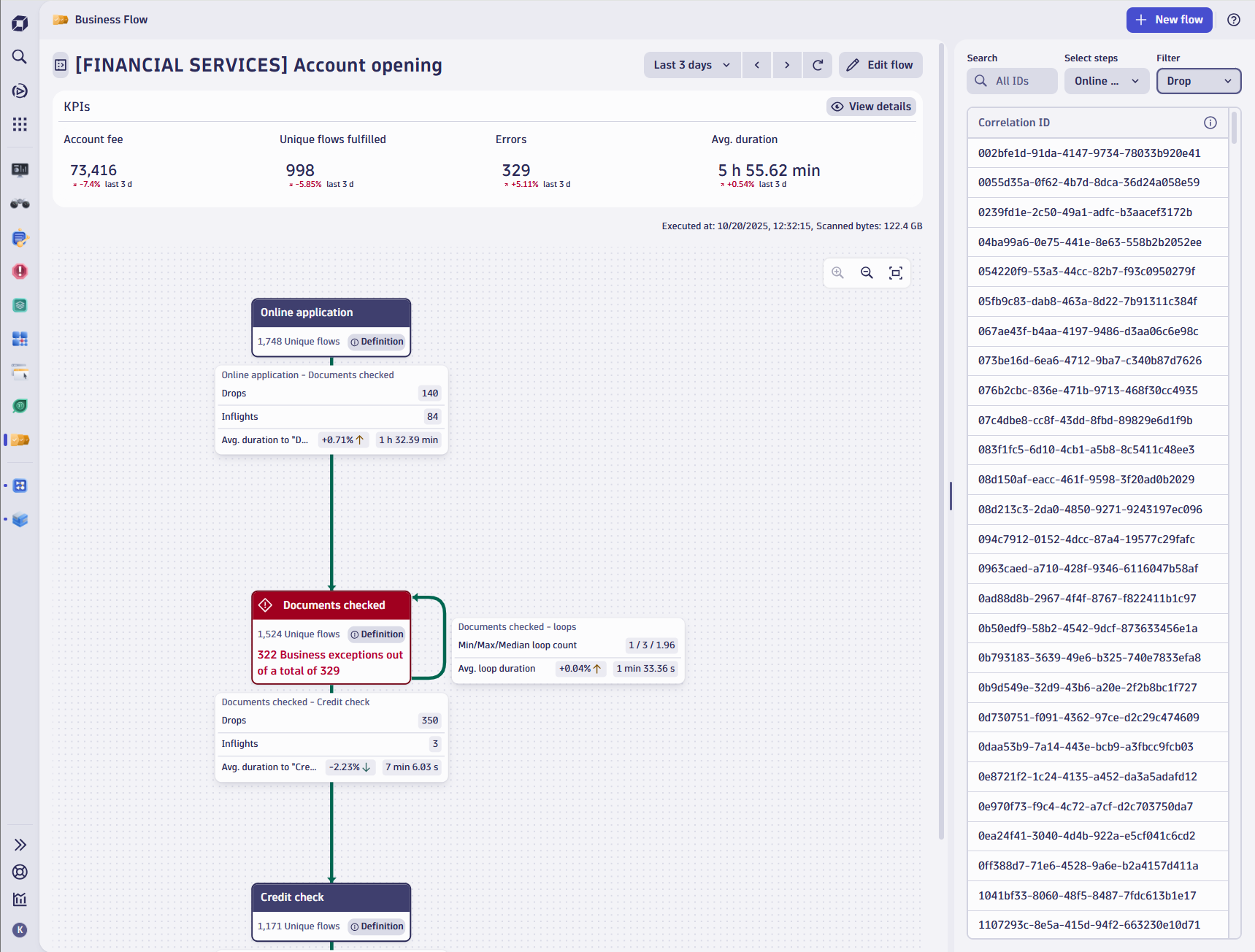
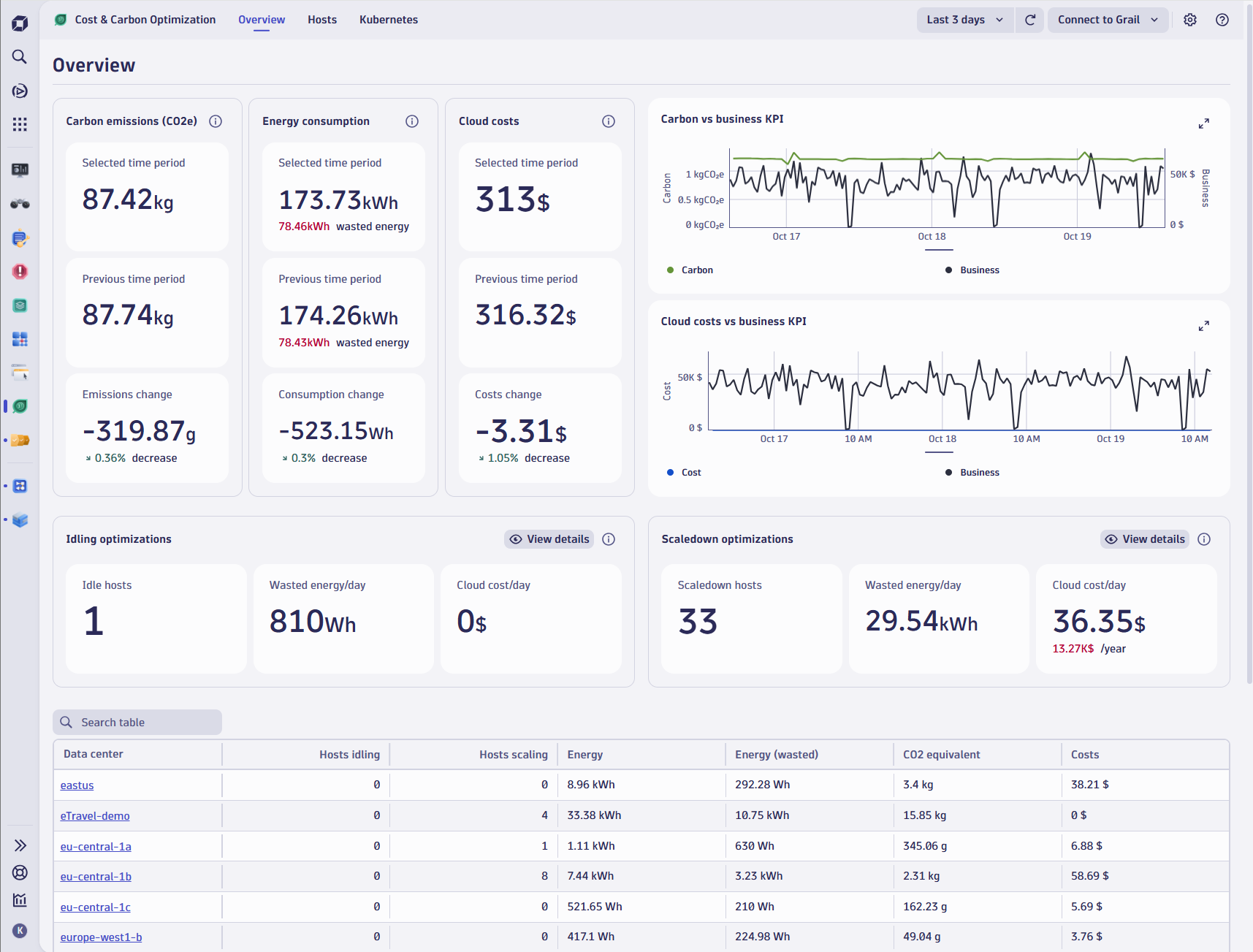
Raw data alone is not enough, as it lacks context on multiple levels. Business observability platforms build an automatically derived, real-time, continuously updated topological model that maps connections across business processes, business events, software services, hosts, routers, data centers, cloud regions, and other relevant entities. On top of this model, the solution applies advanced analytics and AI to deliver contextual insights. These include understanding how technical performance metrics (such as response times or error rates) correlate with business KPIs like revenue, conversion rates, or customer churn.
3. Actionable intelligence
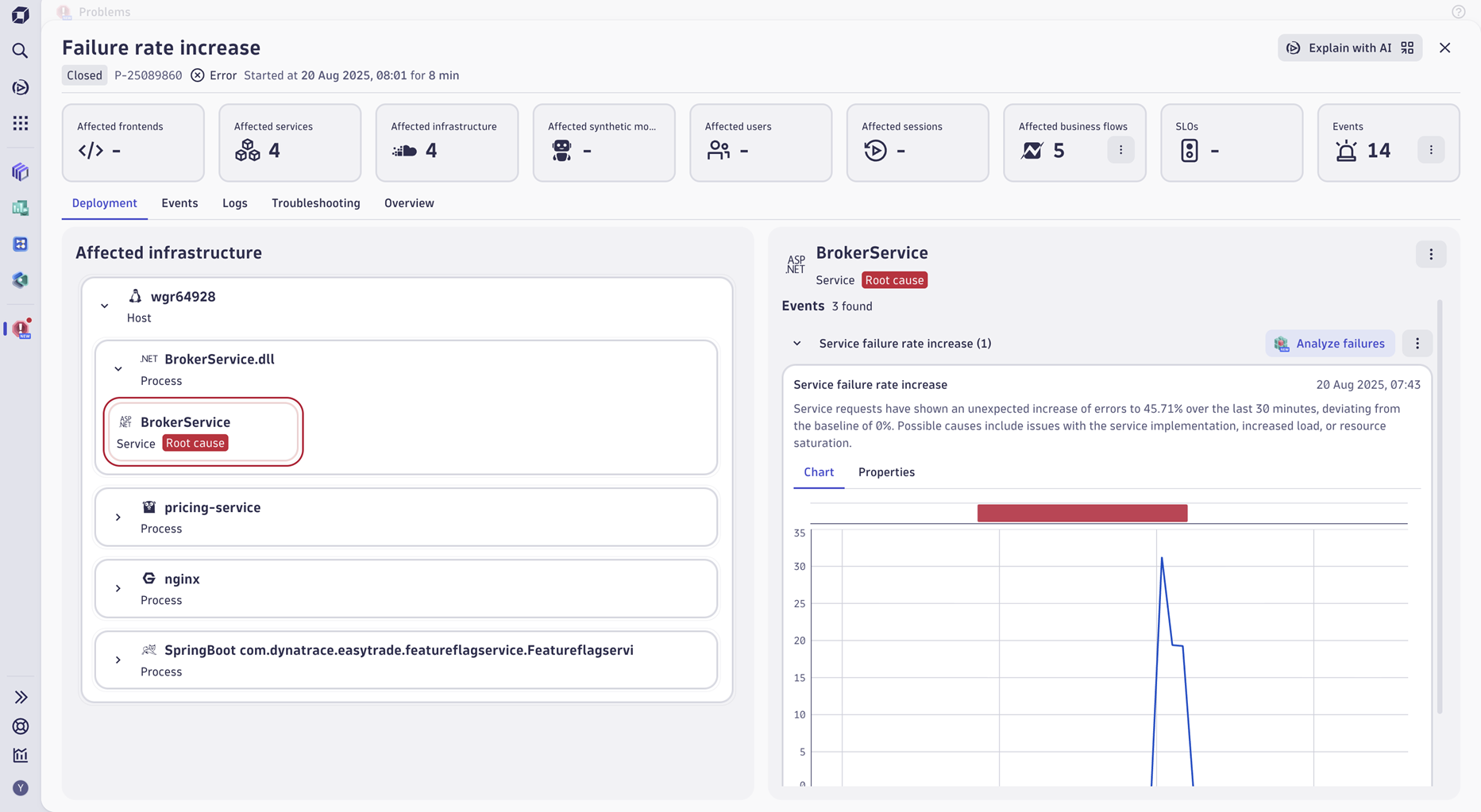
The ultimate goal of business observability is to enable actions that improve the customer experience and the organization's bottom line.
With business observability, organizations can gain actionable intelligence into a variety of processes. For instance, business observability can point out that a lunch delivery order has not gone through the systems as expected and trigger a customer service rep to reach out to the user before they feel the impact. It can trigger an automatic upscale of computing resources ahead of a marketing campaign that could hit your premises too hard and cause service disruptions. Or, business observability use cases can be as simple as alerting teams about potential issues, providing recommendations for optimization, or automating responses. Actionable intelligence is what turns observability into a business enabler.
How business observability differs from traditional monitoring or observability
While traditional monitoring focuses on the health and performance of IT systems, business observability takes a broader approach. It connects technical performance with business outcomes, enabling organizations to:
- Understand the "why" behind performance issues.
- Prioritize fixes based on business impact.
- Align IT and business teams around shared goals.
For example, a traditional monitoring tool might alert you to a spike in application response times. A business observability platform, on the other hand, would show you how that spike is affecting customer checkout rates and revenue, helping you prioritize and address the issue more effectively.
The role of AI in business observability
AI plays a crucial role in modern business observability platforms. By analyzing vast amounts of data in real-time, AI can:
- Detect anomalies early: Spot unusual patterns and predict potential issues before they affect customers.
- Accelerate root-cause analysis: Pinpoint the source of problems faster, reducing resolution times.
- Optimize business processes: Provide actionable recommendations to improve efficiency, performance, and outcomes.
AI-driven intelligence transforms observability from passive monitoring into proactive, business-impacting insight, helping organizations stay resilient and competitive in a digital-first world.
Business observability in action
Business observability comes alive when it drives change. With Dynatrace, organizations across industries are putting business observability into action to understand what truly impacts the business and to act decisively to improve performance and results.
- Coca-Cola Hellenic Beverage Company (CCHBC): Leveraged Dynatrace to gain real-time visibility into IT and business processes, enabling proactive prevention of issues like delivery delays and stock inaccuracies. This optimization improved operational efficiency and enhanced customer satisfaction. Learn more.
- FreedomPay: Used Dynatrace to connect IT performance with business metrics, reducing payment transaction times by 50%. Real-time dashboards also provided customers with self-service insights. Learn more.
- Zurich North America: Optimized IT carbon emissions using Dynatrace's Cost and Carbon Optimization app, achieving a 30% reduction in observability costs while advancing sustainability goals. Learn more.
- Car rental aggregator: A large car rental company used Dynatrace to monitor aggregator KPIs in real time, including quotes sent, bookings, and revenue. By segmenting data by aggregator, product, and geography, they identified high-value partners and regions, improving their operational efficiency and revenue streams. IT metrics such as API response times and errors were monitored alongside business KPIs to ensure service quality.
- Restaurant chain: A multi-brand restaurant chain leveraged Dynatrace to automatically recover abandoned reservations by combining data and automation. Using real user monitoring (RUM), they identified where users abandoned their reservation journey and automated personalized outreach to recover lost bookings. This proactive approach increased customer satisfaction and revenue.
- International airline: Leveraged Dynatrace to create a real-time, end-to-end view of the passenger journey, from ticket purchase to boarding. Teams used business events to track metrics like outstanding balances, baggage issues, and missed flights in real time, enabling them to take immediate action and improve the overall travel experience.
Why Dynatrace for business observability?
Connecting IT performance with business outcomes requires more than traditional monitoring. Dynatrace Business Observability reimagines this approach, using AI-driven monitoring and real-time analytics to provide:
- Unified visibility across applications, infrastructure, and business processes.
- Business and IT data automatically connected end-to-end with Smartscape topology.
- AI-powered insights to detect and resolve issues faster.
- Business context to help you prioritize what matters most.
- An easy way of gathering data.
By leveraging Dynatrace for business observability, organizations can not only ensure the health of their digital systems but also drive better business outcomes.
Turning insight into impact
Today, business observability has evolved from a luxury to a necessity. It empowers organizations to move beyond traditional monitoring and gain real-time, actionable insights that connect technical performance with business outcomes. By integrating data across systems, applying contextual intelligence, and leveraging AI for proactive decision-making, business observability transforms how companies operate, innovate, and serve their customers.
Business observability isn’t just about seeing more: it’s about understanding more, acting faster, and delivering better outcomes.
Keep reading
 Observability ClinicDynatrace Business Events: Expanding Observability into your Business Domain
 BLOGPractical business process monitoring for real-time business observability
Learn how organizations are using the Business Flow app to drive better business outcomes. BlogWhat is Business Analytics? How connecting IT to business improves business outcomes


